The best-supported magnesium benefit is a small drop in blood pressure, about 2 mmHg systolic across 34 trials at around 300 to 370 mg a day. Sleep and anxiety results are positive but come from small, low-quality studies, and cramps in older adults barely change. Citrate and glycinate absorb better than oxide. Keep supplements at or under 350 mg a day.
On this page
- What magnesium benefits does the research support?
- What are the magnesium benefits for sleep?
- Does magnesium help with anxiety?
- Which magnesium benefits the heart?
- What are the magnesium benefits for muscles?
- What are the magnesium benefits for women over 50 and for men?
- Which magnesium form is best: glycinate, citrate, oxide or threonate?
- What are magnesium side effects, and who should avoid it?
- Bottom line
- FAQ
Magnesium benefits are real, though smaller and narrower than most bottle labels suggest. We read the NIH Office of Dietary Supplements fact sheets, a Cochrane review of cramps, meta-analyses on blood pressure and sleep, and the main trials on the four forms people ask about, then set each claim beside the dose that was tested. Our review method explains how we grade evidence.
The short answer: the best-supported benefit is a small drop in blood pressure, about 2 points systolic across 34 trials[4], while results for sleep and anxiety point the right way but come from small, low-quality studies[5][7].
| What it is | A mineral the body stores mostly in bone. An adult carries about 25 g, with 50% to 60% of it in the skeleton[1]. |
|---|---|
| Daily need (RDA) | 400 to 420 mg for men and 310 to 320 mg for women, from food and supplements combined[1]. |
| Upper limit from supplements | 350 mg a day for anyone 9 or older. Food magnesium does not count toward it[1]. |
| Best evidence | A small fall in blood pressure: 2.00 mmHg systolic and 1.78 mmHg diastolic in a pooled analysis[4]. |
| Mixed or weak evidence | Sleep, anxiety and muscle cramps[5][7][8]. |
| Main side effect | Diarrhea, most often with oxide, carbonate, chloride and gluconate forms[1]. |
| Ask a doctor first | Kidney disease, or if you take bisphosphonates, some antibiotics, diuretics or long-term acid reducers[1][3]. |
What magnesium benefits does the research support?
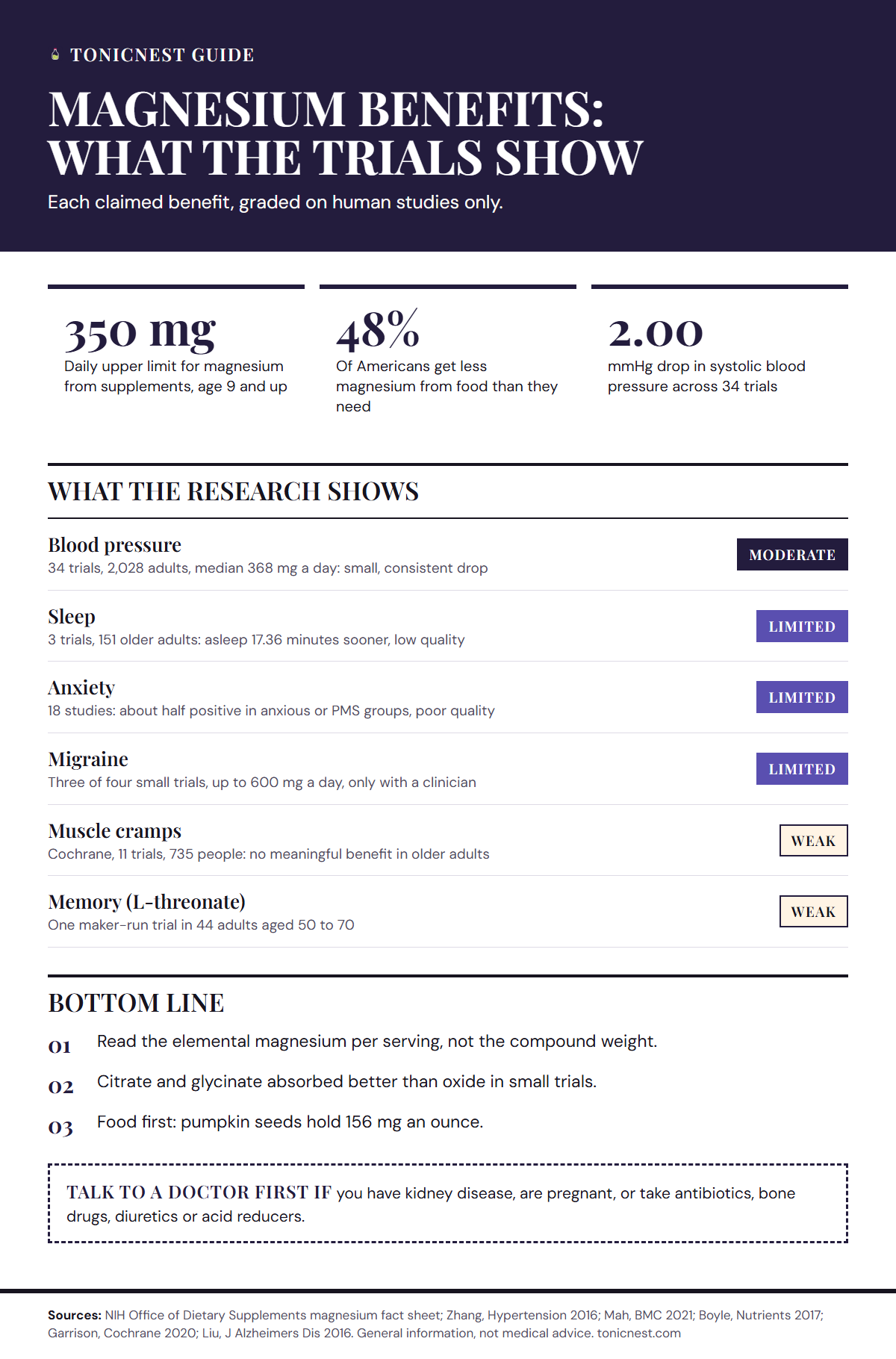
The magnesium benefits with the firmest human data are a modest drop in blood pressure and, for people who eat too little of it, a better chance of meeting daily needs. Most other claims, from sleep to anxiety to cramps, rest on small trials with mixed or weak results. That gap matters, because 48% of Americans get less magnesium from food than they should[1].
We grade each benefit on the human evidence only:
- Moderate: several pooled trials showing a small, consistent effect.
- Limited: some trials, but small, short or low in quality.
- Weak: pilot studies only, or reviews that found no useful benefit.
| Benefit | Best human evidence | Dose studied | Grade |
|---|---|---|---|
| Blood pressure | 34 trials, 2,028 adults: systolic down 2.00 mmHg, diastolic down 1.78 mmHg[4] | Median 368 mg a day for 3 months | Moderate |
| Sleep | 3 trials, 151 older adults: fell asleep 17.36 minutes sooner; evidence low to very low quality[5] | Varied by trial | Limited |
| Anxiety | 18 studies; about half in anxious or PMS groups found a benefit; quality poor[7] | Varied by study | Limited |
| Migraine | Three of four small trials found modest drops in attack frequency[1] | Up to 600 mg a day, above the upper limit | Limited |
| Muscle cramps | Cochrane, 11 trials, 735 people: no meaningful benefit in older adults[8] | Varied by trial | Weak |
| Memory (threonate) | One 12-week trial in 44 adults, run by the maker[11] | 1.5 to 2 g of compound a day | Weak |
Blood sugar and bone health sit between Limited and Weak. Large cohort studies link higher intake with lower diabetes risk, but the supplement trials conflict, and only one small bone study exists[1].
What are the magnesium benefits for sleep?
Magnesium may help some people fall asleep a little faster, but the effect is small and the studies are weak. A 2021 meta-analysis found older adults fell asleep 17.36 minutes sooner on magnesium than on placebo, with total sleep time not clearly changed. The authors rated the evidence low to very low quality[5].
That review pooled just three trials and 151 people[5]. The newer and larger trial is a 2025 German study of 155 adults aged 18 to 65 who reported poor sleep. They took 250 mg of magnesium a day as bisglycinate, or a placebo, for several weeks[6].
At week 4, insomnia scores fell 3.9 points on magnesium and 2.3 points on placebo. The authors called the effect small. People who ate little magnesium at the start seemed to gain the most, though that was an exploratory finding, and one author runs a research firm funded by supplement makers[6].
Read together, the trials suggest a modest effect, most likely in people whose diet runs low. If sleep is your main concern, our mind and sleep guides cover the habits with stronger evidence.
Does magnesium help with anxiety?
Possibly, in people already prone to anxiety, but the research is thin. A 2017 systematic review of 18 studies called the evidence for magnesium and anxiety suggestive but poor in quality. No study in it used a validated stress measure, so claims that magnesium lowers stress go beyond the data[7].
The details are mixed. Four of eight studies in mildly anxious people and four of seven in women with premenstrual syndrome reported less anxiety. Magnesium had no effect on anxiety after childbirth[7]. The review also let in products that paired magnesium with up to five other ingredients, which makes it hard to credit magnesium alone.
The 2025 sleep trial also measured mood and other psychological scores and found no difference from placebo[6]. Keep that in mind when a product sells magnesium as a calming formula.
If anxiety is the main reason you are shopping, compare the trial data in our guide to ashwagandha benefits and side effects, and talk to a doctor if worry affects work, sleep or relationships.
Which magnesium benefits the heart?
No single form has been shown to help the heart more than another. Across forms, the clearest heart-related effect is a small drop in blood pressure: 2.00 mmHg systolic and 1.78 mmHg diastolic in a 2016 meta-analysis of 34 placebo-controlled trials. The median dose was 368 mg a day for about 3 months[4].
The authors found that 300 mg a day, or one month of use, was enough to raise blood magnesium and lower pressure[4]. An older Cochrane review of 12 trials in 545 people with high blood pressure found a smaller drop of 2.2 mmHg in diastolic pressure only[1].
In 2022 the FDA allowed a qualified health claim that adequate magnesium may reduce the risk of high blood pressure, while stating that the evidence is “inconsistent and inconclusive.” Supplements that carry the claim must hold no more than 350 mg per serving[1].
Population studies point the same way, though they cannot prove cause. In one cohort of 88,375 nurses, women with the highest magnesium intake had a 37% lower risk of sudden cardiac death. In seven pooled studies, each extra 100 mg a day was linked to an 8% lower stroke risk[1]. Other parts of a healthy diet could explain those links.
What are the magnesium benefits for muscles?
Magnesium is needed for normal muscle and nerve function, and a real deficiency can cause cramps. For ordinary night cramps in older adults, though, a 2020 Cochrane review found magnesium is unlikely to give a meaningful benefit. The average change was 0.18 fewer cramps a week[8].
That review covered 11 trials with 735 people. Side effects such as diarrhea showed up in 11% to 37% of people taking magnesium, against 10% to 14% on the comparison treatment[8].
A true shortfall does cause symptoms. Early signs include loss of appetite, nausea, fatigue and weakness. Later signs include numbness, tingling, cramps and abnormal heart rhythms[1]. A blood test can miss low stores, because the body pulls magnesium from bone to keep blood levels normal[3].
If tiredness is part of the picture, our guide on why you might be so tired lists the tests worth asking for. Cramps that come with weakness, tingling or a racing heart need a doctor’s visit before any supplement.
What are the magnesium benefits for women over 50 and for men?
Magnesium does the same jobs in everyone, but needs and risks shift with age and sex. Women 31 and older need 320 mg a day and men 31 and older need 420 mg, while absorption from the gut falls and kidney losses rise with age. Men over 70 and teenagers are the most likely to fall short[1][2].
Women over 50
Bone is the main question after menopause. Higher intakes are linked with higher bone density, and women with osteoporosis tend to have lower blood magnesium. In one small study, 20 postmenopausal women with osteoporosis took 290 mg a day as citrate for 30 days, and markers of bone breakdown fell compared with placebo[1]. NIH says more research is needed before magnesium can be used to prevent or manage osteoporosis[1].
Migraine is the other common reason. The American Academy of Neurology and the American Headache Society rate magnesium as probably effective for preventing migraine, but trial doses reached 600 mg a day, above the 350 mg limit, so use it only under a clinician’s supervision[1].
Men
For men, the most studied link is blood sugar. In pooled cohort studies, each extra 100 mg a day of magnesium was tied to a 15% lower risk of type 2 diabetes. Trials of supplements in people who already have diabetes conflict, and the American Diabetes Association says the evidence is not enough to use magnesium for glucose control[1]. Our page on normal blood sugar levels explains what to track instead.
Which magnesium form is best: glycinate, citrate, oxide or threonate?
The best form is the one you absorb and tolerate at a dose under the limit. Forms that dissolve well, such as citrate, are absorbed more completely than oxide, according to NIH, though the studies behind that are small. Glycinate and threonate are popular, but their advantages rest on very few human trials[1][2].
The number that matters on a label is elemental magnesium, the amount of the mineral itself, not the weight of the whole compound[1]. Each form carries a different share of magnesium by weight, so the same 200 mg dose needs very different amounts of powder. The shares below are our arithmetic from the chemical formulas; powders that hold water run a little lower.
| Form | Magnesium by weight (approx.) | Compound needed for 200 mg magnesium | What human studies show |
|---|---|---|---|
| Oxide | About 60% | About 330 mg | Most magnesium per pill, but in a 46-person, 60-day trial it did no better than placebo on absorption markers[9] |
| Citrate | About 16% | About 1,250 mg | Absorbed better than oxide in the same trial at 300 mg a day[9]; can loosen stools |
| Glycinate (bisglycinate) | About 14% | About 1,430 mg | Absorbed like oxide overall in 12 patients, better in the 4 poorest absorbers, and better tolerated[10]; used in the 2025 sleep trial[6] |
| L-threonate | About 8% | About 2,500 mg | One maker-run trial of 1.5 to 2 g a day in 44 adults aged 50 to 70; memory scores improved, sleep effects could not be judged[11] |
The arithmetic shows why threonate capsules list large compound weights. The 2 g daily dose in the threonate trial supplies roughly 160 mg of magnesium, less than half the daily need[11].
Cost varies by form and brand, so compare the price per 100 mg of elemental magnesium on the Supplement Facts panel, not the price per capsule. More forms are covered in our ingredient guides.
Label checklist before you buy
- Find the elemental magnesium per serving on the Supplement Facts panel, not the compound weight[1].
- Add up every product you take. Supplements and magnesium antacids together should stay at or under 350 mg a day unless a clinician says otherwise[1].
- Check the serving size. A dose split across 2 to 4 capsules changes the real cost per day.
- For a “complex” or blend, look for a total magnesium figure, since the label may not split it by form.
- Skip any label that promises to fix insomnia, anxiety or high blood pressure. FDA has only allowed a qualified blood pressure claim[1].
- If you take antibiotics or bone medicine, plan the timing with your pharmacist first[1].
What are magnesium side effects, and who should avoid it?
For most healthy adults, magnesium supplements are safe at or below 350 mg a day. The usual side effects are diarrhea, nausea and stomach cramps, and the real danger is kidney disease, because weak kidneys cannot clear the extra. Most cases of high blood magnesium happen in people with kidney failure[1][3].
Very high doses, often more than 5,000 mg a day from laxatives or antacids, can cause magnesium toxicity, with low blood pressure, vomiting, trouble breathing and an irregular heartbeat[1]. One tablespoon of Milk of Magnesia holds about 500 mg of magnesium[1].
Medicines matter too:
- Bisphosphonates for bone: take them at least 2 hours apart from magnesium[1].
- Tetracycline and quinolone antibiotics: take the antibiotic 2 hours before or 4 to 6 hours after magnesium[1].
- Loop and thiazide diuretics can raise magnesium losses, while potassium-sparing diuretics reduce them[1].
- Acid-reducing proton pump inhibitors taken for more than a year can lower magnesium levels[1].
Pregnancy raises the daily need to 350 to 360 mg for adults, but the 350 mg supplement limit still applies[1]. See a doctor right away if you have a slow or irregular heartbeat, severe weakness, confusion, or trouble breathing after taking magnesium.
What doctors use first
Doctors start with food and with treating the cause. NIH advises getting most nutrients from food[2]. A 1-ounce serving of pumpkin seeds holds 156 mg, almonds 80 mg and half a cup of boiled spinach 78 mg[1]. For high blood pressure, the DASH eating plan lowered pressure by 5.5 and 3.0 mmHg in its trial, a bigger drop than the magnesium pill trials found[1]. Suspected deficiency calls for a blood test, especially with kidney disease, diabetes or long-term diarrhea[3].
Bottom line
Magnesium is a cheap, mostly safe mineral that many people under-eat, and the best-tested benefit is a small fall in blood pressure. Sleep, anxiety and migraine results lean positive but come from small or low-quality trials, and cramps in older adults do not improve in a meaningful way.
For most people, the better first step is to close the food gap with seeds, nuts, beans and greens, then add a citrate or glycinate supplement of 100 to 300 mg only if your diet falls short and your kidneys are healthy. That plan stays under the 350 mg limit and puts the money where the evidence is strongest.
Frequently asked questions
How long does it take to see magnesium benefits?
It depends on the goal. In a pooled analysis, one month at 300 mg a day was enough to raise blood magnesium and lower blood pressure slightly. In a 2025 sleep trial, insomnia scores had improved modestly by week 4.
How much magnesium is needed per day?
Adult men need 400 to 420 mg a day and adult women 310 to 320 mg, from food and supplements combined. Supplements and medicines should stay at or under 350 mg a day unless a clinician advises more.
Is magnesium safe for kids?
Children need magnesium, mostly from food: 80 mg a day at ages 1 to 3 and 130 mg at 4 to 8. Supplement limits are low, 65 mg and 110 mg for those ages, so check with a pediatrician before giving any.
What are the magnesium benefits in pregnancy?
Pregnant adults need 350 to 360 mg a day to cover their own and the baby's needs. The 350 mg limit for supplements still applies, so most of it should come from food. Ask your prenatal provider before adding a separate pill.
What are the benefits of a magnesium complex?
A complex mixes several forms in one capsule. No trials we read tested blends against single forms. Judge one by its total elemental magnesium per serving and keep that, plus any other supplements, at or under 350 mg a day.
Sources
- Magnesium: Fact Sheet for Health Professionals. NIH Office of Dietary Supplements, 2026
- Magnesium: Fact Sheet for Consumers. NIH Office of Dietary Supplements, 2026
- Magnesium Blood Test. MedlinePlus, National Library of Medicine
- Effects of Magnesium Supplementation on Blood Pressure: A Meta-Analysis of Randomized Double-Blind Placebo-Controlled Trials. Zhang X et al., Hypertension, 2016
- Oral magnesium supplementation for insomnia in older adults: a Systematic Review and Meta-Analysis. Mah J, Pitre T, BMC Complementary Medicine and Therapies, 2021
- Magnesium Bisglycinate Supplementation in Healthy Adults Reporting Poor Sleep: A Randomized, Placebo-Controlled Trial. Schuster J et al., Nature and Science of Sleep, 2025
- The Effects of Magnesium Supplementation on Subjective Anxiety and Stress: A Systematic Review. Boyle NB et al., Nutrients, 2017
- Magnesium for skeletal muscle cramps. Garrison SR et al., Cochrane Database of Systematic Reviews, 2020
- Mg citrate found more bioavailable than other Mg preparations in a randomised, double-blind study. Walker AF et al., Magnesium Research, 2003
- Bioavailability of magnesium diglycinate vs magnesium oxide in patients with ileal resection. Schuette SA et al., JPEN, 1994
- Efficacy and Safety of MMFS-01, a Synapse Density Enhancer, for Treating Cognitive Impairment in Older Adults. Liu G et al., Journal of Alzheimer's Disease, 2016 (industry funded)
This article is general information, not medical advice. Dietary supplements are not reviewed by the FDA for safety or effectiveness before they are sold. Talk to your doctor before you start any supplement, especially if you are pregnant, nursing, take medication or have a health condition.