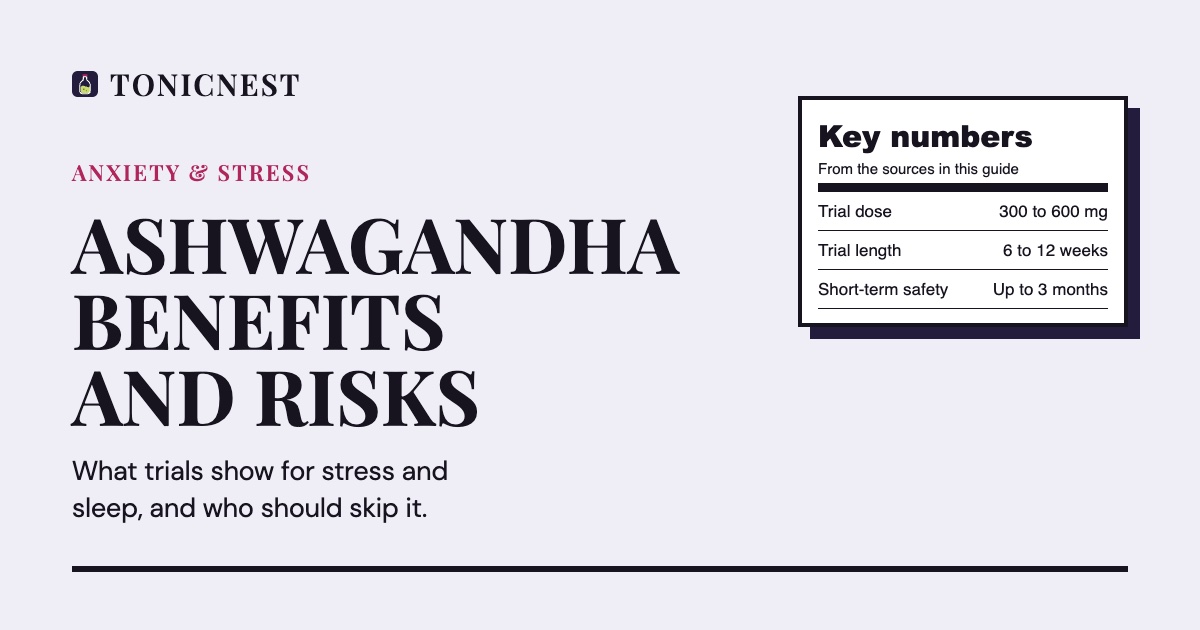
Ashwagandha may ease stress and improve sleep a little. In 12 trials with 1,002 adults, ashwagandha extracts lowered stress and anxiety scores more than placebo, mostly at 300 to 600 mg a day, but the evidence is low in certainty. Side effects are usually mild, though rare cases of liver injury have been reported. Avoid it if pregnant or if you have thyroid disease.
On this page
- What is ashwagandha?
- Ashwagandha benefits and side effects: what is it good for?
- Does ashwagandha lower cortisol?
- What are the ashwagandha benefits for women?
- What are the ashwagandha benefits for men?
- What are the side effects of ashwagandha?
- Is ashwagandha safe for everyone?
- Is a premium ashwagandha supplement worth the price?
- What do doctors try first for stress, anxiety and sleep?
- Bottom line
- FAQ
This guide covers ashwagandha benefits and side effects in plain terms. We read the NCCIH ashwagandha page, the NIH Office of Dietary Supplements fact sheet for health professionals, two meta-analyses, five clinical trials and two liver injury case series. You can see how we grade sources on our how we review supplements page.
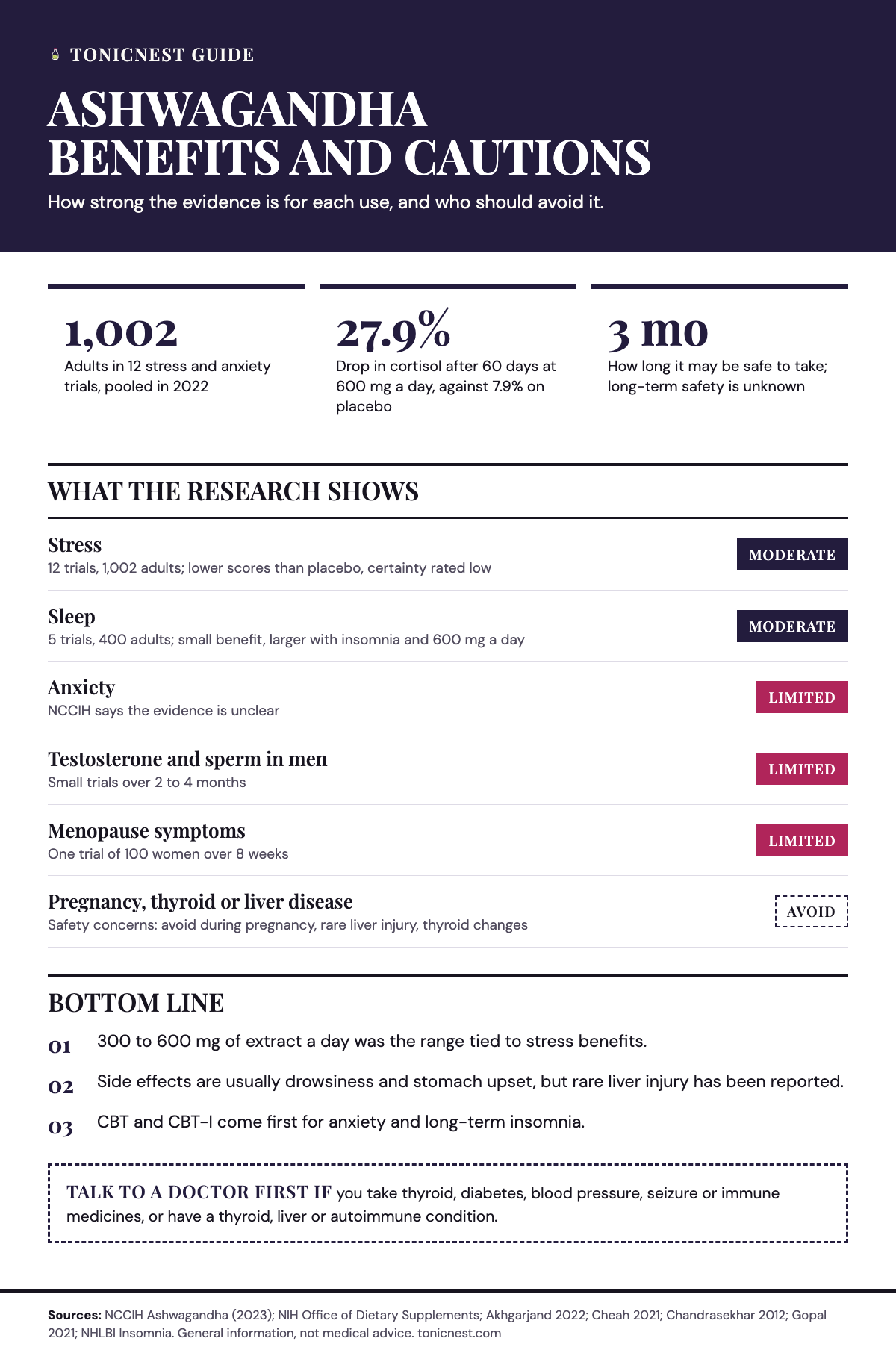
In short, across 12 trials with 1,002 adults, ashwagandha lowered stress and anxiety scores more than placebo, but the certainty of that evidence was rated low.[5] It looks safe for most adults for up to 3 months, and rare cases of liver injury have been reported.[1]
| What it is | An evergreen shrub, Withania somnifera, used in Ayurvedic medicine. Supplements use root, leaf or root and leaf extracts.[1] |
|---|---|
| Studied for | Stress, sleep, anxiety, testosterone and sperm quality, and athletic performance.[1] |
| Amounts in trials | 240 to 1,250 mg of extract a day in the stress trials. Results looked better at 500 to 600 mg a day.[2] |
| Best evidence | Stress and sleep, in small trials of 6 to 12 weeks, mostly run in India.[2][4] |
| Common side effects | Drowsiness, stomach upset, diarrhea and vomiting.[1] |
| Rare but serious | Liver injury and thyroid changes.[2] |
| Who should avoid it | People who are pregnant or breastfeeding, people with thyroid or autoimmune disorders, and people with hormone-sensitive prostate cancer.[1] |
What is ashwagandha?
Ashwagandha is an evergreen shrub whose root has been used in Indian medicine for thousands of years, and it is now sold as a dietary supplement. It grows in India, Africa and the Middle East. It is also called Indian ginseng, though it is not related to ginseng.[1][2]
The plant contains compounds called withanolides. Researchers think they drive many of its effects, but lab work suggests other compounds play a part too.[2]
The name comes from Sanskrit for the smell of a horse, after the smell of the root. Most products sold in the US use root extract. Some use a mix of root and leaf, and the two parts have a different chemical makeup.[2]
Ashwagandha is often called an adaptogen. That is a loosely defined term for something said to help the body resist or adapt to stress.[2]
Ashwagandha benefits and side effects: what is it good for?
The best evidence says some ashwagandha extracts may ease stress and improve sleep, while the data on anxiety is less clear. NCCIH says there is not enough evidence to judge it for asthma, athletic performance, memory and thinking, diabetes, menopause or female infertility.[1]
Here is how the main studies line up.
| Study | Who and how long | Dose | Result |
|---|---|---|---|
| Stress and anxiety meta-analysis, 2022 | 12 trials, 1,002 adults | Varied; stress benefit at 300 to 600 mg a day | Lower stress and anxiety than placebo; certainty rated low[5] |
| Sleep meta-analysis, 2021 | 5 trials, 400 adults | Varied | Small sleep benefit, larger with insomnia, 600 mg a day or more, and 8 weeks or longer[4] |
| Root extract stress trial, 2012 | 64 stressed adults, 60 days | 300 mg twice a day | Cortisol fell 27.9%, against 7.9% on placebo[6] |
| Root and leaf sleep trial | 150 adults, 6 weeks | Two 60 mg capsules a day | Sleep quality improved in 72%, against 29% on placebo[2] |
| Root extract fatigue trial | 120 adults, 12 weeks | Twice a day | No drop in stress, but less fatigue[2] |
Across these studies the benefits were modest and the trials were small and short. A 2021 review of seven stress trials found that all 491 people studied lived in India.[2] That limits how well the results apply elsewhere.
Not every trial was positive. In the 120-person trial above, the extract eased fatigue but did not lower stress.[2]
In 2022 an international psychiatry taskforce gave a provisional nod to 300 to 600 mg a day of root extract with 5% withanolides for generalized anxiety disorder. The group said it needs more data before it can make a stronger call.[2]
Does ashwagandha lower cortisol?
Several small trials found lower cortisol, the main stress hormone, after 6 to 8 weeks of ashwagandha extract. The ODS review of seven trials reported lower blood cortisol levels compared with placebo.[2]
The best-known trial gave 64 adults with chronic stress 300 mg of root extract twice a day for 60 days. Blood cortisol fell 27.9% in the ashwagandha group and 7.9% in the placebo group.[6] The extract used was KSM-66, supplied by the company that makes it.[6]
Lower cortisol on a blood test is a lab marker, so the trials also asked people to rate their stress. If you try it, judge it by how you feel and sleep after several weeks.
What are the ashwagandha benefits for women?
For women, the evidence is limited to small trials on stress, sleep and menopause symptoms, and NCCIH says there is not enough evidence for menopause or female infertility.[1] The stress and sleep trials above included women as well as men.[2]
One 2021 trial gave 100 women in perimenopause 300 mg of root extract twice a day for 8 weeks. Of the 91 who finished, the ashwagandha group had lower menopause symptom scores than the placebo group. Estradiol went up and FSH and LH went down.[9]
That was one small trial, and hormone shifts like these call for caution. ODS notes that ashwagandha may affect thyroid and sex hormones, and that French regulators advised people with hormone disorders not to use it.[2]
Women who are pregnant, trying to conceive or breastfeeding should skip it. That is covered in the safety section below.
What are the ashwagandha benefits for men?
For men, ashwagandha was studied for testosterone, sperm quality and strength training, with small positive results. NCCIH calls the evidence for testosterone and sperm quality limited, after 2 to 4 months of use.[1]
In one crossover trial, overweight men aged 40 to 70 with mild fatigue took a root and leaf extract for 8 weeks. Testosterone rose 14.7% more than on placebo. Only 43 of the 57 men finished, and there was no difference in fatigue, vigor or sexual well-being.[7]
A 2015 trial of 57 young men on a weight program gave 300 mg of root extract twice a day for 8 weeks. Bench press strength rose 46.0 kg with ashwagandha and 26.4 kg with placebo. Testosterone rose 96.2 ng/dL, against 18.0 ng/dL on placebo.[8]
Because it may raise testosterone, men with hormone-sensitive prostate cancer should not use it.[1]
What are the side effects of ashwagandha?
The usual side effects are mild: drowsiness, stomach upset, loose stools, nausea, diarrhea and vomiting.[1][2] In most trials of up to about 3 months, people tolerated it well.[2]
The rare but serious one is liver injury. A 2020 case series described five people, aged 21 to 62, who developed jaundice, nausea and itching 2 to 12 weeks after starting ashwagandha products. None had liver failure, and liver tests returned to normal within 1 to 5 months in four of them.[10]
ODS lists cases where people took 450 to 1,350 mg a day for 1 week to 4 months. Most got better after they stopped, though some products also contained other ingredients.[2]
A 2023 series from India had worse outcomes. Doctors found 23 patients with ashwagandha liver injury and reported on 8 who took single-ingredient products. Five had existing chronic liver disease. Three of them developed acute-on-chronic liver failure and all three died.[11] Lab testing found no contamination in the products, so a clean label does not remove this risk.[11]
See a doctor right away if you notice yellow skin or eyes, dark urine, strong itching or pain in the upper right belly while taking it.
Is ashwagandha safe for everyone?
Ashwagandha may be safe for most adults for up to 3 months, but its long-term safety is unknown and several groups should avoid it.[1]
- Pregnancy and breastfeeding: NCCIH says to avoid it during pregnancy and not to use it while breastfeeding.[1] Some reports raised a risk of miscarriage, and Denmark banned ashwagandha in 2023. The American Herbal Pharmacopoeia says its own report was misread on this point.[2]
- Thyroid problems: in a trial of 50 people with mild underactive thyroid, 300 mg twice a day for 8 weeks lowered TSH and raised T3 and T4. Three women developed an overactive thyroid while taking it, one at 1,950 mg a day.[2]
- Medicines: it may interact with drugs for diabetes, blood pressure, seizures and thyroid disease, plus sedatives and drugs that weaken the immune system.[1]
- Other groups: people with autoimmune disease, people having surgery soon and men with hormone-sensitive prostate cancer.[1]
- Liver disease: the worst outcomes in the Indian case series were in people who already had chronic liver disease.[11]
Ashwagandha is a dietary supplement, so the FDA does not approve it for safety or effectiveness before it is sold.[1]
Is a premium ashwagandha supplement worth the price?
A higher price is only worth it if it buys a named, standardized extract at a dose used in trials, plus an independent quality seal. No study we found compared one branded extract with another, and ODS says it is hard to name a best extract or amount because trials used so many forms.[2]
The trials used branded extracts such as KSM-66 (root only), and Sensoril or Shoden (root and leaf).[2] Those names tell you which extract was tested, though no trial has shown that one beats another.
A quality seal from USP, NSF International or ConsumerLab.com means the product was made properly, holds what the label says and is free of harmful contaminants. ODS adds that these seals do not mean a product is safe or effective.[3]
| If the label shows | What it means | Worth paying for? |
|---|---|---|
| A named extract and its plant part | Matches a form used in trials[2] | Yes |
| Withanolide percentage | The taskforce dose was standardized to 5%[2] | Yes |
| 300 to 600 mg of extract a day | The range most tied to stress benefits[5] | Yes |
| USP, NSF or ConsumerLab seal | Label accuracy and purity, not safety or benefit[3] | Yes |
| Proprietary blend with no mg listed | You cannot match it to any trial | No |
| Doses far above 600 mg | No proof of more benefit; one thyroid case was at 1,950 mg[2] | No |
Label checklist before you buy
- Find the extract name, the plant part (root, or root and leaf) and the mg per serving.
- Check the withanolide percentage on the label.
- Look for a USP, NSF or ConsumerLab seal.[3]
- Skip blends that hide the ashwagandha amount.
- Plan for 8 weeks, then stop and review. Do not go past 3 months without asking a doctor.[1][4]
- Tell your doctor and pharmacist, especially if you take thyroid, blood pressure, diabetes or seizure medicine.[1]
- Read how we check labels on our supplement review method page.
What do doctors try first for stress, anxiety and sleep?
For anxiety and chronic insomnia, doctors start with talk therapy and, when needed, medicine, not supplements. For generalized anxiety disorder, treatment usually means psychotherapy, medication or both, and cognitive behavioral therapy (CBT) is the best-studied talk therapy.[13]
For long-term insomnia, CBT for insomnia (CBT-I) is usually the first treatment. It is a 6 to 8 week plan you can do in person, by phone or online.[12]
Ashwagandha should not replace either one. If stress or poor sleep lasts for weeks, or you have panic attacks, low mood or thoughts of self-harm, talk to a doctor. You can read more in our anxiety and stress supplement guides.
Bottom line
Ashwagandha has more human trials behind it than most herbal supplements, and the results for stress and sleep are modest but fairly steady. The evidence is still low in certainty, the trials are short, and rare liver injury is real.[5][10]
For most stressed adults, the better first step is CBT or CBT-I, because those have stronger evidence and no liver risk. If you still want to try ashwagandha, pick a labeled extract at 300 to 600 mg a day with a quality seal, use it for no more than 3 months, and skip it entirely if you are pregnant or have thyroid or liver disease.[1][3][12]
Frequently asked questions
Does ashwagandha work?
For stress and sleep, small trials suggest it can help a little. A review of 12 trials found lower stress and anxiety than placebo, but rated the certainty low. There is not enough evidence for most other uses, such as diabetes, memory or menopause.
What are the ashwagandha pros and cons?
Pros: several placebo-controlled trials show modest drops in stress, plus better sleep, and side effects are usually mild. Cons: trials are small and short, long-term safety is unknown, rare liver injury occurs, and it can affect thyroid hormones.
Is ashwagandha good for anxiety?
NCCIH says the evidence on anxiety is unclear, while a 2022 meta-analysis found lower anxiety scores with low certainty. For an anxiety disorder, talk therapy such as CBT and medicine are the standard first choices.
What is ashwagandha root extract?
It is a concentrated form made from the root, often standardized to a set percentage of withanolides. Most trials used root extracts at 240 to 600 mg a day. Some products mix root and leaf, which have a different chemical makeup.
Do ashwagandha gummies have the same benefits?
We found no trial that tested gummies. The research used capsules or tablets of standardized extract. A gummy may work the same way if it lists the extract, its withanolide content and a dose near the trial range, which many do not.
Sources
- Ashwagandha: Usefulness and Safety. NCCIH, 2023
- Ashwagandha: Is it helpful for stress, anxiety, or sleep? Fact Sheet for Health Professionals. NIH Office of Dietary Supplements
- Dietary Supplements: What You Need To Know. NIH Office of Dietary Supplements
- Effect of Ashwagandha (Withania somnifera) extract on sleep: A systematic review and meta-analysis. Cheah et al., PLoS One, 2021
- Does Ashwagandha supplementation have a beneficial effect on the management of anxiety and stress? A systematic review and meta-analysis. Akhgarjand et al., Phytotherapy Research, 2022
- A prospective, randomized double-blind, placebo-controlled study of a high-concentration full-spectrum extract of ashwagandha root in reducing stress and anxiety in adults. Chandrasekhar et al., Indian Journal of Psychological Medicine, 2012
- A Randomized, Double-Blind, Placebo-Controlled, Crossover Study Examining the Hormonal and Vitality Effects of Ashwagandha in Aging, Overweight Males. Lopresti et al., American Journal of Mens Health, 2019
- Examining the effect of Withania somnifera supplementation on muscle strength and recovery: a randomized controlled trial. Wankhede et al., J Int Soc Sports Nutr, 2015
- Effect of an ashwagandha root extract on climacteric symptoms in women during perimenopause. Gopal et al., J Obstet Gynaecol Res, 2021
- Ashwagandha-induced liver injury: A case series from Iceland and the US Drug-Induced Liver Injury Network. Bjornsson et al., Liver International, 2020
- Ashwagandha-induced liver injury: A case series from India and literature review. Philips et al., Hepatology Communications, 2023
- Insomnia: Treatment. NHLBI
- Generalized Anxiety Disorder: When Worry Gets Out of Control. NIMH
This article is general information, not medical advice. Dietary supplements are not reviewed by the FDA for safety or effectiveness before they are sold. Talk to your doctor before you start any supplement, especially if you are pregnant, nursing, take medication or have a health condition.