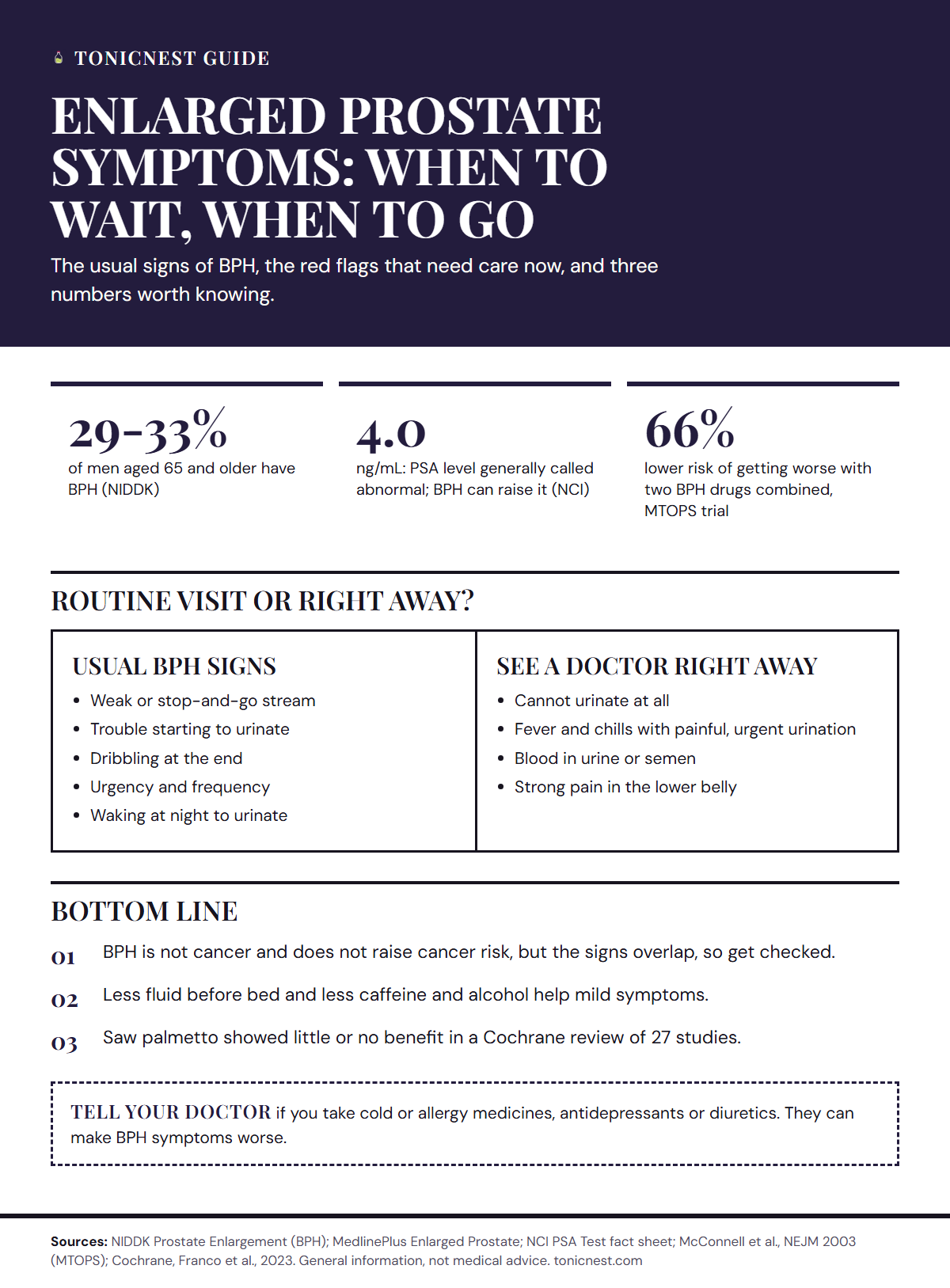
Enlarged prostate symptoms include a weak or stop-and-go urine stream, trouble starting, dribbling, urgency and waking at night to urinate. They come from benign prostatic hyperplasia (BPH), which is not cancer and affects 29% to 33% of men 65 and older. Get care the same day if you cannot urinate at all, or have fever with painful urination.
On this page
- What are enlarged prostate symptoms?
- What causes an enlarged prostate, and who gets it?
- Are enlarged prostate symptoms a sign of cancer?
- When should you see a doctor right away?
- How do doctors diagnose an enlarged prostate?
- How do doctors treat enlarged prostate symptoms?
- How can you relieve enlarged prostate symptoms at home?
- Does saw palmetto help enlarged prostate symptoms?
- Bottom line
- FAQ
Enlarged prostate symptoms are the bladder and urine-flow changes that come from benign prostatic hyperplasia (BPH), a non-cancer growth of the prostate. For this guide we read the NIDDK and MedlinePlus pages on BPH, the NIA and NCI pages on other prostate problems, the NCI PSA fact sheet, the MTOPS drug trial and the 2023 Cochrane review of saw palmetto.
The short answer: the usual signs are a weak or stop-and-go stream, trouble starting, dribbling, and needing to urinate often or urgently, especially at night, and BPH affects 29% to 33% of men aged 65 and older[1].
| What it is | A prostate that grows larger than normal without cancer[1] |
|---|---|
| How common | 5% to 6% of men aged 40 to 64; 29% to 33% of men 65 and older[1] |
| Main symptoms | Weak or interrupted stream, trouble starting, dribbling, urgency, frequency, waking at night to urinate[1] |
| Cancer link | BPH is not cancer and does not raise prostate cancer risk[2] |
| How it is found | History, digital rectal exam, urine test, PSA blood test, sometimes ultrasound or cystoscopy[1] |
| First-line care | Watchful waiting and habit changes, then alpha blockers or 5-alpha reductase inhibitors[1] |
| Emergency sign | Suddenly being unable to urinate at all (acute urinary retention)[2] |
What are enlarged prostate symptoms?
Enlarged prostate symptoms are lower urinary tract problems caused when a growing prostate squeezes the urethra, the tube that carries urine out of the bladder. The NIDDK lists trouble starting a stream, a weak or interrupted stream, dribbling at the end, waking at night to urinate, urgency, frequency and pain while urinating[1].
The prostate sits just below the bladder and wraps around the urethra[3]. As it grows, the bladder muscle has to push harder. Over time that muscle can weaken, and some urine stays behind after you go[2].
Day to day, the early signs are easy to brush off. Men often describe them like this:
- Standing at the toilet for a while before anything comes out.
- A stream that starts, stops and starts again.
- Feeling that the bladder is still not empty.
- A few drops leaking after you zip up.
- Getting up two or more times a night to urinate.
- A sudden, strong need to go that is hard to put off.
MedlinePlus adds leaking urine, pain after ejaculation, and urine with an unusual color or smell to the list[2]. Size and symptoms do not always match. A large prostate can cause few problems, while a slightly enlarged one can make urinating hard[1].
Broken sleep from night-time trips adds up. If you wake up drained most mornings, our guide on why you may be so tired and which tests help covers other causes worth ruling out.
What causes an enlarged prostate, and who gets it?
Scientists are not sure what causes BPH, but aging and changing hormone levels are the leading explanations. The prostate has a second growth phase that starts around age 25 and continues for life, and BPH tends to show up late in that phase[1].
The NIDDK lists these factors that make BPH more likely[1]:
- Being 40 or older.
- A family history of BPH.
- Heart and blood vessel disease, type 2 diabetes, obesity, chronic kidney disease or erectile dysfunction.
- Not being physically active.
BPH is the most common prostate problem in men over 50, and it rarely causes symptoms before 40[1]. In a younger man, a doctor will also look at other causes, such as an infection or prostatitis. Chronic prostatitis, also called chronic pelvic pain syndrome, is common and can cause pain in the lower back, groin or tip of the penis[3].
Type 2 diabetes is itself a BPH risk factor[1], so it is worth knowing your blood sugar numbers. Our page on normal, prediabetes and diabetes blood sugar levels explains the cutoffs.
Are enlarged prostate symptoms a sign of cancer?
Enlarged prostate symptoms are not by themselves a sign of cancer, and BPH does not raise your risk of prostate cancer. MedlinePlus states this plainly[2]. Early prostate cancer, though, often causes no symptoms, and when it does, they can look the same as BPH[4].
The NCI lists trouble starting a stream, frequent urination at night, trouble emptying the bladder and a weak or stop-and-go flow as signs that may come from prostate cancer or from other conditions[5]. In the United States, about one in eight men will be diagnosed with prostate cancer at some point[5].
A few features push doctors to look harder for cancer or another problem[4][5]:
- Blood in the urine or semen.
- Pain in the back, hips or pelvis that does not go away.
- Painful ejaculation.
- A parent, brother or son who has had prostate cancer.
So no, not all enlarged prostates are cancerous. You still cannot tell the two apart by how it feels, which is why any new urinary symptom deserves a visit[1].
When should you see a doctor right away?
Get care the same day if you suddenly cannot urinate at all, because acute urinary retention is a medical emergency. MedlinePlus notes it is common in older men and can be set off by cold or allergy medicines, alcohol, cold temperatures or long periods without moving[2].
See a doctor right away if you[1][3]:
- Cannot urinate at all.
- Have painful, frequent, urgent urination with fever and chills.
- See blood in your urine or semen.
- Have strong pain in your lower belly or urinary tract.
- Have new, lasting pain or stiffness in the lower back, hips, pelvis or upper thighs.
Fever and chills with urinary pain can point to acute bacterial prostatitis, which usually starts suddenly. Most cases clear with antibiotics[3].
Some medicines can make BPH symptoms worse. Tell your doctor if you take over-the-counter cold and cough medicines such as decongestants or antihistamines, tranquilizers, antidepressants or diuretics[1]. Do not stop a prescribed medicine on your own.
| If you notice | Then |
|---|---|
| Cannot urinate at all | Emergency care now[2] |
| Fever, chills and burning or urgent urination | Same-day visit; possible infection or prostatitis[3] |
| Blood in urine or semen | Prompt visit to check for other causes[1][4] |
| Slow stream, night trips or dribbling that are new or getting worse | Routine visit with your doctor or a urologist[1] |
| Mild symptoms that do not bother you | Ask about watchful waiting with yearly checkups[1] |
How do doctors diagnose an enlarged prostate?
Doctors diagnose BPH from your symptom history, a physical exam that usually includes a digital rectal exam, and a few targeted tests. They ask when symptoms began, how much you drink, whether you use caffeine or alcohol, which medicines you take, and whether relatives have had prostate problems[1].
In a digital rectal exam, the doctor feels the prostate with a gloved finger to check whether it is large, tender or irregular[2]. Tests may include[1][2]:
- A urine test to look for infection or blood.
- A PSA blood test.
- Urodynamic tests that measure how well the bladder holds and releases urine.
- Cystoscopy, a thin scope to look inside the urethra and bladder.
- Ultrasound of the prostate and urinary tract.
- A biopsy, only if cancer needs to be ruled out.
Does an enlarged prostate raise PSA levels?
It can. The NCI says BPH and prostatitis can both raise PSA, the protein the PSA test measures[6]. A level above 4.0 ng/mL is generally treated as abnormal, although some doctors use different cutoffs by age[6].
Because of that overlap, false alarms are common. About 6% to 7% of men get a false-positive PSA result in any screening round, and only about 25% of men who have a biopsy for a raised PSA turn out to have cancer[6]. BPH drugs such as finasteride and dutasteride lower PSA, so doctors adjust the cutoff for men taking them[6]. A PSA test alone cannot confirm or rule out BPH.
For screening, the USPSTF advised in 2018 that men aged 55 to 69 talk with their doctor about the benefits and harms of PSA testing[3].
How do doctors treat enlarged prostate symptoms?
Treatment depends on how much the symptoms bother you, and options run from watchful waiting to medicines, office procedures and surgery. Not everyone with BPH needs treatment[2]. If symptoms are mild, a doctor may suggest watchful waiting with yearly checkups and habit changes[1].
The medicines doctors use first fall into three groups[1]:
- Alpha blockers relax muscles in the bladder neck and prostate so urine flows more easily.
- 5-alpha reductase inhibitors (5-ARIs) can stop the prostate growing or shrink it.
- PDE5 inhibitors relax muscles around the bladder and prostate and can ease some symptoms.
An alpha blocker taken with a 5-ARI may work better than either alone[1]. That finding comes from the MTOPS trial.
| Study | Who and how long | What was tested | Result |
|---|---|---|---|
| MTOPS, NEJM 2003[7] | 3,047 men, mean 4.5 years | Doxazosin, finasteride, both, or placebo | Risk of getting worse cut 39%, 34% and 66% versus placebo |
| Cochrane review, 2023[8] | 27 studies, 4,656 men | Saw palmetto versus placebo | Symptom score 0.90 points better at 3 to 6 months, below the 3-point change men notice |
| CAMUS, JAMA 2011[10] | 369 men, 72 weeks | Saw palmetto rising from 320 to 960 mg a day | No better than placebo at any dose |
In MTOPS, the combination and finasteride alone also lowered the chance of sudden urinary retention and of needing surgery. Doxazosin alone did not[7]. These drugs can have side effects, from minor to serious, so report any you notice[1].
When medicines are not enough, minimally invasive options include water vapor therapy, which uses steam to shrink tissue, and a prostatic urethral lift, which uses small implants to hold the prostate away from the urethra[1]. Surgery removes part or all of the prostate. It can relieve symptoms, but about 10% of men need another operation within 20 years[1].
How can you relieve enlarged prostate symptoms at home?
Simple habit changes can ease mild symptoms, mostly by cutting how much urine your bladder has to handle at awkward times. The NIDDK and MedlinePlus list the same core steps. Use them along with a doctor’s check[1][2].
- Drink less before bed or before you go out, while keeping your total daily fluids normal[1].
- Cut back on caffeine and alcohol[1].
- Take your time and empty your bladder fully each time[1].
- Go when you need to and avoid holding urine for long periods[1].
- Stay physically active. Inactivity is a BPH risk factor[1].
- Ask about bladder training and exercises for the muscles that control urine flow[2].
- Prevent or treat constipation[2].
- Review cold, allergy and other medicines with a pharmacist or doctor[1].
Can an enlarged prostate get better on its own? The prostate keeps growing through adult life[1], so the gland itself is unlikely to shrink without treatment. Symptoms can still rise and fall, and watchful waiting suits men whose symptoms stay mild[1]. Researchers have not found a way to prevent BPH, though being active may lower risk, and diet has not been shown to cause or prevent it[1].
Checklist before you see a doctor
- Keep a 3-day log of how often you urinate, day and night.
- Note how much you drink and when, including coffee, tea and alcohol.
- List every medicine and supplement you take, with doses.
- Write down any blood in urine or semen, fever, or pain, and when it started.
- Ask whether a PSA test makes sense for you, and what your result would mean[6].
- Ask which treatment fits your symptoms: watchful waiting, medicine, or a procedure[1].
- Read how TonicNest reviews health sources if you want to check our methods.
Does saw palmetto help enlarged prostate symptoms?
The best evidence says saw palmetto gives little or no benefit for enlarged prostate symptoms. NCCIH concludes it is probably not helpful for this purpose[9]. The 2023 Cochrane review of 27 studies and 4,656 men found that saw palmetto alone made little to no difference to symptom scores[8].
At 3 to 6 months, symptom scores were 0.90 points better than placebo, while men usually notice a change of about 3 points[8]. At 12 to 17 months there was no difference[8]. In the CAMUS trial, raising the dose from 320 mg to 960 mg a day did not help either, and the placebo group improved slightly more[10].
Saw palmetto appears safe. NCCIH says it has been used safely in studies for up to 3 years, with mild, infrequent side effects such as stomach upset, dizziness and headache[9]. It does not appear to change PSA readings[9].
The FDA does not review supplements for safety or effectiveness before they are sold[11]. A product that seems to ease a symptom could also delay a check for something more serious. If you want to try one, tell your doctor first, and treat the money as a bet with poor odds.
More on related conditions is in our prostate health guides.
Bottom line
Enlarged prostate symptoms are common and are not a sign of cancer on their own. A weak stream, night trips and urgency usually mean BPH, but infection, prostatitis and cancer can cause the same signs, so a doctor’s check is the right first step[1][4].
For most men with mild symptoms, habit changes and watchful waiting are a better first step than any supplement, because they cost nothing and NIH backs them, while saw palmetto failed in the largest trials[1][8]. If symptoms bother you, ask about alpha blockers or combination therapy, which have long-term trial data behind them[7].
Frequently asked questions
Can an enlarged prostate heal itself?
The prostate keeps growing through adult life, so it rarely shrinks on its own. Symptoms can come and go, and many men with mild symptoms do well with watchful waiting, yearly checkups and simple habit changes, according to the NIDDK.
Can a young male have enlarged prostate symptoms?
It is unusual. The NIDDK says BPH rarely causes symptoms in men younger than 40. In a younger man, a doctor will usually look for other causes first, such as an infection or prostatitis.
Does a PSA test detect an enlarged prostate?
Not on its own. BPH can raise PSA, but so can prostatitis and prostate cancer. Doctors combine PSA with your symptom history, a digital rectal exam and sometimes ultrasound or other tests to diagnose an enlarged prostate.
What medicines can make enlarged prostate symptoms worse?
The NIDDK names over-the-counter cold and cough medicines such as decongestants and antihistamines, plus tranquilizers, antidepressants and diuretics. Tell your doctor what you take, and do not stop a prescribed medicine without advice.
Can enlarged prostate symptoms come back after surgery?
Yes. Surgery can relieve symptoms but may not cure BPH. The NIDDK says about 10% of people who have prostate surgery need more surgery within 20 years, so yearly prostate checks usually continue afterward.
Sources
- Prostate Enlargement (Benign Prostatic Hyperplasia). NIDDK, reviewed 2024
- Enlarged Prostate (BPH). MedlinePlus, National Library of Medicine
- Prostate Problems. National Institute on Aging
- Prostate Cancer. MedlinePlus, National Library of Medicine
- Prostate Cancer Treatment (PDQ), Patient Version. National Cancer Institute
- Prostate-Specific Antigen (PSA) Test. National Cancer Institute
- The long-term effect of doxazosin, finasteride, and combination therapy on the clinical progression of benign prostatic hyperplasia (MTOPS). New England Journal of Medicine, McConnell et al., 2003
- Serenoa repens (saw palmetto) for lower urinary tract symptoms due to benign prostatic enlargement. Cochrane Database of Systematic Reviews, Franco et al., 2023
- Saw Palmetto: Usefulness and Safety. NCCIH, 2025
- Effect of increasing doses of saw palmetto extract on lower urinary tract symptoms (CAMUS). JAMA, Barry et al., 2011
- Using Dietary Supplements Wisely. NCCIH
This article is general information, not medical advice. Dietary supplements are not reviewed by the FDA for safety or effectiveness before they are sold. Talk to your doctor before you start any supplement, especially if you are pregnant, nursing, take medication or have a health condition.