Most adults need 22 to 34 grams of fiber a day, based on 14 grams for every 1,000 calories. That is 28 grams on a 2,000-calorie diet, the same as the label Daily Value. Women aged 19 to 30 need about 28 grams and men the same age about 34. Beans, lentils, peas, berries, pears and whole grains close the gap fastest.
On this page
- How much fiber per day should you have?
- How many grams of fiber per day do you need by age and sex?
- Why do most people fall short of their daily fiber intake?
- What foods are high in fiber?
- What are the best high fiber fruits and vegetables?
- Which high fiber foods help with constipation?
- Which foods are high in soluble fiber?
- What does a high fiber diet do for your health?
- What does a 30-gram fiber day look like?
- How do you add fiber without gas and bloating?
- Do fiber supplements count toward your daily fiber?
- Who should be careful with more fiber?
- What do doctors suggest first?
- Fiber checklist for your next grocery trip
- Bottom line
- FAQ
To answer how much fiber per day you need, we read the fiber tables in the Dietary Guidelines for Americans, two NIDDK diet pages, the FDA Daily Value list and a 2019 Lancet review that pooled 185 cohort studies and 58 trials.[1][4][8][9] We then pulled fiber numbers for 18 everyday foods from USDA FoodData Central.[3]
The short answer: most adults need 22 to 34 grams of fiber a day, which works out to about 14 grams for every 1,000 calories you eat.[4][1]
| What it is | The part of plant foods your body cannot digest, also called bulk or roughage[6] |
|---|---|
| Daily target | 14 g per 1,000 calories, or 22 to 34 g for most adults[1][4] |
| Label number | The Daily Value on food labels is 28 g[8] |
| Best sources | Beans, peas, lentils, whole grains, fruit, vegetables, nuts and seeds[4][6] |
| Best evidence | Eating 25 to 29 g a day was linked with the largest drop in heart disease, diabetes and death risk in long-term studies[9] |
| Common side effects | Gas, bloating and cramps when you add it too fast[6] |
| Who should check first | People with a past bowel blockage or trouble swallowing, and anyone taking digoxin, aspirin or nitrofurantoin with psyllium[11] |
How much fiber per day should you have?
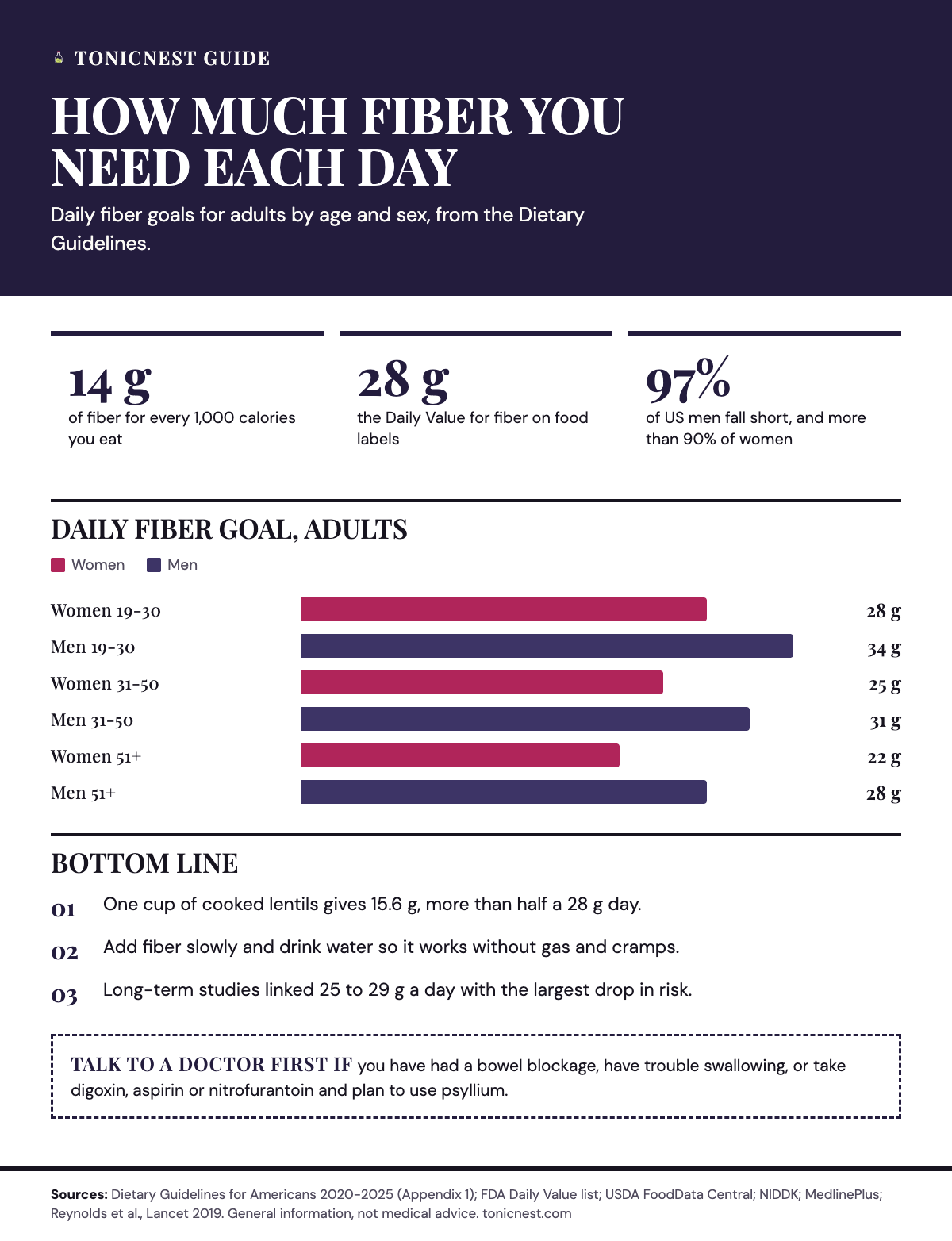
The Dietary Guidelines set the fiber goal at 14 grams for every 1,000 calories you eat.[1] On a 2,000-calorie diet, that comes to 28 grams a day.[5] NIDDK puts the adult range at 22 to 34 grams, depending on your age and sex.[4]
The 28-gram figure is also the Daily Value printed on Nutrition Facts labels.[8] So if a cereal says 20% DV for fiber, one serving gives you about a fifth of a full day.
You may also see older round numbers: about 38 grams for men and 25 grams for women. NIH explains that these came from Institute of Medicine reviews of heart disease studies.[7] They sit close to the calorie-based targets, so you can aim for either one.
The newest Dietary Guidelines, for 2025 to 2030, do not list a new gram target. They tell people to prioritize fiber-rich whole grains, aim for 2 to 4 servings of whole grains a day and eat high-fiber foods to support a diverse gut microbiome.[2]
How many grams of fiber per day do you need by age and sex?
Children aged 2 to 3 need about 14 grams of fiber a day, and the target rises to 34 grams for men aged 19 to 30.[1] The numbers follow calorie needs, so younger men get the highest targets and older women the lowest.
| Group | Calories assessed | Fiber goal |
|---|---|---|
| Children 2-3 (boys and girls) | 1,000 | 14 g |
| Girls 4-8 | 1,200 | 17 g |
| Boys 4-8 | 1,400 | 20 g |
| Girls 9-13 | 1,600 | 22 g |
| Boys 9-13 | 1,800 | 25 g |
| Girls 14-18 | 1,800 | 25 g |
| Boys 14-18 | 2,200 | 31 g |
| Women 19-30 | 2,000 | 28 g |
| Men 19-30 | 2,400 | 34 g |
| Women 31-50 | 1,800 | 25 g |
| Men 31-50 | 2,200 | 31 g |
| Women 51 and older | 1,600 | 22 g |
| Men 51 and older | 2,000 | 28 g |
These goals come from Table A1-2 of the Dietary Guidelines, which multiplies 14 grams by each group’s calorie level.[1] If you eat more or fewer calories than the listed amount, scale your target to match.
Pregnancy raises the goal. For women aged 19 to 30, it moves from 28 grams in the first trimester to 34 grams in the second and 36 grams in the third.[1] For women aged 31 to 50, it goes from 25 to 31 to 34 grams.[1]
Why do most people fall short of their daily fiber intake?
More than 90% of women and 97% of men in the United States do not meet the recommended intake for dietary fiber.[1] The Dietary Guidelines tie this gap to low intakes of fruit, vegetables and whole grains, which more than 85% of adults underconsume.[1]
That is why fiber is listed as a dietary component of public health concern, next to calcium, potassium and vitamin D.[1] A 2010 NIH report put the average American intake at only 14 grams a day, about half the label target.[7]
Chips, fast food, meat and many frozen or packaged meals have little to no fiber.[4] Refined grains such as white bread and crackers also crowd out whole grains, which the newest guidelines ask people to cut back on.[2]
What foods are high in fiber?
Beans, peas and lentils are the richest everyday fiber foods, with 12 to 16 grams in one cooked cup.[3] Chia seeds, avocado, berries and pears come next. The table below ranks 18 common foods by grams of fiber per serving.
| Food | Serving | Fiber |
|---|---|---|
| Split peas, cooked | 1 cup (196 g) | 16.3 g |
| Lentils, cooked | 1 cup (198 g) | 15.6 g |
| Black beans, cooked | 1 cup (172 g) | 15.0 g |
| Chickpeas, cooked | 1 cup (164 g) | 12.5 g |
| Avocado, cubed | 1 cup (150 g) | 10.1 g |
| Chia seeds | 1 oz (28 g) | 9.8 g |
| Green peas, cooked | 1 cup (160 g) | 8.8 g |
| Raspberries | 1 cup (123 g) | 8.0 g |
| Blackberries | 1 cup (144 g) | 7.6 g |
| Pear, with skin | 1 medium (178 g) | 5.5 g |
| Whole-wheat spaghetti, cooked | 1 cup (117 g) | 4.6 g |
| Apple, with skin | 1 medium (182 g) | 4.4 g |
| Oats, dry | 1/2 cup (40 g) | 4.1 g |
| Sweet potato, baked | 1 medium (114 g) | 3.8 g |
| Popcorn, air-popped | 3 cups (24 g) | 3.5 g |
| Almonds | 1 oz (28 g) | 3.5 g |
| Whole-wheat bread | 1 slice (32 g) | 1.9 g |
| Flaxseed, ground | 1 tbsp (7 g) | 1.9 g |
We converted each food’s fiber per 100 grams into a common serving, using the serving weights listed in FoodData Central.[3] Brands vary, so check the Nutrition Facts label on packaged foods. A food with 20% DV or more per serving counts as high in fiber.[8]
One cup of cooked lentils, at 15.6 grams, covers more than half of a 28-gram day on its own.[3][8] A slice of whole-wheat bread gives 1.9 grams, so bread alone rarely gets you there.[3]
What are the best high fiber fruits and vegetables?
Raspberries lead the common fruits with 8 grams of fiber per cup, and cooked green peas lead the vegetables with 8.8 grams per cup.[3] Blackberries give 7.6 grams per cup, a medium pear 5.5 grams and a medium apple with skin 4.4 grams.[3]
Keep the skin on. NIDDK lists apples with the skin on and pears among its good fiber sources.[4] A medium baked sweet potato adds 3.8 grams, and a cup of cubed avocado adds 10.1 grams.[3]
NIDDK also names berries, oranges, carrots, broccoli and collard greens as good sources.[4] Its diverticular disease page lists 1 cup of cooked broccoli at 5.2 grams and 1 cup of cooked collard greens at 4.8 grams.[5]
Which high fiber foods help with constipation?
NIDDK advises people with constipation to eat enough fiber from whole grains, beans, fruit, vegetables and nuts, and to drink plenty of liquids so the fiber works better.[4] Liquids help make stools softer and easier to pass.[4]
Its list of good choices includes whole wheat bread and pasta, oatmeal, bran flake cereals, lentils, black beans, kidney beans, chickpeas, berries, apples with the skin on, oranges, pears, carrots, broccoli, green peas, almonds, peanuts and pecans.[4]
NIH notes that insoluble fiber, found in wheat bran and some vegetables, is the type most often used for constipation.[7] Add these foods slowly. Older adults sometimes eat less because they lose interest in food, so a dietitian can help plan meals with enough fiber.[4]
Which foods are high in soluble fiber?
Soluble fiber is found in oat bran, beans, peas and most fruits, and it may help lower blood sugar and cholesterol.[7] Insoluble fiber, in wheat bran and some vegetables, adds bulk and moves food through the gut.[7]
FDA rules let some foods carry a heart health claim for soluble fiber from whole oats, barley and psyllium husk, as part of a diet low in saturated fat and cholesterol.[10] The claim sets what a label may say about these fibers in an overall diet.
Most plant foods contain both kinds. Good soluble picks from our table include oats, beans, lentils, peas, pears and berries.[3][7] If your goal is blood sugar control, our guide to berberine benefits for blood sugar explains why diet changes still come first.
What does a high fiber diet do for your health?
In a 2019 Lancet review, people who ate the most fiber had 15% to 30% lower rates of death, heart disease, stroke, type 2 diabetes and colorectal cancer than people who ate the least.[9] The benefit was greatest at 25 to 29 grams a day.[9]
Most of that evidence comes from long-term observational studies, which show links rather than proof. The review rated the certainty of the fiber evidence as moderate.[9] Its 58 clinical trials, with 4,635 adults, found lower body weight, systolic blood pressure and total cholesterol with higher fiber intake.[9]
Fiber also helps you feel full faster.[6] NIH reports that people on high-fiber diets in studies tend to eat about 10% fewer calories.[7] And NIDDK notes that a low-fiber diet high in red meat may raise the risk of diverticulitis.[5]
| Study | Who and how many | What was compared | Result |
|---|---|---|---|
| Reynolds, Lancet 2019[9] | 185 cohort studies (about 135 million person-years) and 58 trials with 4,635 adults | Highest vs lowest fiber intake | 15% to 30% lower death, heart disease, stroke, type 2 diabetes and colorectal cancer; best at 25 to 29 g a day |
| Jovanovski, AJCN 2018[12] | 28 trials, 1,924 people, 3 weeks or longer | About 10.2 g psyllium a day vs control | LDL cholesterol down 0.33 mmol/L; evidence rated moderate quality |
| Dietary Guidelines 2020-2025[1] | US intake data | Usual intake vs fiber goal | More than 90% of women and 97% of men fall short |
What does a 30-gram fiber day look like?
A day of oatmeal with berries, a sandwich on whole-wheat bread with an apple, a handful of almonds and lentils with a sweet potato gives about 33 grams of fiber.[3] That clears the 28-gram Daily Value and comes close to the 34-gram goal for young men.[8][1]
| Meal | Foods | Fiber |
|---|---|---|
| Breakfast | 1/2 cup dry oats (4.1 g), 1/2 cup raspberries (4.0 g), 1 tbsp ground flaxseed (1.9 g) | 10.0 g |
| Lunch | Sandwich on 2 slices whole-wheat bread (3.8 g), 1 medium apple with skin (4.4 g) | 8.2 g |
| Snack | 1 oz almonds | 3.5 g |
| Dinner | 1/2 cup cooked lentils (7.8 g), 1 medium baked sweet potato (3.8 g) | 11.6 g |
| Total | Four meals and snacks | 33.3 g |
If you eat about 14 grams now, do not jump straight to this menu. Build up over a few weeks, as the next section explains. Swap the lentils for black beans or split peas on other days; both carry about the same fiber per cup.[3]
How do you add fiber without gas and bloating?
Add fiber slowly, because increasing it too quickly can cause gas, bloating and cramps.[6] NIDDK says to add fiber a little at a time so your body gets used to the change, and to drink water and other liquids so the fiber works better.[4]
- Write down what you eat for 3 days and add up the fiber from labels and our food table.
- Pick one meal and add one high fiber food, such as berries on cereal.
- Hold that change for about a week before adding another.
- Swap one refined grain a day for a whole grain, such as whole-wheat pasta for white.[2]
- Add a half cup of beans, peas or lentils to soups, salads or rice dishes.[4]
- Drink water with meals and through the day.[4]
- Stop adding once you reach your target from the age table.[1]
If you have pain that does not ease, see the safety section below.
Do fiber supplements count toward your daily fiber?
Yes, the grams in a fiber supplement count, but supplements are a backup to fiber-rich foods. Psyllium husk, the best-studied option, is a bulk-forming laxative that swells in the gut to form a soft, bulky stool.[11]
A 2018 review of 28 trials with 1,924 people found that about 10.2 grams of psyllium a day lowered LDL cholesterol by 0.33 mmol/L.[12] FDA rules allow a heart health label claim at 7 grams or more a day of soluble fiber from psyllium husk.[10]
Each powder dose must be mixed with 8 ounces (240 mL) of liquid.[11] Food should still come first, since the Dietary Guidelines build fiber goals around vegetables, fruit, beans and whole grains.[1] If you take a statin and are also looking at heart supplements, our CoQ10 benefits and dosage guide covers what the trials show.
Who should be careful with more fiber?
People with a past bowel blockage, trouble swallowing or certain gut conditions should ask a doctor before adding a lot of fiber or a fiber supplement.[11]
- Do not take digoxin, aspirin or other salicylates, or nitrofurantoin within 3 hours of psyllium.[11]
- Tell your doctor before using psyllium if you have diabetes, heart disease, kidney disease, rectal bleeding or are pregnant or breastfeeding.[11]
- People with diverticulosis usually do not need to avoid nuts, popcorn or seeds, based on newer research.[5]
See a doctor right away if you have:
- Trouble breathing or swallowing after taking a fiber supplement[11]
- Stomach pain, nausea or vomiting after taking a fiber supplement[11]
- Skin rash or itching after a dose[11]
What do doctors suggest first?
For most people, doctors and dietitians start with food: more vegetables, fruit, beans and whole grains, plus enough liquids.[4][1] NIDDK suggests talking with a health care professional, such as a dietitian, to plan meals with the right amount of fiber for you.[4]
For constipation, the first steps are more fiber and more fluids, and fewer low-fiber processed foods.[4] For past diverticulitis, a doctor may recommend more high-fiber foods, added slowly.[5] A doctor may add a supplement such as psyllium on top of these food changes.[11]
Fiber checklist for your next grocery trip
- Know your number from the age and sex table, or use 14 g per 1,000 calories.[1]
- Read the Dietary Fiber line on the Nutrition Facts label. 20% DV or more per serving is high; 5% DV or less is low.[8]
- Buy one bag of dried or canned beans, lentils or split peas each week.[3]
- Choose whole-grain bread, pasta and oats over refined versions.[2]
- Keep berries, pears and apples on hand, and eat the skin.[4]
- If you buy a fiber supplement, check the grams of fiber per dose and the liquid directions. See how we review supplements and labels.[11]
More guides on digestion live in our gut, liver and detox section.
Bottom line
Most adults need 22 to 34 grams of fiber a day, set at 14 grams per 1,000 calories, and most people get far less.[4][1] Beans, lentils, peas, berries, pears, oats and whole grains close the gap fastest.[3]
For most people, adding one cup of beans or lentils a day is the better first step than buying a fiber supplement, because one cooked cup brings about 15 grams of fiber from a whole food.[3] Add it slowly and drink water with it. If you have a gut condition, ask your doctor first.[4][6]
Frequently asked questions
What is dietary fiber?
Dietary fiber is the part of plant foods your body cannot digest. It comes in soluble and insoluble forms, adds bulk to your diet, helps you feel full and helps digestion. Whole grains, nuts, seeds, fruit and vegetables are good sources.
Is fibre the same as fiber?
Yes. Fibre is the British and Commonwealth spelling and fiber is the American spelling. Both mean the same indigestible part of plant foods, and the daily targets from the Dietary Guidelines apply whichever spelling a label uses.
What is the daily fiber recommendation on a Nutrition Facts label?
The FDA Daily Value for dietary fiber is 28 grams a day. The %DV on a label shows how much one serving gives toward that 28 grams, based on a 2,000-calorie diet.
How can you tell if a food is high in fiber?
Check the %DV for dietary fiber on the Nutrition Facts label. FDA says 20% DV or more per serving is high and 5% DV or less is low. A food with 20% DV gives about 5.6 grams of fiber.
Can high fiber foods help you feel full?
Yes. Fiber adds bulk and makes you feel full faster, according to MedlinePlus. NIH reports that people on high fiber diets in studies tend to eat about 10% fewer calories, which may help with weight control.
Sources
- Dietary Guidelines for Americans, 2020-2025 (Appendix 1). USDA and HHS, 2020
- Dietary Guidelines for Americans, 2025-2030. HHS and USDA, 2026
- FoodData Central (SR Legacy records). USDA Agricultural Research Service, 2019
- Eating, Diet, and Nutrition for Constipation. NIDDK, NIH
- Eating, Diet, and Nutrition for Diverticular Disease. NIDDK, NIH, 2021
- Dietary Fiber. MedlinePlus, National Library of Medicine
- Rough Up Your Diet: Fit More Fiber Into Your Day. NIH News in Health, 2010
- Daily Value on the Nutrition and Supplement Facts Labels. FDA
- Carbohydrate quality and human health: a series of systematic reviews and meta-analyses. Reynolds et al., Lancet, 2019
- 21 CFR 101.81: Soluble fiber from certain foods and risk of coronary heart disease. eCFR, FDA regulation
- Psyllium. MedlinePlus Drug Information, National Library of Medicine
- Effect of psyllium fiber on LDL cholesterol and alternative lipid targets: a meta-analysis. Jovanovski et al., Am J Clin Nutr, 2018
This article is general information, not medical advice. Dietary supplements are not reviewed by the FDA for safety or effectiveness before they are sold. Talk to your doctor before you start any supplement, especially if you are pregnant, nursing, take medication or have a health condition.