Berberine benefits in trials are modest. A review of 46 studies found small drops in blood sugar and blood fats, mostly as an add-on to standard care, and weight fell about 2 kg or less. Side effects are mainly nausea, diarrhea and constipation. Berberine can raise cyclosporine levels, affect diabetes medicines, and should not be used in pregnancy, breastfeeding or infancy.
On this page
- What is berberine?
- What are the main berberine benefits?
- What does berberine do for the body?
- Does berberine help with weight loss?
- Berberine HCl vs berberine phytosome: does the premium form buy better results?
- How much berberine do people take?
- What are berberine side effects and warnings?
- Is berberine safe with other medicines?
- What about berberine benefits for women?
- Can berberine replace metformin or a GLP-1 drug?
- Should you try berberine? A quick decision table
- Checklist before you buy a premium berberine
- Bottom line
- FAQ
We read the NCCIH fact sheets on diabetes supplements and goldenseal, three meta-analyses, the main metformin comparison trial and two drug interaction studies to see which berberine benefits hold up. We also read the absorption study behind berberine phytosome, the premium form many brands sell at a higher price.
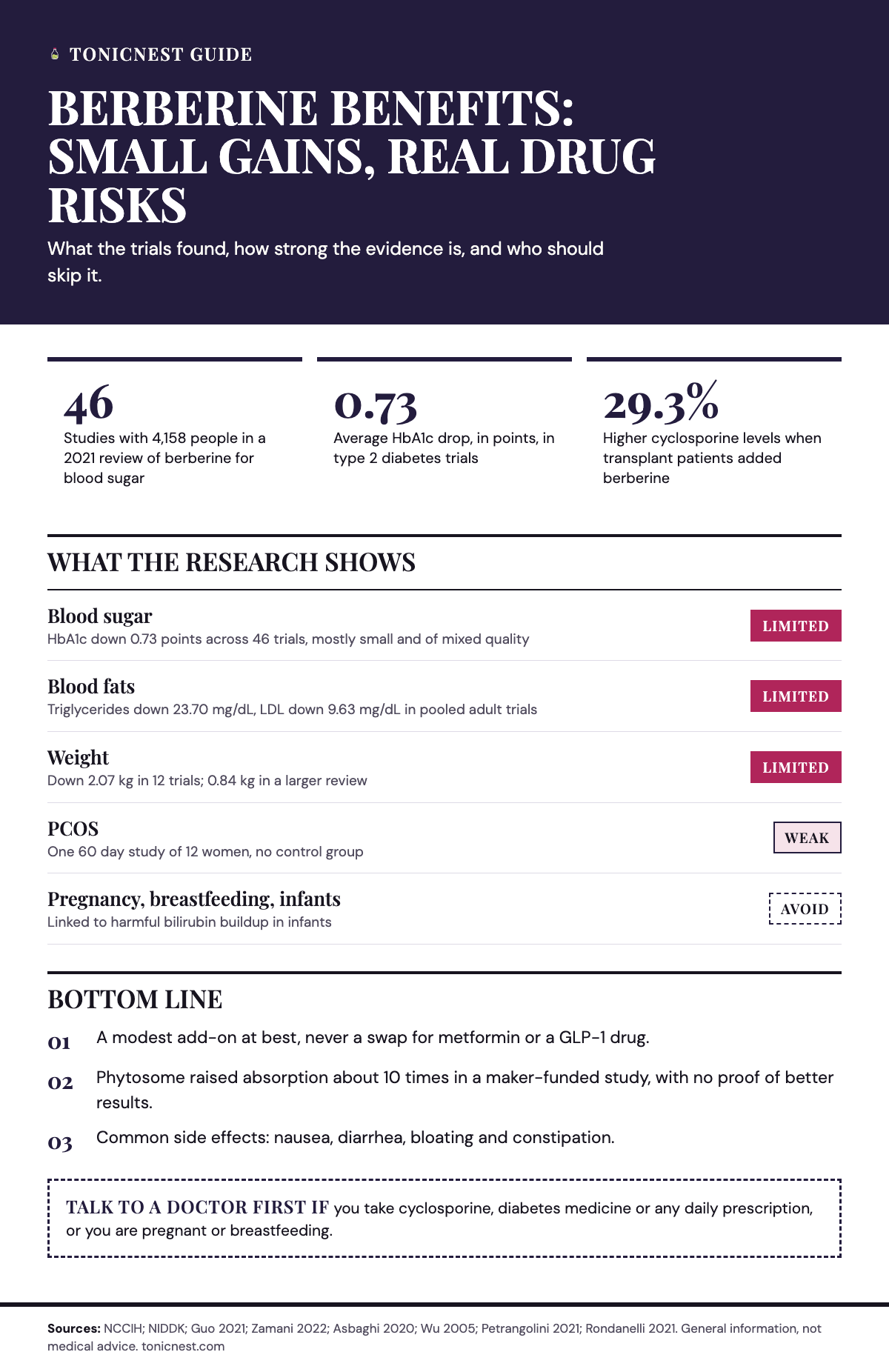
The short answer: in a 2021 review of 46 studies with 4,158 people, berberine lowered blood sugar and blood fats a little, mostly as an add-on to standard care, and it can change how some medicines work.[1]
| What it is | A bitter yellow plant compound found in barberry, goldenseal, goldthread, Oregon grape and tree turmeric[1] |
|---|---|
| Studied for | Blood sugar, cholesterol, body weight and blood pressure[4] |
| Amounts used in studies | 200 to 1,000 mg two to three times a day[1] |
| Best evidence | Small drops in HbA1c and fasting glucose in type 2 diabetes, mostly from Chinese trials of mixed quality[1][3] |
| Common side effects | Nausea, diarrhea, bloating and constipation[1] |
| Who should avoid it | Pregnant or breastfeeding women and infants; anyone on cyclosporine or diabetes medicine without a doctor’s approval[1][7] |
What is berberine?
Berberine is a bitter, yellow alkaloid made by plants such as barberry, goldenseal, goldthread, Oregon grape and tree turmeric. It has been used in Ayurvedic and traditional Chinese medicine for thousands of years. Today it is sold as a dietary supplement, usually in capsules.[1]
Berberine and goldenseal are not interchangeable. NCCIH notes that very little berberine may be absorbed when people take goldenseal by mouth, so results from berberine studies may not apply to goldenseal products.[2] Some goldenseal products have also been found to contain herbs that were not on the label.[2]
As a supplement, berberine falls under rules that are less strict than the rules for prescription or over-the-counter drugs.[14] That matters when you pay a premium price, because the price tag alone does not tell you what is in the bottle.
Most berberine research measures lab numbers: blood sugar, HbA1c, cholesterol, triglycerides, weight and blood pressure. Few trials tracked outcomes people feel, such as heart attacks or diabetes complications. Keep that in mind when a label promises big changes.
What are the main berberine benefits?
The best-studied berberine benefits are small drops in blood sugar and blood fats in adults. A 2022 meta-analysis of adult trials found lower triglycerides, total cholesterol, LDL cholesterol, fasting glucose and HbA1c, plus a slight rise in HDL cholesterol.[4]
Here is how large those average changes were:[4]
- Triglycerides: down 23.70 mg/dL
- Total cholesterol: down 20.64 mg/dL
- LDL cholesterol: down 9.63 mg/dL
- Fasting blood glucose: down 7.74 mg/dL
- HbA1c: down 0.45 percentage points
- Systolic blood pressure: down 5.46 mmHg
- HDL cholesterol: up 1.37 mg/dL
The same review estimated that about 1 g a day was the most effective dose for triglycerides, total cholesterol and weight.[4] That is a statistical estimate from pooled trials. It does not mean that taking more works better.
NCCIH is more cautious and groups berberine with chromium and cinnamon as supplements with “weak evidence of a possible benefit” for blood sugar, because the studies differ in size, dose, product and results.[1]
What does berberine do for the body?
In trials, berberine mainly lowered blood sugar and helped the body respond to insulin a little better. The 2021 Guo review pooled 46 randomized trials in type 2 diabetes. HbA1c fell by 0.73 points and fasting glucose by 0.86 mmol/L when berberine was used alone or on top of standard diabetes care.[3]
The authors said berberine looked most useful “as an adjunctive therapy,” which means an add-on to regular care.[3] NCCIH adds three limits. Most of the studies were done in Chinese patients, the results varied widely, and some studies were of poor quality.[1]
The trial most often quoted in marketing is a 2008 pilot. In it, 36 adults with newly diagnosed type 2 diabetes took either berberine or metformin, 0.5 g three times a day, for 3 months. HbA1c in the berberine group fell from 9.5% to 7.5%, and the authors called the effect similar to metformin.[6] It was small and short, so it cannot show that the two are interchangeable.
| Study | Who and how long | Dose | Result |
|---|---|---|---|
| Guo 2021 review[3] | 46 randomized trials, type 2 diabetes | Varied | HbA1c down 0.73 points; fasting glucose down 0.86 mmol/L |
| Zamani 2022 review[4] | Adult trials on heart risk factors | Varied; about 1 g a day looked best for blood fats and weight | LDL down 9.63 mg/dL; weight down 0.84 kg |
| Asbaghi 2020 review[5] | 12 randomized trials | Varied | Weight down 2.07 kg; waist down 1.08 cm; no change in liver enzymes |
| Yin 2008 pilot[6] | 36 adults with new type 2 diabetes, 3 months | 0.5 g three times a day | HbA1c 9.5% to 7.5%, similar to metformin |
| Rondanelli 2021[10] | 12 women with PCOS, 60 days, no control group | Two 550 mg phytosome tablets a day | Lower insulin resistance, testosterone and BMI |
Does berberine help with weight loss?
Berberine may help with weight loss slightly, about 2 kg or less on average in pooled trials. A 2020 meta-analysis of 12 randomized trials found weight fell by 2.07 kg, BMI by 0.47 and waist size by 1.08 cm.[5] A larger 2022 review found an average weight drop of only 0.84 kg.[4]
That is much smaller than what prescription weight medicines are designed for. The FDA has approved six drugs for long-term weight management, including semaglutide (Wegovy) and tirzepatide (Zepbound).[12] NIDDK says GLP-1 medicines may make you feel less hungry and help you lose some weight.[11]
The “nature’s Ozempic” label does not fit for that reason. We found no trial comparing berberine with semaglutide or tirzepatide. A supplement that averaged about 2 kg in trials is not a stand-in for a prescription GLP-1 drug, and nobody should stop or skip one to try berberine.
When a brand leans on that nickname, treat it as marketing. The nickname says nothing about how much berberine is in each capsule.
Berberine HCl vs berberine phytosome: does the premium form buy better results?
Berberine phytosome is berberine bound to phospholipids, a type of fat, to help the gut absorb it. In a 2021 study in healthy volunteers, the phytosome form put about 10 times more berberine into the blood than plain berberine, on a molar basis.[9]
The study has two limits. Its authors work for Indena, the company that makes the ingredient.[9] And higher blood levels are not the same thing as better blood sugar or cholesterol results. The one outcome study we found on the phytosome form had 12 women, no comparison group and Indena coauthors.[10]
The phytosome is a recent formulation, described as novel in 2021.[9] The large reviews pooled trials of standard berberine, so most of the evidence for berberine benefits belongs to the plain form that labels often list as berberine HCl.[3]
So a premium price for phytosome buys better absorption on paper, with no trial yet showing extra health benefit. The trial data mostly describe plain berberine.
How much berberine do people take?
Studies have used 200 to 1,000 mg of berberine two to three times a day, and NCCIH considers that range safe at clinical doses. Splitting the dose across the day is how most trials gave it.[1]
Some examples from the studies we read:
- The 2008 metformin comparison used 0.5 g three times a day for 3 months.[6]
- The transplant study used 0.2 g three times a day.[7]
- The drug interaction study used 300 mg three times a day for 2 weeks.[8]
- The PCOS study used two 550 mg phytosome tablets a day for 60 days.[10]
The 2022 dose-response review suggested about 1 g a day for blood fats and weight, and it estimated that fasting glucose changes were largest after about 40 weeks.[4] These are averages across many products, not a personal dosing plan. Your doctor or pharmacist should set any dose if you take other medicines.
What are berberine side effects and warnings?
The most common berberine side effects are stomach problems: nausea, diarrhea, bloating and constipation, usually mild to moderate. NCCIH lists these as the usual complaints at the doses used in clinical studies.[1]
Stomach upset is common: in the 2008 trials, 20 patients (34.5%) had short-lived digestive side effects.[6]
The bigger warnings involve medicines and certain groups:
- Pregnancy and breastfeeding: NCCIH says berberine should not be used.[1]
- Infants: exposure to berberine has been linked to a harmful buildup of bilirubin in infants, which can cause brain damage.[1]
- Prescription drugs: berberine can raise blood levels of some drugs, covered in the next section.[7][8]
- Low blood sugar: some diabetes medicines can cause hypoglycemia, and adding a supplement that also lowers glucose may push levels too low.[11]
On the reassuring side, the 2020 review found no change in the liver enzymes ALT and AST.[5] Safety over many years is less clear, because most trials ran for months, not years.
Is berberine safe with other medicines?
Berberine can slow the liver enzymes that clear many common drugs, which can raise those drugs to higher levels in the blood. In a 2012 study, healthy men took 300 mg three times a day for 2 weeks. Activity of the enzymes CYP2D6, CYP2C9 and CYP3A4 dropped, and exposure to the test drug midazolam rose 40%.[8]
Cyclosporine, an anti-rejection drug, is the clearest example. In a 2005 trial of kidney transplant patients, 52 took cyclosporine plus berberine 0.2 g three times a day for 3 months, and 52 took cyclosporine alone. Cyclosporine levels ended 29.3% higher in the berberine group.[7] Transplant teams adjust cyclosporine doses closely, so an unplanned rise is a real risk.
Diabetes medicines are the other concern. NCCIH reports that metformin levels dropped about 25% in healthy adults given goldenseal extract, which contains berberine, and that this was enough to possibly weaken glucose control.[2] Berberine also lowers glucose by itself, so its effect can stack with drugs that do the same.[3]
NCCIH’s advice is direct: people who take medicines should talk with their health care providers before taking berberine.[1]
What about berberine benefits for women?
For women, berberine has been studied mainly in polycystic ovary syndrome (PCOS), and the evidence is thin. In one 2021 study, 12 women with PCOS took two 550 mg tablets of phytosome berberine a day for 60 days. Insulin resistance, testosterone, BMI and acne scores went down.[10]
That study had no placebo group, so it cannot tell us how much of the change came from berberine. It was also co-written by staff from the ingredient’s maker.[10]
Berberine should not be used during pregnancy or while breastfeeding, and it should not be given to infants.[1] NCCIH also warns that the berberine in goldenseal can be harmful to newborns.[2] Women who could become pregnant should raise this with a doctor before starting it.
Can berberine replace metformin or a GLP-1 drug?
No. Berberine is a dietary supplement, and it should not replace metformin, a GLP-1 drug or any prescribed medicine. NIDDK says most people with type 2 diabetes start with metformin pills, along with healthy eating and physical activity.[11] Metformin helps the liver make less glucose and helps the body use insulin better.[11]
Prescription drugs come with dosing rules, monitoring and known risks that doctors manage. MedlinePlus warns that metformin may rarely cause lactic acidosis, which is why doctors ask about kidney disease before prescribing it.[13] A supplement bought online skips that safety net.
The best-supported role for berberine in the trials was as an add-on.[3] Even then, NCCIH calls the evidence weak.[1] If you want to try it next to a prescription, make that decision with your prescriber, with your lab numbers in front of you.
For weight, NIDDK lists FDA-approved medicines such as semaglutide and tirzepatide for long-term use.[12] No supplement has that level of evidence behind it.
Should you try berberine? A quick decision table
| If this is you | What the evidence suggests |
|---|---|
| Pregnant, breastfeeding or buying for a baby | Do not use it[1] |
| Taking cyclosporine | Do not start it without your transplant team; it raised cyclosporine levels 29.3%[7] |
| Taking metformin, insulin or other diabetes drugs | Ask your prescriber first and watch for low blood sugar[2][11] |
| Taking other daily prescriptions | Ask a pharmacist to check for CYP2D6, CYP2C9 and CYP3A4 interactions[8] |
| Adult with slightly high cholesterol or blood sugar and no medicines | Small benefits are possible; a doctor’s plan and lifestyle changes come first[4][11] |
| Hoping for GLP-1 sized weight loss | Trials averaged about 2 kg or less[5] |
Checklist before you buy a premium berberine
- Find the berberine amount per capsule and per serving, and compare it with the 200 to 1,000 mg range NCCIH cites.[1]
- Check the form. Plain berberine has most of the trial data; the phytosome form has an absorption study run by its maker.[9]
- Skip products sold as “nature’s Ozempic” or that hint they can replace your medicine.
- Do not swap in goldenseal, because very little of its berberine may be absorbed.[2]
- Look for independent third-party testing, and remember that words like “standardized” or “verified” do not guarantee quality by themselves.[14]
- Bring the bottle to your doctor or pharmacist if you take any prescription.[1]
- See how we check supplement labels and testing claims before you compare brands.
- Compare other options in our blood sugar support supplement guides.
Bottom line
Berberine benefits are real but modest: small drops in blood sugar, blood fats and weight, mostly in short trials from one country.[1][3] Its side effects are mostly digestive, yet its drug interactions are serious, and it is off-limits in pregnancy, breastfeeding and infancy.[1][7]
For most people with high blood sugar, the better first step is a doctor’s plan, which usually starts with metformin and lifestyle change, because that path has far stronger evidence.[11] If you add berberine later, a plain, clearly dosed product with independent testing is a fairer use of your money than a premium phytosome sold on a nickname.
Frequently asked questions
What are the pros and cons of berberine?
Pros: trials show small drops in blood sugar, cholesterol, triglycerides and weight, and plain berberine is widely available. Cons: stomach upset is common, it interacts with drugs such as cyclosporine and diabetes medicines, the evidence quality is mixed, and it is unsafe in pregnancy and for infants.
How long does berberine take to work?
In a small 2008 trial, fasting and after-meal blood sugar fell from the first week, and HbA1c changed over 3 months. A 2022 review estimated fasting glucose changes were largest around 40 weeks. Lab tests with your doctor are the only way to know if it works for you.
Is goldenseal the same as berberine?
No. Goldenseal is a plant that contains berberine, but NCCIH says very little berberine may be absorbed when people take goldenseal by mouth. Berberine study results may not apply to goldenseal, and some goldenseal products contain herbs not listed on the label.
Can you take berberine with metformin?
Only with your prescriber's approval. Both lower blood sugar, so lows are possible, and an NCCIH-funded study found goldenseal, which contains berberine, cut metformin levels by about 25 percent. Never stop or reduce metformin to use berberine instead.
Is berberine approved by the FDA?
Berberine is sold as a dietary supplement, not as an approved drug. Supplement makers are responsible for safety and truthful labels, and the rules are less strict than for prescription or over-the-counter drugs, so independent testing matters more when you pay a premium price.
Sources
- Diabetes and Dietary Supplements. NCCIH, NIH
- Goldenseal. NCCIH, NIH
- The Effect of Berberine on Metabolic Profiles in Type 2 Diabetic Patients: A Systematic Review and Meta-Analysis of Randomized Controlled Trials. Guo et al., Oxidative Medicine and Cellular Longevity, 2021
- The effects of berberine supplementation on cardiovascular risk factors in adults: A systematic review and dose-response meta-analysis. Zamani et al., Frontiers in Nutrition, 2022
- The effect of berberine supplementation on obesity parameters, inflammation and liver function enzymes: A systematic review and meta-analysis. Asbaghi et al., Clinical Nutrition ESPEN, 2020
- Efficacy of berberine in patients with type 2 diabetes mellitus. Yin et al., Metabolism, 2008
- Effects of berberine on the blood concentration of cyclosporin A in renal transplanted recipients. Wu et al., European Journal of Clinical Pharmacology, 2005
- Repeated administration of berberine inhibits cytochromes P450 in humans. Guo et al., European Journal of Clinical Pharmacology, 2012
- Development of an Innovative Berberine Food-Grade Formulation with an Ameliorated Absorption. Petrangolini et al., Evidence-Based Complementary and Alternative Medicine, 2021 (authors employed by Indena)
- Berberine Phospholipid Is an Effective Insulin Sensitizer and Improves Metabolic and Hormonal Disorders in Women with Polycystic Ovary Syndrome. Rondanelli et al., Nutrients, 2021
- Insulin, Medicines, and Other Diabetes Treatments. NIDDK, NIH
- Prescription Medications to Treat Overweight and Obesity. NIDDK, NIH
- Metformin. MedlinePlus, National Library of Medicine
- Using Dietary Supplements Wisely. NCCIH, NIH
This article is general information, not medical advice. Dietary supplements are not reviewed by the FDA for safety or effectiveness before they are sold. Talk to your doctor before you start any supplement, especially if you are pregnant, nursing, take medication or have a health condition.