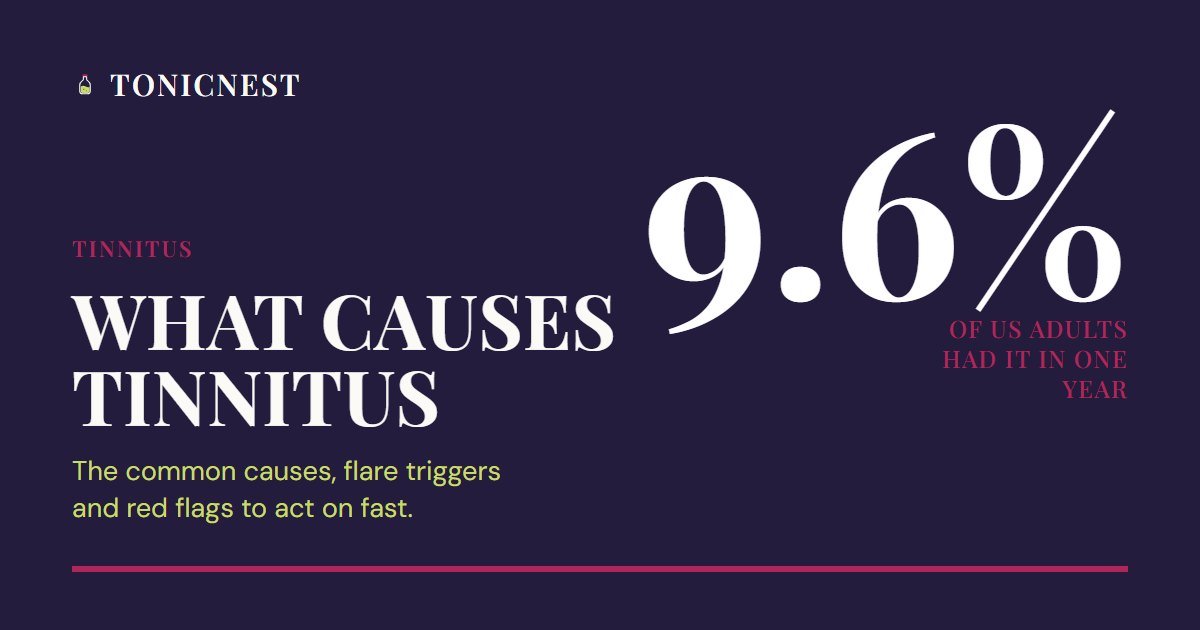
Most tinnitus comes with some hearing loss, usually from aging or loud noise. Other causes include earwax, ear infections, certain medicines such as high-dose aspirin, head or neck injury, Ménière's disease and blood vessel problems. About 1 in 10 US adults has it each year. Ringing in one ear, a pulsing sound or sudden hearing loss needs a prompt medical check.
On this page
- What causes tinnitus?
- What is tinnitus, and what causes it in the brain?
- What causes tinnitus in one ear only?
- What causes tinnitus in both ears?
- What causes pulsatile tinnitus?
- What causes tinnitus besides loud noises?
- What causes tinnitus to get louder or flare up?
- What causes tinnitus and vertigo together?
- Why is tinnitus so common in the military?
- What does the research say about tinnitus causes?
- Which cause fits your pattern?
- When should you see a doctor for tinnitus?
- How do doctors find the cause and treat it?
- A practical checklist before your appointment
- Bottom line
- FAQ
To answer what causes tinnitus, we read the National Institute on Deafness and Other Communication Disorders (NIDCD) tinnitus page, the MedlinePlus health topic, the 2014 tinnitus guideline from the American Academy of Otolaryngology-Head and Neck Surgery (AAO-HNS), and a US survey of 75,764 adults.[1][2][3][4] We also read the NIDCD pages on the ear conditions that list ringing as a symptom.
The short answer: most tinnitus comes with some degree of hearing loss, often from age or loud noise, and other causes include earwax, ear infections, medicines, head or neck injury and less common ear, blood vessel and nerve problems.[1] About 1 in 10 US adults (9.6%) had it in a single year.[4]
| What it is | Hearing a sound with no outside source, such as ringing, buzzing, hissing or roaring[1] |
|---|---|
| How common | Surveys put it at 10 to 25% of adults; 9.6% of US adults reported it in the past year[1][4] |
| Most common causes | Hearing loss, loud noise, certain medicines, earwax or ear infection, head or neck injury[1] |
| Less common causes | Ménière’s disease, jaw joint problems, tumors on the hearing nerve, blood vessel problems, thyroid problems[1][2] |
| When it counts as long term | Chronic at 3 months (NIDCD); the guideline calls it persistent at 6 months or longer[1][3] |
| Red flags | Ringing in one ear only, pulsing in time with your heartbeat, sudden hearing loss, dizziness, facial weakness[3][8][9] |
| Standard care | Treat the cause if one is found; hearing aids for hearing loss; cognitive behavioral therapy for bothersome ringing[1][3] |
What causes tinnitus?
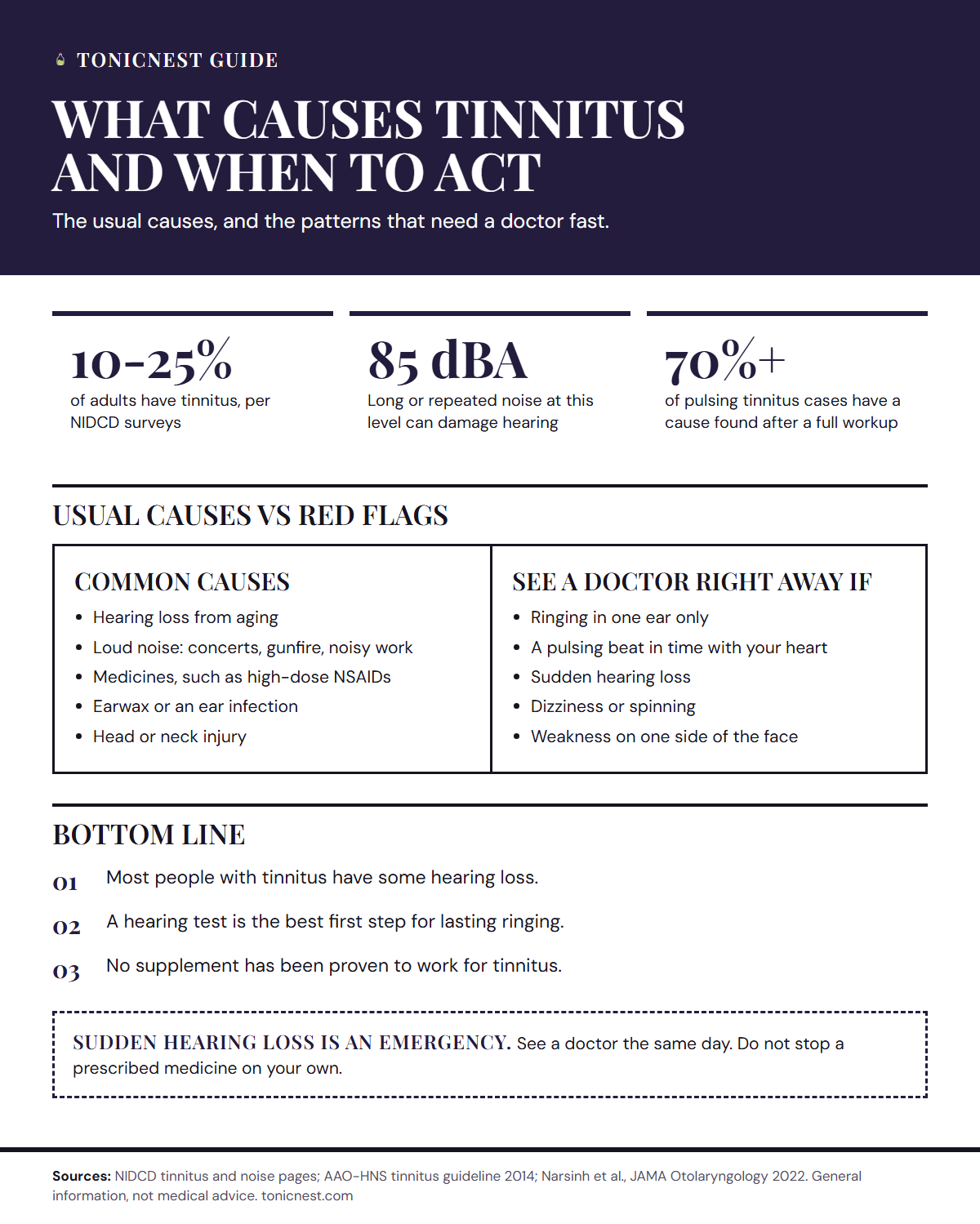
Tinnitus is a symptom, and the most common thing behind it is damage to hearing from aging, loud noise or both. NIDCD says most people with tinnitus have some hearing loss.[1] Other causes include medicines, a blocked ear canal, ear infections, injuries and a list of less common ear, blood vessel and body-wide conditions.[1][2]
Some people never find a cause. NIDCD notes that some people develop tinnitus “for no known reason.”[1] Most cases, with or without a known cause, are not linked to a serious illness.[1] The table below groups the causes our sources name, with the clue that tends to go with each one.
| Cause | How it leads to ringing | Typical clue |
|---|---|---|
| Age-related hearing loss | Slow wear in the inner ear changes the signal sent to the brain[1][6] | Both ears, older adults, trouble following speech[6] |
| Loud noise | Damage to the inner ear from sound at or above 85 dBA[5] | Ringing after a concert, gunfire or noisy work[1][5] |
| Medicines | Some drugs affect the ear, mostly at high doses[1] | Started after a new drug or a dose increase[1] |
| Earwax or ear infection | Wax or fluid blocks the ear canal or middle ear[1] | Muffled hearing, ear pain, a cold or sinus infection[1][2] |
| Head or neck injury | Damage to the ear, the hearing nerve or the brain’s sound areas[1] | Began after a fall, crash or blast[1] |
| Ménière’s disease | An inner ear disorder[7] | Spinning attacks, ear fullness, hearing that comes and goes[7] |
| Jaw joint problems | The jaw joint sits next to the ear; clenching or grinding can damage nearby tissue[1] | Jaw pain, or ringing that changes when you move your jaw[1] |
| Vestibular schwannoma | A benign, slow-growing tumor on the hearing and balance nerve[8] | One-sided ringing and hearing loss, unsteadiness[8] |
| Blood vessel problems | High blood pressure, hardened arteries or vessel malformations change blood flow near the ear[1] | A pulsing sound in time with your heartbeat[1][10] |
| Body-wide conditions | Diabetes, migraine, thyroid disorders, anemia, lupus and multiple sclerosis have been linked[1] | Other symptoms of the condition[1][2] |
What is tinnitus, and what causes it in the brain?
Tinnitus is the perception of sound that has no outside source, so other people cannot hear it.[1] It can ring, buzz, roar, whistle, hum, click, hiss or squeal, in one ear, both ears or the head.[1] It may come and go or stay all the time.[1]
The leading theory puts the noise in the brain. When the inner ear is damaged, the signal it sends changes, and the hearing part of the brain, the auditory cortex, seems to produce sound of its own.[1] NIDCD also describes links between that area and the brain circuits for attention and emotion.[1] That may help explain why tinnitus often feels louder when you are anxious or focused on it.
A smaller group has somatosensory tinnitus. Moving the head, neck or eyes, or touching parts of the body, changes the sound.[1] If yours shifts when you clench your jaw or turn your neck, tell the doctor, since that pattern helps narrow down the cause.
What causes tinnitus in one ear only?
One-sided tinnitus is more often tied to a local problem in that ear, and it is the pattern doctors take most seriously. Earwax, an ear infection and Ménière’s disease often affect one side.[1][7] So do sudden hearing loss and a vestibular schwannoma, which is why ringing in one ear only deserves a hearing test.[8][9]
The AAO-HNS guideline tells clinicians to get a prompt hearing exam for tinnitus that is in one ear, has lasted 6 months or more, or comes with hearing trouble.[3] NIDCD’s page on vestibular schwannoma puts it plainly: one-sided or uneven symptoms “are the worrisome ones.”[8]
One-sided ringing is still far more often wax or infection than a tumor. It should be checked by a doctor rather than waited out, especially if hearing on that side has dropped.
What causes tinnitus in both ears?
Ringing in both ears most often points to hearing loss on both sides, from aging or years of noise. NIDCD says age-related hearing loss “typically occurs in both ears,” and about one in three US adults aged 65 to 74 has hearing loss.[6] Nearly half of those over 75 have trouble hearing.[6]
Noise can hit both ears too. Long or repeated exposure at or above 85 dBA can cause hearing loss, and music through headphones at full volume, concerts and sporting events run about 94 to 110 dBA.[5] In the 2016 US survey, people with steady loud noise at work had about 3.3 times the odds of tinnitus, and leisure noise carried about 2.6 times the odds.[4]
Medicines and body-wide conditions such as thyroid disease also tend to affect both ears, since they act on the whole body.[1][2]
What causes pulsatile tinnitus?
Pulsatile tinnitus is a rhythmic sound that beats in time with your heart, and it usually has a cause doctors can find. A 2022 review in JAMA Otolaryngology found that a careful workup identifies a cause in more than 70% of patients.[10] NIDCD says doctors may order imaging, especially when the sound pulses.[1]
The review sorts the causes into three groups.[10]
- Structural: tumors and problems in the bone around the ear.[10]
- Metabolic: medicines that harm the ear and conditions that raise how much blood the heart pumps.[10]
- Vascular: raised pressure around the brain (idiopathic intracranial hypertension) and abnormal links between arteries and veins (dural arteriovenous fistulas).[10]
The same review notes that pulsing tinnitus can be an early warning of stroke, which is why it belongs on the “see a doctor” list.[10] NIDCD also lists high blood pressure and atherosclerosis among blood vessel causes.[1] If your doctor has flagged your cholesterol, our guide on how to lower LDL cholesterol covers the first steps for artery health.
What causes tinnitus besides loud noises?
Besides noise, the most common causes are hearing loss from aging, certain medicines, blocked ears and head or neck injuries.[1] NIDCD names non-steroidal anti-inflammatory drugs such as ibuprofen, naproxen and aspirin, plus certain antibiotics, cancer drugs, malaria drugs and antidepressants, especially at high doses.[1]
Do not stop a prescribed medicine on your own. Bring your full list, including over-the-counter pain relievers and supplements, to the doctor or pharmacist and ask whether any of them is linked to ringing.
Other causes are easy to miss:
- Jaw joint problems. Clenching or grinding can cause or worsen tinnitus.[1]
- Thyroid problems and anemia. Both are on the NIDCD and MedlinePlus lists.[1][2] They can also leave you worn out, which is why our guide to why you might be so tired covers thyroid and iron tests.
- Hormonal changes in women. MedlinePlus lists these as a cause.[2]
- Diabetes, migraine and autoimmune disease. These have been linked to tinnitus.[1]
- Ear and sinus infections. Fluid can block sound and set off ringing.[1][2]
What causes tinnitus to get louder or flare up?
Tinnitus often gets louder after more noise, with new hearing loss, with a cold or blocked ear, or during stretches of anxiety and poor sleep. NIDCD says tinnitus may come and go and can worsen over time in some people.[1] Counselors teach people to limit loud noise so symptoms do not get worse.[1]
Stress comes up often in reader questions. The research shows a strong link, though not a proven cause. In the 2007 national survey, 26.1% of adults with tinnitus reported anxiety, against 9.2% of those without it, and 25.6% reported depression, against 9.1%.[11] People with tinnitus also slept less, 7.00 hours a night against 7.21.[11] That study was a snapshot, so it cannot show which came first.
Brain research gives a likely reason the two travel together: the hearing cortex talks to the brain’s attention and emotion circuits.[1] A sudden jump in loudness with hearing loss in one ear calls for a quick check.[9]
What causes tinnitus and vertigo together?
Ringing plus spinning dizziness points to the inner ear, and Ménière’s disease is the classic cause. NIDCD describes Ménière’s as an inner ear disorder that causes severe vertigo, tinnitus, hearing loss and a feeling of fullness in the ear.[7] It usually affects one ear, though both ears are involved in 15% to 25% of people.[7]
A diagnosis needs two or more vertigo episodes lasting 20 minutes to 12 hours, along with hearing loss and ringing or fullness in the ear.[7] It is most likely to start between ages 40 and 60, and about 615,000 people in the US have it.[7]
Ringing with unsteadiness can also come from a vestibular schwannoma or sudden hearing loss.[8][9] Because the causes range from harmless to urgent, new dizziness with ringing should be seen by a doctor.
Why is tinnitus so common in the military?
Tinnitus is the most common service-related disability among veterans, mainly because of noise from gunfire, machinery and blasts.[1] Loud impulse noise, such as a blast or gunshot, can damage the inner ear, and repeated exposure adds up.[1][5]
Blasts can also injure the head and neck, another cause on the NIDCD list.[1] NIDCD’s noise page notes that temporary hearing loss after loud sound often clears in 16 to 48 hours, yet the ringing can continue.[5] Hearing protection is the main defense. Earplugs or earmuffs during any loud activity are the simplest step.[5]
What does the research say about tinnitus causes?
Most of what we know about causes comes from large surveys and clinical reviews, which show links rather than proof of cause. The strongest pattern across sources is the tie to hearing loss and noise.[1][4] The studies below are the ones we leaned on for numbers in this guide.
| Study | Who and how many | Design | Main finding |
|---|---|---|---|
| Bhatt et al., 2016[4] | 75,764 respondents, US national survey | Cross-sectional | 9.6% had tinnitus in a year; noise at work raised the odds about 3.3 times |
| Bhatt et al., 2017[11] | About 21.4 million US adults with tinnitus (weighted) | Cross-sectional | Anxiety 26.1% vs 9.2%; depression 25.6% vs 9.1% |
| Narsinh et al., 2022[10] | Published work on pulsing tinnitus | Narrative review | A cause is found in more than 70% after a full workup |
| Fuller et al., 2020[12] | 28 studies, 2,733 people | Cochrane review | Talk therapy (CBT) lowers tinnitus impact; side effects rare |
The same survey found that 27% of people with tinnitus had it for more than 15 years and 36% heard it nearly all the time.[4] Only 49.4% had talked to a doctor about it.[4]
Which cause fits your pattern?
The pattern of your tinnitus is the best first clue to its cause, and it tells you how soon to see someone. Use this table to sort what you notice, then bring your notes to the appointment so you can describe the pattern clearly.
| If you notice | Likely causes | What to do |
|---|---|---|
| Ringing after a concert or loud event | Noise exposure[5] | Rest your ears; see a doctor if it does not settle within 2 days[5] |
| Slow onset in both ears, missing words in talk | Age-related hearing loss[6] | Book a hearing test[3] |
| Muffled ear with a cold or ear pain | Fluid or earwax[1] | See your primary care doctor[1] |
| Started after a new medicine | Drug side effect[1] | Ask the prescriber; do not stop on your own |
| Changes when you move your jaw or neck | Jaw joint or somatosensory tinnitus[1] | Mention it at your visit[1] |
| Pulsing in time with your heartbeat | Blood vessel or structural cause[10] | See a doctor soon; imaging may be needed[1] |
| One ear with sudden hearing loss | Sudden hearing loss[9] | Treat it as an emergency[9] |
When should you see a doctor for tinnitus?
See a doctor for any tinnitus that lasts, and go the same day for sudden hearing loss or ringing with nerve symptoms. NIDCD says sudden hearing loss should be treated as a medical emergency.[9] About half of people recover some or all hearing within 1 to 2 weeks, but delay can make treatment work less well.[9]
See a doctor right away if you have:
- Ringing in one ear only, especially with hearing loss on that side.[3][8]
- A pulsing sound that keeps time with your heartbeat.[1][10]
- Sudden hearing loss, with or without ringing or ear fullness.[9]
- Dizziness, spinning or loss of balance along with the ringing.[7][8]
- Weakness or numbness on one side of the face.[8]
Also book a visit if the ringing follows a head injury, if it started with a new medicine, or if it is affecting your sleep or mood.[1] If you are pregnant or take several medicines, mention that as well, since some drugs are linked to tinnitus.[1]
How do doctors find the cause and treat it?
Doctors start with an ear exam, your history and a hearing test, then treat any cause they find. NIDCD says the primary care doctor checks for earwax or infection fluid and reviews medicines, then may refer you to an ear, nose and throat doctor and an audiologist.[1]
The AAO-HNS guideline advises against routine head scans for tinnitus that is in both ears, does not pulse and comes with no nerve signs or uneven hearing loss.[3] Scans are kept for the red-flag patterns.[1][3]
When a cause such as earwax or a jaw problem is found, treating it can remove or greatly reduce the ringing.[1] For lasting, bothersome tinnitus, the guideline recommends a hearing aid evaluation when hearing loss is documented, and cognitive behavioral therapy.[3] A Cochrane review of 28 studies with 2,733 people found CBT lowered tinnitus impact by about 11 points on a standard questionnaire compared with a wait list.[12]
There are no FDA-approved drugs for tinnitus.[1] The guideline recommends against ginkgo, melatonin, zinc or other supplements for it, and NIDCD says none has been proven to work.[1][3] Our tinnitus guides cover sound therapy and coping tools in more detail.
A practical checklist before your appointment
- Write down when the ringing started and whether it is in one ear or both.[3]
- Note whether it pulses with your heartbeat.[1]
- List every medicine, pain reliever and supplement you take, with doses.[1]
- Note any recent loud noise, ear infection, cold or head injury.[1]
- Check for dizziness, ear fullness, jaw pain or face changes.[7][8]
- Ask for a hearing test if the ringing has lasted or is one-sided.[3]
- Wear earplugs around loud noise from now on.[5]
We explain how we pick and check sources on our how we review page.
Bottom line
Most tinnitus traces back to hearing loss from age or noise, and a smaller share comes from medicines, blocked ears, injuries or other ear and blood vessel problems.[1] For many people, the cause is never pinned down.[1]
Our judgement: for most people, a hearing test is a better first step than any product, because hearing loss is the most likely cause and a hearing aid can make the ringing less noticeable.[1][3] If your symptoms are one-sided, pulsing or sudden, skip the wait and see a doctor promptly.
Frequently asked questions
Can tinnitus be cured?
There is no cure for most tinnitus, but symptoms can be reduced. When a clear cause such as earwax or a jaw problem is treated, the ringing can disappear or greatly improve. Hearing aids, sound therapy and CBT help many others.
Can you prevent tinnitus?
You cannot prevent every case, but you can cut the biggest risk you control: loud noise. Sound at or above 85 dBA can damage hearing, so wear earplugs at concerts, shooting ranges and noisy work, and keep headphone volume down.
Why does my tinnitus stop and start?
Tinnitus often comes and goes. It may seem louder in quiet rooms, after noise, with a cold or during stressful weeks. Some people can change it by moving the jaw, neck or eyes, which doctors call somatosensory tinnitus.
Can stress cause tinnitus?
Stress has not been proven to cause tinnitus, but the two are closely linked. In a US survey, 26.1% of adults with tinnitus reported anxiety, against 9.2% without it. Stress can make existing ringing harder to ignore.
Why have I suddenly started getting tinnitus?
New ringing often follows loud noise, a cold or ear infection, earwax, or a new medicine. If it came with sudden hearing loss, dizziness, a pulsing beat or face weakness, treat it as urgent and see a doctor the same day.
Sources
- Tinnitus. NIDCD, NIH, 2023
- Tinnitus. MedlinePlus, National Library of Medicine
- Clinical practice guideline: tinnitus. AAO-HNS Foundation, Otolaryngology-Head and Neck Surgery, 2014
- Prevalence, severity, exposures, and treatment patterns of tinnitus in the United States. Bhatt et al., JAMA Otolaryngology-Head and Neck Surgery, 2016
- Noise-induced hearing loss. NIDCD, NIH
- Age-related hearing loss (presbycusis). NIDCD, NIH
- Ménière's disease. NIDCD, NIH
- Vestibular schwannoma (acoustic neuroma) and neurofibromatosis. NIDCD, NIH
- Sudden sensorineural hearing loss. NIDCD, NIH
- Diagnostic approach to pulsatile tinnitus: a narrative review. Narsinh et al., JAMA Otolaryngology-Head and Neck Surgery, 2022
- Relationships between tinnitus and the prevalence of anxiety and depression. Bhatt et al., Laryngoscope, 2017
- Cognitive behavioural therapy for tinnitus. Fuller et al., Cochrane Database of Systematic Reviews, 2020
This article is general information, not medical advice. Dietary supplements are not reviewed by the FDA for safety or effectiveness before they are sold. Talk to your doctor before you start any supplement, especially if you are pregnant, nursing, take medication or have a health condition.