To lower LDL, cut saturated fat and eat more soluble fiber, nuts, soy foods and plant sterols, ideally together. Across 7 trials this portfolio approach lowered LDL by about 17%. Losing 3% to 5% of body weight, staying active and sleeping 7 to 9 hours help further. Supplements add little, and adults with LDL of 160 mg/dL or higher should ask about a statin.
On this page
- How to lower LDL cholesterol: 7 steps in order
- What is LDL, and what level is too high?
- How do you lower LDL cholesterol naturally with food?
- Which foods raise LDL the most?
- What does a low cholesterol diet look like in practice?
- How do you lower cholesterol without medication beyond diet?
- Do supplements lower LDL?
- When do you need medicine to lower LDL?
- Who should be careful, and what are the side effects?
- What do doctors use first?
- Practical checklist for lowering LDL
- Bottom line
- FAQ
How to lower LDL is a question with a well-tested answer, and most of it happens in the kitchen. We read the MedlinePlus and NHLBI pages on cholesterol, the NCCIH summary of natural products, a Cochrane review of saturated fat, three diet meta-analyses and two head-to-head trials that set food and supplements against statins.
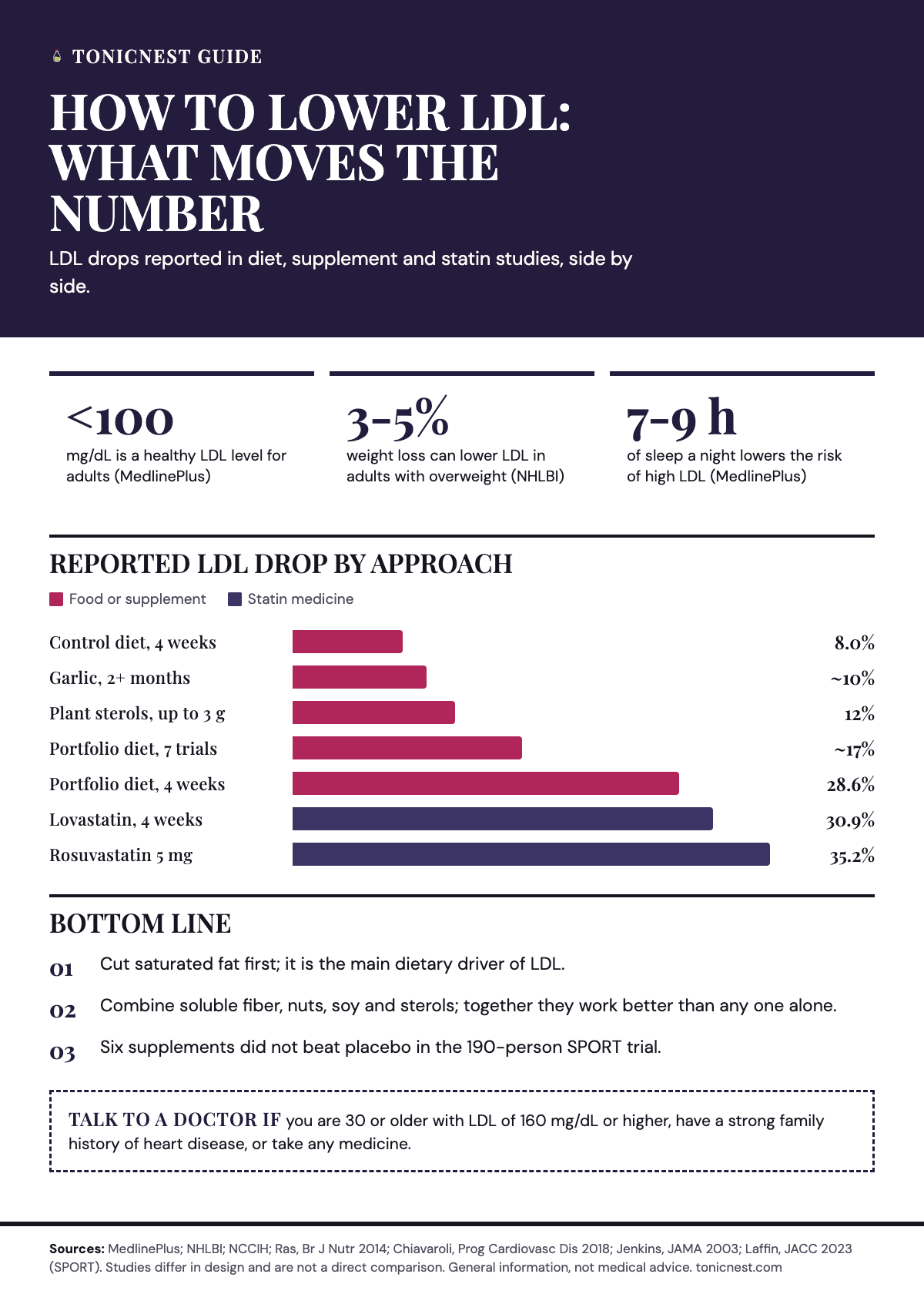
The short answer: cut saturated fat, add soluble fiber, nuts and plant sterols, and lose 3% to 5% of your weight if you carry extra; a combined “portfolio” diet lowered LDL by about 17% across 7 trials.[4][10]
| What LDL is | The “bad” cholesterol; a high level leads to cholesterol buildup in the arteries[3] |
|---|---|
| Healthy adult level | Less than 100 mg/dL[2] |
| First-line approach | Lifestyle changes, with medicine added when they are not enough[1] |
| Best diet evidence | Portfolio diet: about 17% lower LDL in 7 trial comparisons with 439 people[10] |
| Weight | Losing 3% to 5% of body weight can lower LDL in adults with overweight[4] |
| Supplements | Plant sterols have the clearest effect; none of six supplements beat placebo in a 190-person trial[5][12] |
| Who needs a doctor | Adults 30 or older with LDL of 160 mg/dL or higher may need a statin[2] |
How to lower LDL cholesterol: 7 steps in order
LDL falls fastest when you stack several food changes at once, because each one adds a modest drop. Start with saturated fat, then add the foods that pull LDL down, then fix weight, activity and sleep.[1][10] The order below follows the size of the evidence, largest first.
- Swap saturated fat for unsaturated fat. MedlinePlus calls saturated fat “the main problem” for blood cholesterol. Fatty red meat, full-fat dairy and butter are the big sources.[2]
- Eat soluble fiber every day. Oats, barley, beans and psyllium all count; 2 to 10 grams a day lowered LDL in 67 trials.[6]
- Have a small handful of nuts. One ounce a day lowered LDL by 4.8 mg/dL across 61 trials.[7]
- Add plant sterols or stanols with meals, from enriched foods or supplements, up to about 3 grams a day.[8][1]
- Lose 3% to 5% of your weight if you are carrying extra. For a 200-pound person, 10 pounds is the MedlinePlus target.[4][2]
- Move most days, and ask your provider which level of activity suits you before starting.[1]
- Sleep 7 to 9 hours, manage chronic stress and quit smoking.[1][4]
Follow the plan for a few months, then retest. If your number is still high, talk to your doctor about medicine, covered below.
What is LDL, and what level is too high?
LDL (low-density lipoprotein) carries cholesterol through the blood, and too much of it builds plaque in artery walls. MedlinePlus lists a healthy LDL level for adults as less than 100 mg/dL.[3][2] Higher numbers raise the risk of coronary artery disease.
HDL, the “good” cholesterol, does the opposite job. It carries cholesterol back to the liver, which clears it from the body.[3]
Several things push LDL up. Saturated fat and dietary cholesterol raise it, extra weight raises it, and a lack of activity can lead to weight gain that raises it further. Smoking lowers HDL, which leaves more LDL in circulation.[3]
Some causes are out of your hands. Genes partly set your level, and after menopause women’s LDL tends to rise.[3] A person with a strong family history of high cholesterol may need medicine even with a good diet.[2]
How do you lower LDL cholesterol naturally with food?
The foods with the best LDL evidence are soluble fiber, tree nuts, plant sterols and soy foods, eaten together. Each one alone gives a small drop. The Portfolio diet combines them and lowered LDL by about 17% across 7 trial comparisons, with high certainty of evidence.[10]
Soluble fiber binds cholesterol in the gut. In a meta-analysis of 67 controlled trials, each extra gram of soluble fiber lowered LDL by about 0.057 mmol/L. Three servings of oatmeal give about 3 grams of soluble fiber and lowered LDL by about 0.13 mmol/L, close to 5 mg/dL.[6]
Tree nuts help a little more per serving. Across 61 trials and 2,582 people, each daily ounce of walnuts, almonds, pistachios or similar nuts lowered LDL by 4.8 mg/dL.[7]
Plant sterols and stanols block some cholesterol absorption. A review of 124 studies found the effect kept growing up to about 3 grams a day, reaching an average 12% drop; its authors worked for a sterol maker, so treat the size of the effect with some caution.[8]
Soy foods such as tofu and edamame have a small effect, and they beat soy protein powders or isoflavone pills.[5]
Which foods raise LDL the most?
Saturated fat is the main dietary driver of high LDL, and dietary cholesterol adds to it. Foods high in saturated fat include fatty red meat, full-fat dairy, butter and many baked goods. MedlinePlus says reducing saturated fat helps lower blood cholesterol.[2]
Cutting saturated fat also lowers heart events. A Cochrane review of 15 randomized trials with about 59,000 people found that eating less saturated fat for at least two years lowered combined cardiovascular events by 21%. The evidence was rated moderate quality.[9]
A heart-healthy plan also limits trans fats, which MedlinePlus groups with saturated fat as the fats to cut.[1][9]
At the store, check the Nutrition Facts panel for saturated fat per serving, and pick the lower option when two foods are otherwise alike.
What does a low cholesterol diet look like in practice?
A low cholesterol diet is low in saturated and trans fat, built on vegetables, fruit, whole grains, beans and lean protein, and sized to keep a healthy weight. NHLBI points to the Therapeutic Lifestyle Changes (TLC) programme and the DASH plan as models.[4][1]
The trials below show what diet can do next to a statin. They differ in size and length, so compare them with care.
| Study | Who and how long | What was tested | LDL result |
|---|---|---|---|
| Jenkins, JAMA 2003 | 46 adults, 4 weeks | Portfolio diet vs lovastatin vs control diet | Down 28.6% portfolio, 30.9% lovastatin, 8.0% control[11] |
| Chiavaroli, 2018 meta-analysis | 7 trial comparisons, 439 people | Portfolio added to a cholesterol-lowering diet | About 17% lower, high certainty[10] |
| Del Gobbo, 2015 meta-analysis | 61 trials, 2,582 people, 3 to 26 weeks | Tree nuts | 4.8 mg/dL lower per daily ounce[7] |
| Brown, 1999 meta-analysis | 67 controlled trials | Soluble fiber, 2 to 10 grams a day | About 0.057 mmol/L lower per gram[6] |
| SPORT, JACC 2023 | 190 adults, 28 days | Rosuvastatin 5 mg vs six supplements vs placebo | Statin 35.2% lower than placebo; no supplement beat placebo[12] |
A sample day on these lines: oatmeal with walnuts for breakfast, a bean and barley soup at lunch, tofu stir-fried in canola oil with vegetables at dinner, and a sterol-enriched spread on whole-grain toast.
How do you lower cholesterol without medication beyond diet?
Weight loss, regular activity, good sleep and quitting smoking all move cholesterol in the right direction, on top of diet. NHLBI says adults with overweight can lower LDL by losing only 3% to 5% of their weight.[4]
MedlinePlus sets a firmer goal for people with high cholesterol who are overweight: lose at least 5% of body weight, or 10 pounds for a 200-pound person.[2]
Physical activity can lower LDL and triglycerides and raise HDL. Ask your provider which level is right for you before you start a new programme.[1]
Sleep and stress matter too. Getting 7 to 9 hours a night lowers the risk of high LDL, and chronic stress can raise it.[1]
Quitting smoking raises HDL, which helps clear LDL from the arteries. NHLBI also advises limiting alcohol.[1][4]
Do supplements lower LDL?
A few supplements lower LDL slightly, and none match a statin. Plant sterols taken with meals have the clearest support. Garlic lowered total and LDL cholesterol by about 10% when taken for more than two months, and green tea by about 2% to 5%.[1][5]
The 2023 SPORT trial put six popular supplements to a direct test. Fish oil, cinnamon, garlic, turmeric, plant sterols and red yeast rice did not lower LDL more than placebo over 28 days, while rosuvastatin 5 mg did, by 35.2%. A drug maker funded the trial.[12]
Flaxseed oil does not lower cholesterol, although whole flaxseed may help.[1]
Red yeast rice needs a warning of its own. Its active compound, monacolin K, is chemically identical to the drug lovastatin, so it carries the same side effects and drug interactions. Some products are contaminated with citrinin, which may damage the kidneys.[5]
Two supplements often sold for heart health come up in our other guides. Our berberine benefits and side effects guide covers its cholesterol trials, and CoQ10 benefits and dosage for statin users looks at muscle pain claims.
When do you need medicine to lower LDL?
Medicine is added when lifestyle changes alone do not bring LDL down far enough, or when your heart risk is high. MedlinePlus says you may need a statin if you are 30 or older with LDL of 160 mg/dL or higher, or if you have a strong family history of heart disease.[2][1]
Statins are the most common choice. They reduce the cholesterol the liver makes and lower the risk of heart attack and stroke in people with high LDL.[4]
Other options exist. Ezetimibe blocks cholesterol absorption, bile acid sequestrants keep bile acids from being absorbed, and PCSK9 inhibitors are injections that help the liver clear LDL.[4]
People who take a statin still need the lifestyle changes, according to MedlinePlus.[1]
Who should be careful, and what are the side effects?
Diet changes are safe for most people, but supplements and some medicines carry real risks. Plant sterols can cause diarrhea or fat in the stool. People with the rare condition sitosterolemia should avoid them.[5]
- Garlic supplements can cause breath and body odor, heartburn and upset stomach.[5]
- Red yeast rice with monacolin K acts like lovastatin. Do not combine it with a statin, and skip it if you are pregnant or breastfeeding.[5]
- Bile acid sequestrants can make other medicines less effective and may raise triglycerides.[4]
- Any supplement can interact with medicines. Check with your provider first.[1]
See a doctor soon if your LDL is 160 mg/dL or higher, if close relatives had early heart disease, or if you have diabetes or heart disease, since those groups need closer follow-up.[2][3]
What do doctors use first?
Doctors start with heart-healthy lifestyle changes and add medicine, most often a statin, when risk or LDL stays high. MedlinePlus names lifestyle changes and medicines as the two main treatments for high cholesterol.[1] NHLBI offers the TLC guide with sample menus to help.[4]
Testing is part of the plan. Younger adults should be tested every 5 years. Men ages 45 to 65 and women ages 55 to 65 should be tested every 1 to 2 years, and people over 65 every year.[3]
No supplement is a replacement for a prescribed statin. If you take one, keep taking it unless your doctor changes the plan. You can read how we weigh studies on our how we review page, and more heart guides sit in our cholesterol and heart section.
Practical checklist for lowering LDL
- Know your number: ask for a lipid panel and write down your LDL.[3]
- Check the saturated fat line on food labels and choose the lower option.[2]
- Eat oats, barley or beans daily for soluble fiber.[6]
- Keep an ounce of unsalted nuts on hand.[7]
- If you use a sterol product, take it with meals and stay near 2 to 3 grams a day.[8]
- Aim for 7 to 9 hours of sleep.[1]
- Read supplement labels against our review standards before buying, and tell your provider what you take.
- Retest after a few months and bring the result to your doctor.
Bottom line
The plan that lowers LDL most without a prescription is a combined diet: less saturated fat plus fiber, nuts, soy and sterols. In one 4-week trial it came close to a starter statin, though real-world results are usually smaller.[11][10]
For most people, food changes and a few pounds of weight loss are the better first step than a supplement, because the supplement trials show small or no effects. If your LDL is 160 mg/dL or higher, or your family history is strong, talk to your doctor about medicine now rather than waiting.[12][2]
Frequently asked questions
How long does it take to lower LDL with diet?
Trials show changes within weeks. In a 2003 JAMA trial of 46 adults, a portfolio diet lowered LDL by 28.6% in 4 weeks. Most people retest after a few months of steady changes, since results vary with genes and starting level.
How do women lower cholesterol naturally after menopause?
The same steps apply: less saturated fat, more soluble fiber, nuts and sterols, and weight control. LDL tends to rise after menopause, so women ages 55 to 65 should have their cholesterol checked every 1 to 2 years.
How often should I check my LDL cholesterol?
Adults 20 and older should be tested every 5 years. Men ages 45 to 65 and women ages 55 to 65 should be tested every 1 to 2 years, and adults over 65 every year, more often with heart disease or diabetes.
Does flaxseed oil lower cholesterol?
No. MedlinePlus says flaxseed oil does not lower cholesterol. Whole flaxseed and flaxseed lignans may help a little. Both flaxseed and its oil can cause diarrhea, so start with a small amount if you try ground flaxseed.
Is red yeast rice a safe way to lower LDL?
It carries real risks. Its monacolin K is chemically identical to lovastatin, so it has the same side effects and drug interactions, and some products contain citrinin, which may harm the kidneys. In the SPORT trial it did not beat placebo.
Sources
- How to Lower Cholesterol. MedlinePlus, National Library of Medicine
- Cholesterol Levels: What You Need to Know. MedlinePlus, National Library of Medicine
- LDL: The Bad Cholesterol. MedlinePlus, National Library of Medicine
- Blood Cholesterol: Treatment. National Heart, Lung, and Blood Institute
- High Cholesterol and Natural Products: What the Science Says. National Center for Complementary and Integrative Health
- Cholesterol-lowering effects of dietary fiber: a meta-analysis. Brown et al., American Journal of Clinical Nutrition, 1999
- Effects of tree nuts on blood lipids, apolipoproteins, and blood pressure. Del Gobbo et al., American Journal of Clinical Nutrition, 2015
- LDL-cholesterol-lowering effect of plant sterols and stanols across different dose ranges. Ras et al., British Journal of Nutrition, 2014
- Reduction in saturated fat intake for cardiovascular disease. Hooper et al., Cochrane Database of Systematic Reviews, 2020
- Portfolio Dietary Pattern and Cardiovascular Disease: a systematic review and meta-analysis. Chiavaroli et al., Progress in Cardiovascular Diseases, 2018
- Effects of a dietary portfolio of cholesterol-lowering foods vs lovastatin. Jenkins et al., JAMA, 2003
- Rosuvastatin versus placebo or dietary supplements on LDL cholesterol (SPORT). Laffin et al., Journal of the American College of Cardiology, 2023
This article is general information, not medical advice. Dietary supplements are not reviewed by the FDA for safety or effectiveness before they are sold. Talk to your doctor before you start any supplement, especially if you are pregnant, nursing, take medication or have a health condition.