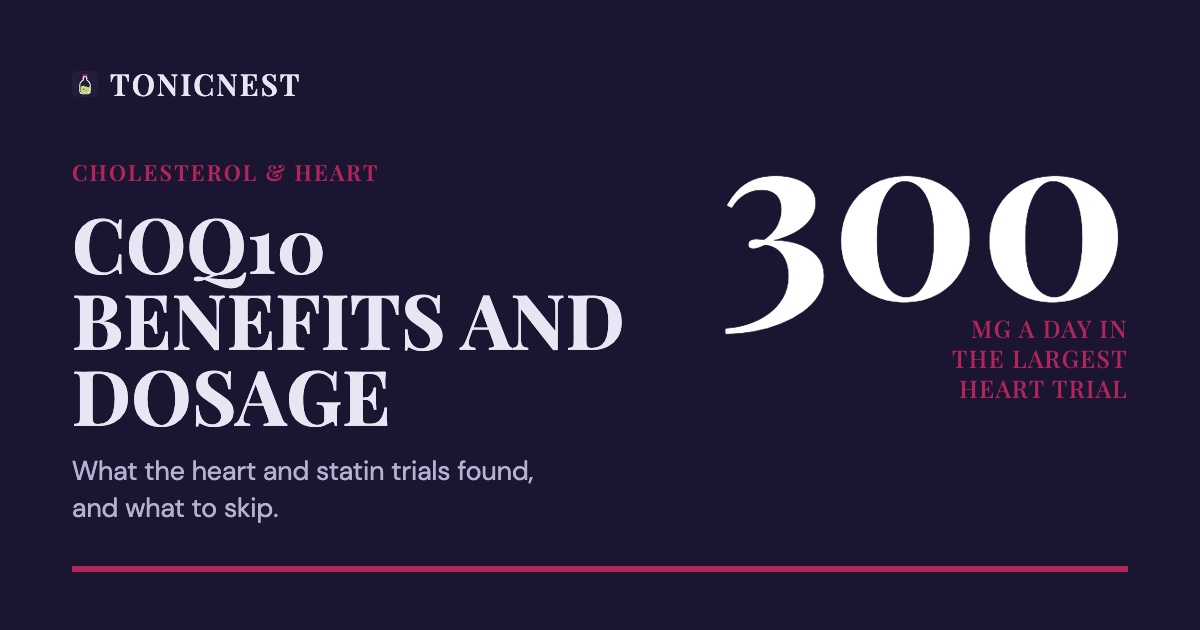
CoQ10 is a compound your body makes for energy. Its best evidence is one 420-person heart failure trial, where 300 mg a day added to usual care cut major heart events from 26% to 15%. Research on statin muscle pain and blood pressure is weak or mixed. It is well tolerated, but it may interact with warfarin and insulin.
On this page
- What is CoQ10 and what does it do for your body?
- What are the main CoQ10 benefits backed by research?
- Does CoQ10 help with statin muscle pain?
- How much CoQ10 is recommended daily?
- Is ubiquinol worth the higher price than ubiquinone?
- What are CoQ10 side effects and warnings?
- What do doctors use first?
- What should you check before buying CoQ10?
- Bottom line
- FAQ
CoQ10 benefits are easier to judge once you set the trials beside the label claims. We read the NCCIH and National Cancer Institute pages on coenzyme Q10, the MedlinePlus pages on warfarin and statins, two meta-analyses on statin muscle pain, a Cochrane review on blood pressure and the largest heart failure trial, then checked what premium bottles charge extra for against that record.
CoQ10 is well tolerated by most adults, and its best support comes from one 420-person heart failure trial where 300 mg a day, added to usual care, lowered major heart events from 26% to 15%.[5][1] Evidence for statin muscle pain and blood pressure is weak.[1][8]
| What it is | A compound the body makes, with the highest levels in the heart, liver, kidneys and pancreas[1][2] |
|---|---|
| Studied for | Heart failure, statin muscle pain, blood pressure, migraine and Parkinson’s disease[1][9] |
| Amounts used in trials | 100 mg three times a day (300 mg) in the heart failure and migraine trials[5][9] |
| What food supplies | About 3 to 6 mg a day, mostly from meat, fish, nuts and some oils[12] |
| Best evidence | One heart failure trial of 420 people; NCCIH still calls heart failure research inconclusive[5][1] |
| Safety | No serious side effects reported; trouble sleeping or an upset stomach can occur[1] |
| Ask a doctor first | People taking warfarin or insulin, or getting cancer treatment[1][3] |
What is CoQ10 and what does it do for your body?
CoQ10 (coenzyme Q10) is a compound your body makes, which your cells use to produce energy and as an antioxidant. Labels may also call it ubiquinone or ubidecarenone. It sits in most tissues, with the most in the heart, liver, kidneys and pancreas and the least in the lungs.[2]
A coenzyme helps an enzyme do its job. CoQ10 works inside the part of the cell that makes energy, so the organs that burn the most energy hold the most of it.[2] Your levels drop as you age.[2] People with some diseases also have lower levels, which is the main reason researchers began testing supplements.[1]
Food gives you only a little. The average diet supplies about 3 to 6 mg a day, and about half of that already comes as ubiquinol, the reduced form.[12] Meat, fish, nuts and some oils are the richest sources, while dairy, vegetables, fruit and cereals hold much less.[12] Trials used far more than any diet provides, usually 300 mg a day.[5][9]
A low level on its own does not prove that topping it up helps. Each claim below is judged on whether people who took CoQ10 did better than people who took a placebo.
What are the main CoQ10 benefits backed by research?
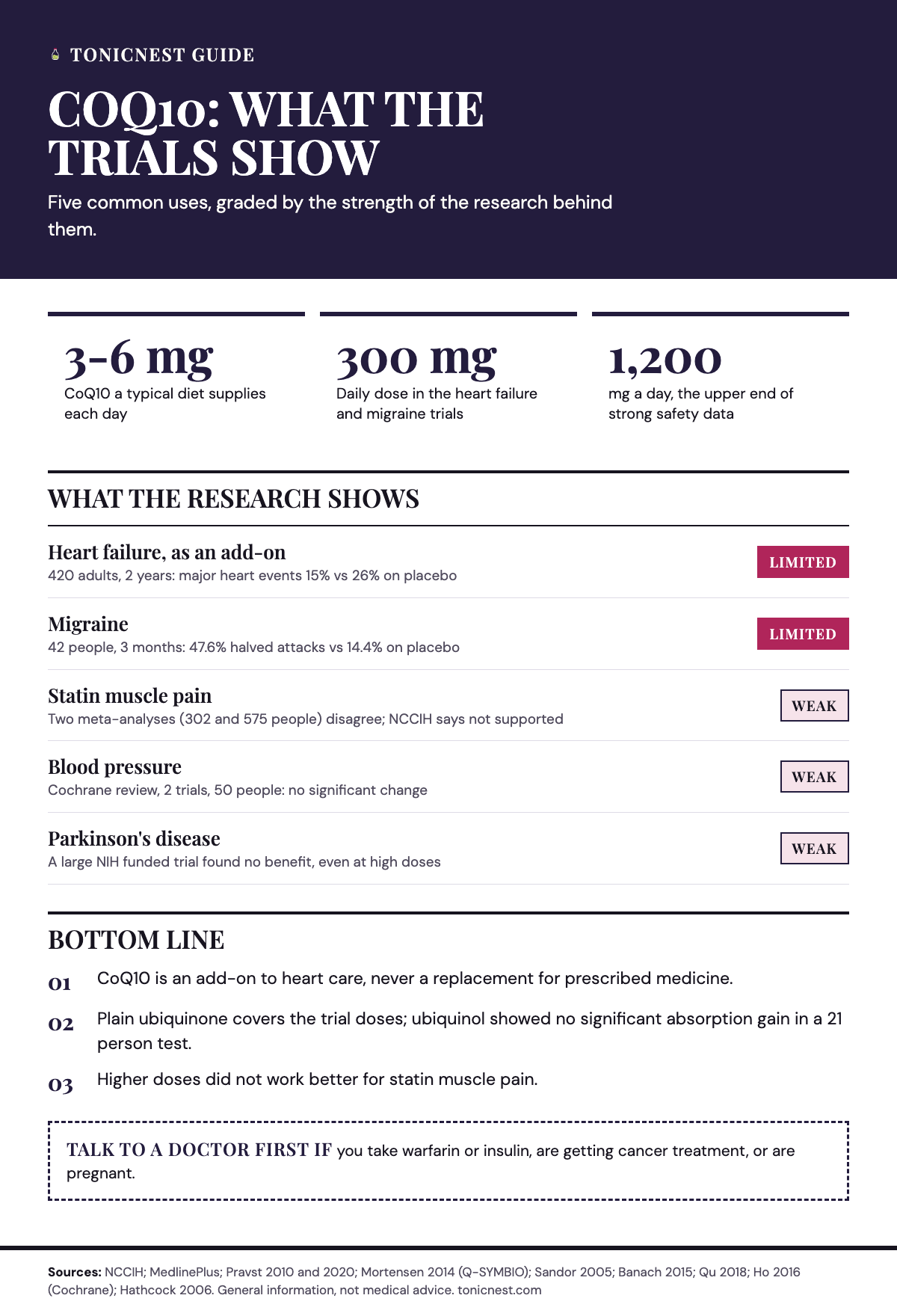
The strongest support for CoQ10 benefits comes from a single heart failure trial, and most other uses are unproven or tested negative. NCCIH’s summary: heart failure research is inconclusive, the evidence does not support CoQ10 for statin muscle pain, it probably has no meaningful effect on blood pressure, and a major NIH-funded trial found it did not help early Parkinson’s disease, even at higher-than-usual doses.[1]
NCCIH does list a few possible gains: CoQ10 may lower the risk of some complications of heart surgery and of heart damage from one type of chemotherapy drug.[1] The National Cancer Institute describes a trial of 20 children given doxorubicin in which CoQ10 reduced harm to the heart. A 236-person breast cancer trial, by contrast, found no gain in fatigue or quality of life.[2]
| Study | Who and how many | Dose and length | Result |
|---|---|---|---|
| Q-SYMBIO trial, 2014[5] | 420 adults with moderate to severe heart failure | 100 mg three times a day for 2 years, plus usual care | Major heart events 15% vs 26% on placebo; no change at 16 weeks |
| Qu et al. meta-analysis, 2018[6] | 12 trials, 575 statin users | Varied by trial | Less muscle pain, weakness, cramps and tiredness; muscle enzyme unchanged |
| Banach et al. meta-analysis, 2015[7] | 6 trials, 302 statin users | Varied by trial | No significant effect on muscle pain or muscle enzyme |
| Cochrane review, 2016[8] | 2 pooled trials, 50 people with high blood pressure | At least 3 weeks | No significant change in blood pressure |
| Sandor et al. trial, 2005[9] | 42 people with migraine | 100 mg three times a day for 3 months | 47.6% cut attacks by half or more vs 14.4% on placebo |
We grade evidence on a simple scale across TonicNest, explained on our how we review page. Heart failure and migraine reach limited evidence, meaning some trials that are small or few. Statin muscle pain, blood pressure and Parkinson’s disease rate weak, because reviews or a large trial found no clear benefit.[1][7][8]
Heart failure and blood pressure
In Q-SYMBIO, patients kept all their heart medicines and added CoQ10 or a placebo.[5] Walking distance, symptom class and a blood marker of heart strain did not change at 16 weeks. After 2 years, heart-related deaths were 9% in the CoQ10 group against 16% on placebo.[5] One trial with results this large still needs repeating, which is why NCCIH calls the field inconclusive.[1]
Blood pressure looks flatter. The 2016 Cochrane review pooled 2 trials with 50 people. Systolic pressure fell by 3.68 mm Hg on average, but the range of the estimate crossed zero, and the authors found moderate-quality evidence of no clinically significant effect.[8] For more on heart supplements, see our cholesterol and heart health guides.
Does CoQ10 help with statin muscle pain?
Trials on CoQ10 for statin muscle pain disagree, and NCCIH says the overall evidence does not support using it for that.[1] Statins are the most common medicines for high cholesterol, so this question reaches a lot of people.[4] Many start reading about CoQ10 after their muscles begin to ache on one.
The two meta-analyses point in different directions. A 2015 review in Mayo Clinic Proceedings pooled 6 trials with 302 statin users and found no significant effect on muscle pain or on creatine kinase, a blood marker of muscle damage.[7] It also found no link between the dose of CoQ10 and the result.[7]
A 2018 review in the Journal of the American Heart Association pooled 12 trials with 575 patients. It reported less muscle pain, weakness, cramping and tiredness with CoQ10, though creatine kinase did not change.[6] The trials were small, and pooling more of them changed the answer, so neither review settles it.
MedlinePlus adds useful context. Muscle damage from statins is rare. If you get muscle pain, your provider may order a blood test, and the pain may go away on a different statin.[4] Keep taking the statin until you talk to your prescriber. Trying CoQ10 alongside it is a reasonable thing to raise at that visit, as long as it does not replace the conversation about switching drugs.
How much CoQ10 is recommended daily?
The federal sources we read set no official daily intake for CoQ10, and most trials used 100 mg three times a day, or 300 mg in total.[5][9] A safety review put the observed safe level at 1,200 mg a day, the top of the range where safety data is strong.[10]
That makes the common search questions about 100 mg and 200 mg easy to place. Both sit inside the range the trials used, and both are far below the 1,200 mg safety mark.[5][9][10] No trial we read showed that more is better. The 2015 statin review looked for a dose effect and did not find one.[7]
| Situation | Amount | What it showed |
|---|---|---|
| Typical diet | About 3 to 6 mg a day[12] | Background intake; about half arrives as ubiquinol |
| Heart failure, added to usual care | 100 mg three times a day[5] | Fewer major heart events at 2 years in one trial |
| Migraine prevention trial | 100 mg three times a day[9] | More people halved their attacks by month three |
| Statin muscle pain | Varied by trial[6][7] | Mixed; no dose effect found |
| Upper end of strong safety data | 1,200 mg a day[10] | Stomach upset no more common than at 60 mg |
CoQ10 dissolves in fat, not water.[12] Many people take it with a meal for that reason, though the trials we read did not test timing. If a dose upsets your stomach, splitting it across meals matches how the trials gave it.[5][9]
Is ubiquinol worth the higher price than ubiquinone?
Ubiquinol is the reduced form of CoQ10, and in the head-to-head test we read it did not absorb significantly better than standard ubiquinone.[11] Premium bottles often charge more for ubiquinol, so the absorption data matters for your wallet.
The 2020 study gave 21 healthy adults aged 65 to 74 a single dose equal to 100 mg of CoQ10 in three forms, a week apart.[11] Ubiquinol capsules raised blood levels 1.7-fold compared with plain ubiquinone capsules, but the result was not statistically significant. A water-soluble syrup form raised them 2.4-fold, which was significant.[11]
The same study found that CoQ10 showed up in the blood mostly as ubiquinol, even when people swallowed ubiquinone.[11] The body converts it. Diet already supplies about half its CoQ10 as ubiquinol too.[12]
This was one single-dose study in 21 people, and a blood level is not the same as a health result. Even so, it gives no reason to pay double for ubiquinol on absorption alone. If you pay a premium, the solubilized formula mattered more in this test than the ubiquinol label.
What are CoQ10 side effects and warnings?
No serious side effects of CoQ10 have been reported, and the usual complaints are trouble sleeping and an upset stomach.[1] The National Cancer Institute lists others seen in studies: raised liver enzymes, nausea, heartburn, headache, upper belly pain, dizziness, rashes, tiredness, irritability and sensitivity to light.[2]
A safety review found stomach complaints were no more common at 1,200 mg a day than at 60 mg, which suggests many of them are not caused by the CoQ10 itself.[10] The reviewers come from a supplement trade group, so weigh that finding with care.
Warfarin and other medicines
CoQ10 may interact with warfarin, a blood thinner, and with insulin.[1] MedlinePlus lists coenzyme Q10 among the nonprescription products that may interact with warfarin and says your doctor may change your dose or watch you more closely.[3] The National Cancer Institute says CoQ10 may change how the body uses warfarin, and that drugs for cholesterol, blood pressure or blood sugar may lower CoQ10’s effects.[2] NCCIH adds that it may not suit some cancer treatments.[1]
Ask your doctor before taking CoQ10 if you:
- take warfarin or another blood thinner[1][3]
- use insulin[1]
- are getting chemotherapy or radiation[1]
- are pregnant or breastfeeding, since we found no federal guidance on a safe amount
If you take warfarin, call your doctor right away for bleeding that will not stop, easy bruising, or red or tarry black stools.[3]
What do doctors use first?
Doctors treat heart failure, high cholesterol and high blood pressure with prescription medicines and lifestyle changes, and CoQ10 is at most an add-on. Statins are the most common medicines for high cholesterol, prescribed when lifestyle changes do not lower it enough.[4] In the heart failure trial, everyone stayed on standard therapy, with CoQ10 added on top.[5]
The FDA has not approved CoQ10 as a cancer treatment.[2] If a statin causes aches, the first step MedlinePlus describes is a blood test and possibly a different statin.[4] A supplement should never replace those steps or a prescribed drug.
What should you check before buying CoQ10?
Check the dose per capsule, the form, and whether an independent lab has tested the product, because batches and brands can differ. The National Cancer Institute notes the FDA does not regularly review how supplements are made, so all batches and brands of CoQ10 may not be the same.[2]
- Match the dose to the research: 100 mg capsules taken up to three times a day mirror the trials.[5][9]
- Do not pay more for a higher dose expecting a bigger effect; no dose effect showed up for statin muscle pain.[7]
- Treat ubiquinol as optional. A solubilized formula beat plain capsules in the one head-to-head test we read.[11]
- Look for a third-party testing seal on the label, which checks that the capsule holds what the label says. Our label-reading checklist covers what each seal means.
- Skip bottles that claim to treat a disease or promise heart protection.
- Tell your doctor and pharmacist before starting if you take warfarin or insulin.[1][3]
Bottom line
CoQ10 is a low-risk supplement with one strong heart failure trial behind it and weak or mixed evidence for most other uses, including statin muscle pain and blood pressure.[1][5][8] For most people with aching muscles on a statin, talking to the prescriber about a different statin is the better first step because that is the step with a clear track record.[4]
If you do buy CoQ10, 100 to 300 mg a day of plain ubiquinone covers what the trials used, and the extra cost of ubiquinol bought no significant absorption gain in the test we read.[5][11] Check with your doctor first if you take warfarin.[3]
Frequently asked questions
What is CoQ10 good for?
CoQ10 has the most support as an add-on for heart failure, based on one 420-person trial. One small trial also found fewer migraine attacks. Research on statin muscle pain, blood pressure and Parkinson's disease has not shown a clear benefit.
Are there CoQ10 benefits for women?
The sources we read did not report benefits specific to women, so the same evidence applies: some support in heart failure and migraine, little elsewhere. If you are pregnant or breastfeeding, ask a doctor first, since we found no federal guidance on a safe amount.
Are there CoQ10 benefits for men?
CoQ10 has been studied for male infertility, but NCCIH says that research is too limited to draw any conclusion. Otherwise the evidence for men is the same as for everyone: some support in heart failure, little elsewhere.
Is 200 mg of CoQ10 too much?
No. A 200 mg dose sits inside the 100 to 300 mg a day range used in trials and well below the 1,200 mg a day that a safety review found to be the upper end of strong safety data.
Does CoQ10 lower blood pressure?
Probably not by a useful amount. A 2016 Cochrane review pooled 2 trials with 50 people and found no significant change, and NCCIH says CoQ10 probably has no meaningful effect on blood pressure.
Sources
- Coenzyme Q10. National Center for Complementary and Integrative Health, 2019
- Coenzyme Q10 (PDQ), Patient Version. National Cancer Institute
- Warfarin. MedlinePlus, National Library of Medicine
- Statins. MedlinePlus, National Library of Medicine
- The effect of coenzyme Q10 on morbidity and mortality in chronic heart failure: results from Q-SYMBIO. Mortensen et al., JACC Heart Failure, 2014
- Effects of Coenzyme Q10 on Statin-Induced Myopathy: An Updated Meta-Analysis of Randomized Controlled Trials. Qu et al., Journal of the American Heart Association, 2018
- Effects of coenzyme Q10 on statin-induced myopathy: a meta-analysis of randomized controlled trials. Banach et al., Mayo Clinic Proceedings, 2015
- Blood pressure lowering efficacy of coenzyme Q10 for primary hypertension. Ho et al., Cochrane Database of Systematic Reviews, 2016
- Efficacy of coenzyme Q10 in migraine prophylaxis: a randomized controlled trial. Sandor et al., Neurology, 2005
- Risk assessment for coenzyme Q10 (Ubiquinone). Hathcock and Shao, Regulatory Toxicology and Pharmacology, 2006 (industry authors)
- Comparative Bioavailability of Different Coenzyme Q10 Formulations in Healthy Elderly Individuals. Pravst et al., Nutrients, 2020
- Coenzyme Q10 contents in foods and fortification strategies. Pravst et al., Critical Reviews in Food Science and Nutrition, 2010
This article is general information, not medical advice. Dietary supplements are not reviewed by the FDA for safety or effectiveness before they are sold. Talk to your doctor before you start any supplement, especially if you are pregnant, nursing, take medication or have a health condition.