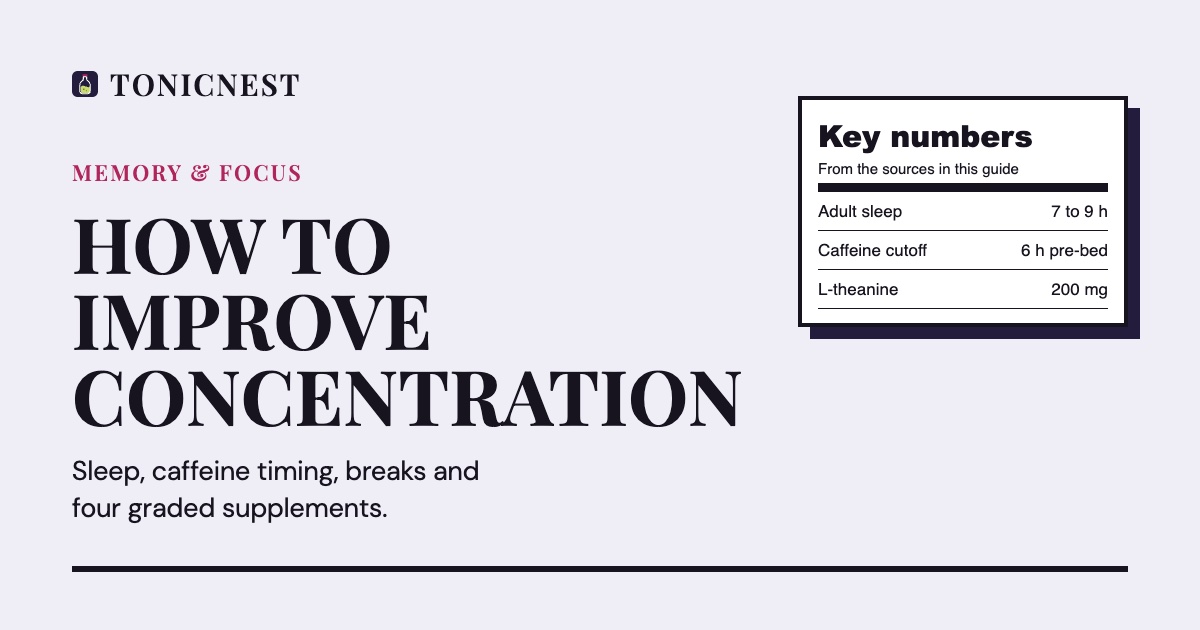
To improve concentration, start with sleep: adults need 7 to 9 hours, and sleep loss hits attention harder than anything else. Then stop caffeine at least 6 hours before bed, exercise briefly before hard tasks, and take short breaks. Caffeine with L-theanine and bacopa have the best supplement evidence, and both rate only Limited.
On this page
- How to improve concentration: where do you start?
- How does sleep affect concentration?
- When should you drink coffee to focus?
- Does exercise improve concentration?
- Do breaks help you focus?
- Which supplements help concentration?
- What does the research show for each focus aid?
- How to focus better today, and what about memory and reaction time?
- Are focus supplements safe, and who should avoid them?
- When is poor concentration a sign of something else?
- Practical checklist
- Bottom line
- FAQ
This guide explains how to improve concentration with the habits that have the best evidence, then grades four popular focus supplements. We read two NHLBI sleep pages, the MedlinePlus caffeine page, two NCCIH fact sheets, and six meta-analyses and trials on sleep loss, exercise, breaks, caffeine timing, L-theanine and bacopa. Our grading method is on our how we review supplements page.
The short answer: sleep 7 to 9 hours, stop caffeine at least 6 hours before bed, move your body, and take real breaks.[2][4] Supplements add small effects at best, and none replaces sleep.
| Biggest factor | Sleep. Adults need 7 to 9 hours a night, and short sleep makes it harder to learn, focus and react.[1][2] |
|---|---|
| Fastest fix | Caffeine from coffee or tea. It peaks in your blood within 1 hour and lasts 4 to 6 hours.[5] |
| Caffeine limit | Up to 400 mg a day is not harmful for most adults. Stop at least 6 hours before bed.[4][5] |
| Exercise and breaks | A single workout gives a small boost. Short breaks lift energy and cut fatigue.[6][7] |
| Best supplement evidence | Caffeine with L-theanine for short tasks, and bacopa after 12 weeks. Both are graded Limited here.[9][10] |
| Who should be careful | People on blood thinners (ginkgo), and anyone sensitive to caffeine, pregnant or on medicine.[5][11] |
How to improve concentration: where do you start?
The best way to improve concentration is to fix sleep first, then time caffeine, move, and pace your work with breaks. Each step has research behind it, and together they cost little. Supplements come last, because their effects in trials were small.[3][6][10]
Here is the order we suggest, with the evidence for each step in the sections below:
- Protect a 7 to 9 hour sleep window on most nights.[2]
- Have your coffee or tea in the morning, and stop at least 6 hours before bed.[4]
- Keep total caffeine under 400 mg a day. One 8-ounce coffee has 95 to 200 mg.[5]
- Do a short bout of exercise before hard mental work.[6]
- Work in blocks and take short breaks. Take a longer one after very demanding tasks.[7]
- If you still want a supplement, try caffeine with L-theanine for a single task, and judge it honestly.[8][9]
- If poor focus lasts for weeks, or came on with other symptoms, talk to a doctor.[1]
How does sleep affect concentration?
Short sleep hurts attention more than almost anything else you can change. NHLBI says sleep deficiency can make it hard to learn, focus and react.[1] Experts advise adults to sleep 7 to 9 hours a night, yet about 1 in 3 US adults report not getting enough rest or sleep.[1][2]
The research is clear on which skills suffer most. A 2010 meta-analysis pooled 70 articles and 147 cognitive tests after up to 48 hours without sleep.[3] The largest effect was on lapses in simple attention, the moments when your mind just drops out (g = -0.776). Reasoning accuracy barely changed.[3]
In plain terms, a tired brain can still reason, but it keeps losing the thread, and no focus trick fixes that after a short night.
To improve sleep quality, keep the same bed and wake times, and stop caffeine early. If stress keeps you awake, our guide to ashwagandha benefits and side effects for stress and sleep covers what the trials found. Talk to your doctor if you think you sleep too much or too little.[2]
When should you drink coffee to focus?
Drink caffeine in the morning or early afternoon, and stop at least 6 hours before bed. Caffeine reaches its peak in your blood within 1 hour, and you may feel it for 4 to 6 hours.[5] A late cup can cost you focus the next day.
A 2013 sleep study shows why. Adults took 400 mg of caffeine at bedtime, 3 hours before bed or 6 hours before bed, on separate nights.[4] All three times disturbed sleep compared with a placebo pill. Even at 6 hours, the authors estimated sleep fell by more than 1 hour. The home sleep monitor measured a 41 minute drop at that time.[4]
Amounts matter too. MedlinePlus lists these typical values:[5]
- 8-ounce cup of coffee: 95 to 200 mg
- 8-ounce cup of tea: 14 to 60 mg
- 8-ounce energy drink: 70 to 100 mg
- 12-ounce can of cola: 35 to 45 mg
Up to 400 mg a day is not harmful for most people. Too much can cause restlessness, headaches, a fast heart rate, anxiety and insomnia.[5]
Does exercise improve concentration?
Yes, a single bout of exercise gives a small, real lift in mental performance. A 2012 meta-analysis of 79 studies found a positive but small effect (g = 0.097).[6] The lift showed up during exercise, right after it and after a delay.[6]
The size of the effect depended on the details. Exercise length, intensity, the type of mental task and the person’s fitness all changed the result.[6] So a brisk walk before a study session is worth trying, though results vary from person to person.
The effect is small, so a workout will not make up for a sleepless night.
A practical way to use this finding: schedule your hardest task right after a short walk or a few flights of stairs. Keep notes for a couple of weeks to see whether your first hour of work goes better.
Do breaks help you focus?
Short breaks reliably lift energy and reduce fatigue, but they do less for performance on hard tasks. A 2022 meta-analysis pooled 22 study samples with 2,335 people.[7] Micro-breaks of 10 minutes or less raised vigor (d = .36) and cut fatigue (d = .35).[7]
The effect on overall performance was smaller (d = .16) and not statistically significant.[7] Breaks helped performance only on less demanding tasks. Longer breaks gave bigger boosts, and the authors said recovery from very draining work may need more than 10 minutes.[7]
So use two kinds of breaks. Take a few minutes away from the screen every so often to stay fresh. After a long, heavy task, such as writing a report or studying for an exam, take a proper break before you start the next one. A walk counts as a break and as a bit of exercise.
Which supplements help concentration?
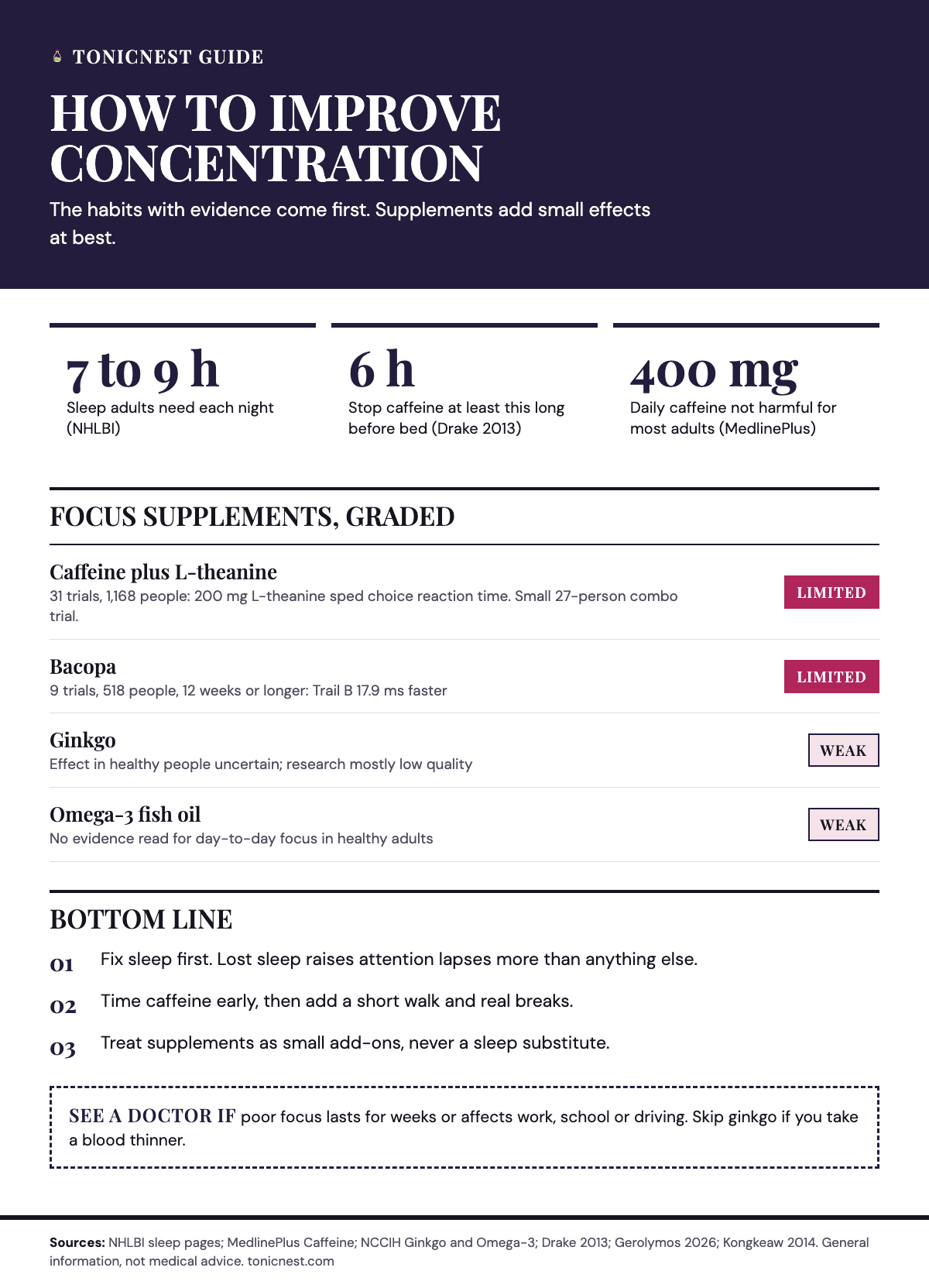
Caffeine with L-theanine and bacopa have the best supplement evidence for focus, and both rate only Limited. Ginkgo and omega-3 rate Weak for concentration in healthy adults. No supplement in this list matches the effect of a full night’s sleep.[3][9][10][11][12]
We use four grades, defined in our review method:
- Moderate: several pooled trials, small consistent effect
- Limited: some trials, small or low quality
- Weak: pilot studies only, or reviews found no benefit
- Avoid: no evidence plus a safety problem
Caffeine plus L-theanine: Limited
In a 2008 trial of 27 healthy adults, 50 mg of caffeine with 100 mg of L-theanine improved speed and accuracy on an attention-switching task at 60 minutes.[8] It also made people less distracted on a memory task. The trial was run by Unilever, a tea company, so read it with care.[8]
A 2026 meta-analysis of 31 trials with 1,168 people found a single 200 mg dose of L-theanine, taken 30 to 60 minutes before testing, sped up choice reaction time (SMD 0.51).[9] It had no effect on fatigue, and no serious side effects were reported. One author founded a supplement company.[9]
Bacopa: Limited
A 2014 meta-analysis of 9 trials with 518 people tested standardized bacopa extract for 12 weeks or longer.[10] It shortened a mental speed test (Trail B) by 17.9 milliseconds and choice reaction time by 10.6 milliseconds. The authors said bacopa may improve speed of attention, but called for larger trials.[10] The trials tested daily use over months, not single doses.
Ginkgo: Weak
NCCIH says it is uncertain whether ginkgo affects mental performance in healthy people, and much of the research is low quality.[11] In a trial of more than 3,000 adults aged 75 or older followed for a median of 6 years, ginkgo did not lower dementia risk.[11]
Omega-3 fish oil: Weak
A 2022 review of 33 studies suggested omega-3s may help protect against cognitive decline, and people who eat more seafood may have lower risk.[12] We found no NCCIH evidence that fish oil pills sharpen day-to-day focus in healthy adults.[12] Eating seafood has somewhat more support than the pills, though that evidence comes mostly from observing what people eat.
Pricier “brain” blends do not change this picture. The same logic applies to other premium pills, such as those covered in our look at NMN supplement benefits and the human trials.
What does the research show for each focus aid?
The habit studies are larger and more consistent than the supplement studies. The table below sums up the main trial or review for each step, so you can compare them side by side.
| Focus aid | Study | Dose or setting | Result |
|---|---|---|---|
| Enough sleep | Meta-analysis, 70 articles, 147 tests[3] | Up to 48 hours awake | Large rise in attention lapses (g = -0.776) |
| Caffeine timing | Home sleep study, 2013[4] | 400 mg, 0, 3 or 6 hours before bed | Sleep disturbed at all three times |
| Exercise | Meta-analysis, 79 studies[6] | Single exercise session | Small gain (g = 0.097) |
| Micro-breaks | Meta-analysis, 2,335 people[7] | Breaks of 10 minutes or less | More vigor, less fatigue; performance gain not significant |
| Caffeine plus L-theanine | Crossover trial, 27 adults[8] | 50 mg plus 100 mg | Better attention switching at 60 minutes |
| L-theanine | Meta-analysis, 31 trials, 1,168 people[9] | 200 mg single dose | Faster choice reaction time (SMD 0.51) |
| Bacopa | Meta-analysis, 9 trials, 518 people[10] | 12 weeks or longer | Trail B 17.9 ms faster |
How to focus better today, and what about memory and reaction time?
If you need to focus today, a well-timed cup of coffee or tea and a short walk are the quickest tools with evidence. Memory and reaction time respond to the same basics, because sleep loss and fatigue hurt all three.[1][3][5][6]
Here is a sample plan for a heavy work or study day, built only from the findings above:
- Wake at your usual time after 7 to 9 hours in bed.[2]
- Have one cup of coffee or tea with breakfast. Note that one 8-ounce coffee can hold 95 to 200 mg.[5]
- Take a 10 to 20 minute walk before your hardest task.[6]
- Work in focused blocks with a few minutes off between them.[7]
- After the hardest block, take a break longer than 10 minutes.[7]
- Have your last caffeine at least 6 hours before bed.[4]
Reaction time shows up in the supplement data too. Both L-theanine and bacopa were measured mainly through faster choice reaction time.[9][10] For memory, the strongest single lever is still sleep.[1]
Are focus supplements safe, and who should avoid them?
Most of these supplements had mild side effects in trials, but ginkgo and caffeine carry real cautions. Check with a doctor or pharmacist before you add any of them, especially if you take medicine.[5][11]
- Caffeine: too much can cause restlessness, shakiness, insomnia, headaches, dizziness, a fast heart rate, anxiety and dependency. Some people are more sensitive than others.[5]
- L-theanine: no serious side effects were reported across 31 trials.[9]
- Bacopa: the meta-analysis abstract we read did not report side effects, and benefits took 12 weeks to appear.[10] Ask a pharmacist before a long course.
- Ginkgo: may raise bleeding risk with blood thinners such as warfarin. Side effects include dizziness, stomach upset and headache. Raw or roasted ginkgo seeds are toxic.[11]
- Omega-3: side effects are usually mild, such as a fishy taste, bad breath, headache, heartburn, nausea and diarrhea.[12]
If you are pregnant, breastfeeding, have a heart condition or have surgery planned, ask your doctor before trying any of these.
When is poor concentration a sign of something else?
Poor focus that lasts for weeks, or comes with other changes, is a reason to see a doctor rather than buy a supplement. Doctors start by looking for common, treatable causes, and sleep problems are high on that list.[1]
NHLBI notes that an estimated 50 to 70 million Americans have chronic sleep disorders, and sleep deficiency is linked to depression and other health problems.[1] A doctor may ask about your sleep, mood, stress, medicines and alcohol before anything else.
See a doctor soon if:
- You fall asleep during the day without meaning to
- Your focus problems affect work, school or driving
- You also feel low, anxious or unusually tired most days
- Memory or focus changes came on suddenly, or others have noticed them
Finding and treating a cause, such as a sleep disorder, comes first. Supplements are never a replacement for that care.
Practical checklist
- Track your sleep for one week and aim for 7 to 9 hours.[2]
- Add up your daily caffeine from coffee, tea, soda and energy drinks.[5]
- Set a caffeine cutoff 6 hours before your usual bedtime.[4]
- Plan a short walk before your hardest task of the day.[6]
- Check any supplement label for the exact dose of each ingredient, and avoid blends that hide amounts. Our label checks explain what to look for.
- For bacopa, look for a standardized extract and plan on at least 12 weeks before judging it.[10]
- Skip ginkgo if you take a blood thinner.[11]
- Browse more memory and focus guides before you buy anything.
Bottom line
Sleep is the main driver of focus. Caffeine timing, a bit of exercise and real breaks come next, and each has research behind it.[2][3][4][6][7]
For most people, fixing sleep is a better first step than any nootropic, because sleep loss hits attention hard and supplements add only small effects. If you want to try one, caffeine with L-theanine is the cheapest test, and bacopa needs patience.[3][9][10]
Frequently asked questions
What causes poor concentration?
Short or poor sleep is one of the most common causes. NHLBI says sleep deficiency makes it hard to learn, focus and react. Stress, low mood, medicines and health conditions can also play a part, so lasting problems deserve a doctor visit.
How much caffeine should I have to focus?
Most adults can have up to 400 mg a day without harm, according to MedlinePlus. One 8-ounce coffee has 95 to 200 mg. More is not better, and too much brings jitters, headaches and poor sleep.
How long does it take bacopa to work?
The trials in a 2014 meta-analysis lasted 12 weeks or longer, and that is when small gains in speed of attention showed up. It does not work like caffeine, so a single dose will not change your focus that day.
Can L-theanine replace coffee?
No. L-theanine alone sped up reaction time in a pooled analysis of 31 trials, but most focus studies paired it with caffeine. Taken alone it does not keep you alert the way caffeine does.
Does drinking water help concentration?
We did not find an NIH or MedlinePlus source on water and focus in healthy adults, so we left it out of this guide. Dehydration is listed as a side effect of too much caffeine, which is one more reason to keep caffeine moderate.
Sources
- Sleep Deprivation and Deficiency. NHLBI, 2022
- How Much Sleep Is Enough?. NHLBI, 2022
- A meta-analysis of the impact of short-term sleep deprivation on cognitive variables. Psychological Bulletin, 2010
- Caffeine effects on sleep taken 0, 3, or 6 hours before going to bed. Journal of Clinical Sleep Medicine, 2013
- Caffeine. MedlinePlus, NLM
- The effects of acute exercise on cognitive performance: a meta-analysis. Brain Research, 2012
- A systematic review and meta-analysis on the efficacy of micro-breaks for increasing well-being and performance. PLOS ONE, 2022
- The combined effects of L-theanine and caffeine on cognitive performance and mood. Nutritional Neuroscience, 2008
- Cognitive and affective effects of L-Theanine: a systematic review and meta-analysis of 31 randomized trials. Molecular Psychiatry, 2026
- Meta-analysis of randomized controlled trials on cognitive effects of Bacopa monnieri extract. Journal of Ethnopharmacology, 2014
- Ginkgo. NCCIH
- Omega-3 Supplements: What You Need To Know. NCCIH
This article is general information, not medical advice. Dietary supplements are not reviewed by the FDA for safety or effectiveness before they are sold. Talk to your doctor before you start any supplement, especially if you are pregnant, nursing, take medication or have a health condition.