NMN reliably raises NAD levels in the blood, but human trials are small and short. Pooled studies of 250 to 2,000 mg a day found no clear benefit for blood sugar, cholesterol, weight or muscle, and only a small drop in diastolic blood pressure. It was well tolerated for up to 24 weeks. The FDA again treats it as a supplement since 2025.
On this page
- What is NMN?
- What are the main NMN benefits shown in human trials?
- NMN vs NAD: what is the difference?
- Are there NMN benefits for women?
- Is NMN legit, and is it legal to sell as a supplement?
- What are NMN side effects, and who should avoid it?
- Is liposomal NMN or NMN powder worth a premium price?
- What should you check on an NMN label?
- Are NMN benefits worth the price?
- FAQ
NMN benefits in people are smaller and less certain than the marketing suggests. We read the FDA’s 2022 and 2025 letters on NMN, four meta-analyses that pooled up to 15 randomized trials, and the main individual trials, then checked what a premium price can and cannot buy.[1][11]
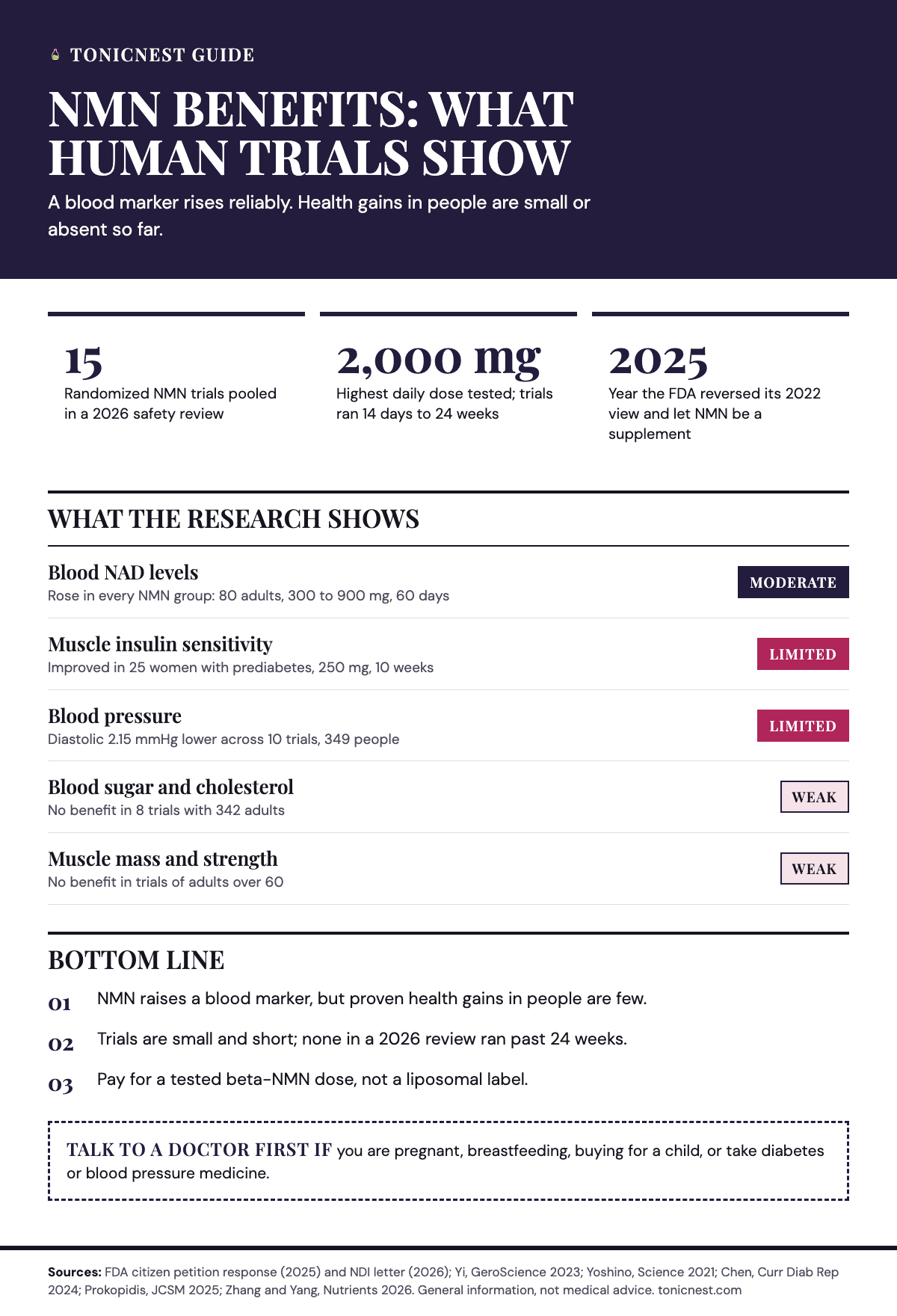
NMN reliably raises NAD levels in the blood, but pooled trials of 250 to 2,000 mg a day found no clear benefit for blood sugar, cholesterol, weight or muscle, and only a small drop of about 2 mmHg in diastolic blood pressure.[6][8][10][11]
| What it is | Nicotinamide mononucleotide, a form of vitamin B3 that the body turns into NAD+, a molecule cells use to make energy[4] |
|---|---|
| Main selling point | NAD+ levels are thought to fall with age, so NMN is sold as a way to raise them[4] |
| Amounts in trials | 250 to 2,000 mg a day, for 14 days to 24 weeks[11] |
| Best human evidence | Blood NAD rises; a small diastolic blood pressure drop; no clear effect on glucose, lipids or muscle[6][10][11] |
| Safety so far | No rise in side effects or liver enzymes in trials up to 24 weeks[11] |
| Who should avoid it | Pregnant or breastfeeding women and children, who were excluded from the notified uses[2] |
| Legal status (US) | FDA said in 2022 it could not be a supplement, then reversed that view in September 2025[1] |
What is NMN?
NMN (nicotinamide mononucleotide) is a building block your cells convert into NAD+, a coenzyme involved in energy production and cell repair. An enzyme called NMNAT does that final step.[4] Researchers became interested because NAD+ in skin, blood, liver, muscle and brain is thought to decline as people age.[4]
NMN is already in food, but in tiny amounts. Vegetables tested so far hold about 0.035 to 1.88 mg per 100 grams.[4] Supplements usually give hundreds of milligrams, which a review of the human trials called very high next to the vitamin B3 intake people need from diet.[4]
Most of the exciting results, including longer life and better health in aging animals, come from cell and mouse studies. The authors of a 2023 review in Advances in Nutrition said plainly that most NMN research has been done in cells or animals, and that early human trials enrolled only 8 to 66 people.[4]
What are the main NMN benefits shown in human trials?
The most consistent finding is that NMN raises NAD levels in the blood; health effects beyond that are small, mixed or absent. In a 60-day trial of 80 healthy middle-aged adults, blood NAD rose in every NMN group, with the highest levels at 600 and 900 mg a day.[6]
That same trial reported longer six-minute walk distances with NMN, but no change in insulin resistance.[6] Its lead author worked for an NMN manufacturer, so treat it as industry-linked.[6] A 10-week trial in 25 postmenopausal women with prediabetes found better muscle insulin sensitivity on 250 mg a day.[5] A 6-week trial in 48 amateur runners saw some breathing threshold measures improve at 600 and 1,200 mg, yet VO2max did not change in any group.[7]
Pooled analyses of several trials found less. Eight trials with 342 adults found no benefit on fasting glucose, insulin, HbA1c or blood fats.[8] A review of trials in adults with an average age of 60.9 to 83 found no effect on muscle mass, grip strength or walking speed.[9]
| Study | Who and how long | Dose | Result |
|---|---|---|---|
| Yoshino, Science 2021[5] | 25 women with prediabetes, 10 weeks | 250 mg/day | Better muscle insulin sensitivity |
| Liao, JISSN 2021[7] | 48 amateur runners, 6 weeks | 300 to 1,200 mg/day | Some threshold gains; no VO2max change |
| Yi, GeroScience 2023[6] | 80 healthy adults, 60 days | 300 to 900 mg/day | Blood NAD up; longer walk distance |
| Chen meta-analysis 2024[8] | 8 trials, 342 adults | 250 to 2,000 mg/day | No glucose or lipid benefit |
| Prokopidis meta-analysis 2025[9] | Trials in adults over 60 | Varied | No muscle mass or strength benefit |
| Zhang meta-analysis 2026[10] | 10 trials, 349 people | Varied | Diastolic BP 2.15 mmHg lower |
| Yang meta-analysis 2026[11] | 15 trials | 250 to 2,000 mg/day | Well tolerated; no broad metabolic benefit |
NMN vs NAD: what is the difference?
NAD+ is the working coenzyme inside your cells, and NMN is the step right before it in the recycling pathway the body uses to make NAD+. Nicotinamide is turned into NMN, and NMN is then turned into NAD+.[4] So when people search NMN vs NAD, they are comparing a precursor with the end product.
Supplement sellers market both. The human trials we read tested NMN and measured what happened to NAD in the blood.[6][11] Blood levels are not the whole story, though. In the prediabetes trial, 250 mg a day raised NAD+ in blood cells but did not raise it in skeletal muscle.[4] Many claims about NMN assume the extra NAD+ reaches the tissues that age, and this result suggests it may not.
We did not find human trials that directly compared NAD+ capsules with NMN capsules, so we cannot tell you that one form beats the other.
Are there NMN benefits for women?
The only women-only human trial we found studied 25 postmenopausal women with prediabetes and overweight or obesity. On 250 mg of NMN a day for 10 weeks, the 13 women taking NMN had better insulin sensitivity in muscle than the 12 on placebo.[4][5]
The study, published in Science, used a careful lab method. It was also small, and some of its authors hold patent or licensing interests tied to NMN.[5] Later pooled reviews, which included both men and women, did not find better fasting glucose or HbA1c with NMN.[8][11]
We found no human trials of NMN for menopause symptoms, fertility, skin aging or hair in women. Claims in those areas rest on animal or lab work. Pregnant and breastfeeding women were also excluded from the uses one NMN maker notified to the FDA.[2]
Is NMN legit, and is it legal to sell as a supplement?
NMN is not a fake ingredient, but its proven effects in people are modest, and product quality varies. A 2026 lab study tested eight commercial NMN supplements and found large differences in the form of NMN inside, including undeclared or inaccurately labeled ingredients.[12]
The legal story also confused buyers. On October 11, 2022, the FDA told an NMN supplier that NMN was excluded from the definition of a dietary supplement, because it had been authorized for investigation as a drug first.[1] The agency sent similar letters to every company that had filed a notice for NMN.[1]
Industry groups petitioned in 2023. On September 29, 2025, the FDA reversed course. It said it had evidence NMN was sold as a supplement in the United States as early as 2017, before the drug authorization, and concluded NMN is not excluded from the supplement definition.[1] In January 2026 it set aside an earlier exclusion letter for one NMN ingredient.[2]
None of this means NMN works or is FDA approved. The FDA does not approve dietary supplements before they are sold,[3] and it said accepting an NMN notice is not a finding that the ingredient is safe.[2]
What are NMN side effects, and who should avoid it?
In trials lasting up to 24 weeks, NMN did not raise the rate of side effects compared with placebo. A 2026 meta-analysis of 15 randomized trials, at 250 to 2,000 mg a day, found no increase in overall, serious or dropout-causing adverse events, and no rise in the liver enzymes ALT and AST.[11]
The 80-person trial reported no safety issues up to 900 mg a day.[6] Still, no human data cover years of use. Reviewers have said safe long-term amounts still need to be set.[4] One NMN maker notified the FDA of use up to 600 mg a day for no more than 60 days, or up to 300 mg a day for ongoing use.[2]
Skip NMN, or talk to a doctor first, if you:
- Are pregnant, breastfeeding, or buying for a child, since these groups were excluded from the notified uses[2]
- Take medicine for diabetes or blood pressure, since trials looked at insulin sensitivity and blood pressure[5][10]
- Have liver or kidney disease, or cancer, since the trials enrolled mostly healthy or prediabetic adults[8][11]
What doctors use first
For tiredness or worries about aging, doctors start by looking for a cause, such as poor sleep, anemia, thyroid problems or rising blood sugar. For prediabetes, the condition in the best-known NMN trial, NIH advice is to lose weight if you are overweight, get regular physical activity and follow a healthy, reduced-calorie eating plan, with diabetes medicines in some cases.[13]
NMN trials do not show it can replace any of these. Pooled trials found no fasting glucose or HbA1c benefit, and the blood pressure change was 2.15 mmHg in diastolic pressure, which the authors called preliminary.[8][10]
Is liposomal NMN or NMN powder worth a premium price?
We found no randomized human trial showing that liposomal NMN works better than plain NMN. Our PubMed search for liposomal NMN turned up lab and animal delivery studies only. So a higher price for liposomal capsules pays for a delivery claim that has not been tested in people.
Powder and capsules contain the same molecule. Powder often costs less per gram, but you have to measure it. What a premium price can fairly buy is a dose that matches the trials, the right form of NMN, and proof of what is in the tub. The lab test of eight products is the reason that last point matters.[12]
Use this decision table before you pay extra:
| If the label says | Then |
|---|---|
| Under 250 mg NMN per day | It is below the lowest dose used in the trials we read[11] |
| 250 to 600 mg per day | It matches the range most trials tested[5][6] |
| Over 600 mg per day for long-term use | It goes beyond what one maker notified to the FDA for ongoing use[2] |
| “Liposomal” with a higher price | No human trial shows better results; put the extra money toward lab testing instead[12] |
| Beta-NMN with a third-party lab report | This is where extra money buys something you can check[12] |
| Anti-aging or disease claims | Skip it; supplements are not FDA approved[3] |
Trials have also not shown that higher doses give better health results. Blood NAD peaked at 600 to 900 mg in one trial, but walking and health scores did not keep rising in a clear dose pattern.[6] Read more about how we judge value in our supplement review method.
What should you check on an NMN label?
A good NMN label tells you the exact milligrams of beta-NMN per serving and points to a lab test you can read. Here is the checklist we use when a bottle costs more than average:
- The amount of NMN per daily serving is stated in milligrams, not hidden in a blend.
- It names beta-NMN, the form used in the trials, since one lab study found products with mixed or unlabeled forms.[12]
- A batch-specific certificate of analysis from an independent lab is available.
- The daily amount sits in the 250 to 600 mg range used in most human studies.[5][6][11]
- No promises to reverse aging, fix blood sugar, or extend life.[3]
- The label warns against use in pregnancy, breastfeeding and children.[2]
Our guide to how we read supplement labels explains what a useful lab report looks like. For related ingredients, browse our energy and longevity supplement guides.
Are NMN benefits worth the price?
For most healthy adults, NMN is a pricey way to raise a blood marker without proven gains in how you feel or function. The trials are small, short and partly industry-linked, and pooled results show little beyond a slight drop in diastolic blood pressure.[10][11]
If you still want to try it, a plain, third-party tested beta-NMN product at 250 to 300 mg a day is the better buy than a premium liposomal blend, because no trial shows the extra cost buys a better result. For energy and healthy aging, sleep, exercise and care for blood pressure and blood sugar are the steps with real evidence behind them.
Frequently asked questions
What is NMN good for?
In human trials, NMN is good for raising NAD levels in the blood. Small studies saw better muscle insulin sensitivity in women with prediabetes and longer walking distance, but pooled trials found no clear benefit for blood sugar, cholesterol or muscle strength.
How much NMN do studies use?
Human trials used 250 to 2,000 mg a day for 14 days to 24 weeks. Most used 250 to 600 mg. One maker notified the FDA of use up to 300 mg a day long term, or 600 mg a day for up to 60 days.
Does NMN work better with resveratrol?
No human trial we found tested NMN and resveratrol together for health outcomes. The pairing comes from animal research and marketing. Anyone taking both is paying for a combination with no human data behind it.
Can you get NMN from food?
Yes, but only in tiny amounts. Vegetables tested so far contain about 0.035 to 1.88 mg of NMN per 100 grams, far below the hundreds of milligrams in a typical supplement serving.
How long does NMN take to show effects in trials?
Blood NAD rose within 30 days in one trial of 80 adults. Other measured effects, such as insulin sensitivity, were checked after 6 to 12 weeks. None of the 15 trials in a 2026 review lasted more than 24 weeks.
Sources
- Response letter to Natural Products Association and Alliance for Natural Health USA on the regulatory status of NMN (Docket FDA-2023-P-0872). U.S. Food and Drug Administration, 2025
- NDI 1267 reinstatement response letter regarding beta-nicotinamide mononucleotide (Uthever). U.S. Food and Drug Administration, 2026
- Questions and Answers on Dietary Supplements. U.S. Food and Drug Administration
- The Safety and Antiaging Effects of Nicotinamide Mononucleotide in Human Clinical Trials: an Update. Advances in Nutrition, 2023
- Nicotinamide mononucleotide increases muscle insulin sensitivity in prediabetic women. Yoshino et al., Science, 2021
- The efficacy and safety of beta-nicotinamide mononucleotide (NMN) supplementation in healthy middle-aged adults. Yi et al., GeroScience, 2023
- Nicotinamide mononucleotide supplementation enhances aerobic capacity in amateur runners. Liao et al., Journal of the International Society of Sports Nutrition, 2021
- Effects of Nicotinamide Mononucleotide on Glucose and Lipid Metabolism in Adults: A Systematic Review and Meta-analysis. Chen et al., Current Diabetes Reports, 2024
- The Effect of Nicotinamide Mononucleotide and Riboside on Skeletal Muscle Mass and Function: A Systematic Review and Meta-Analysis. Prokopidis et al., Journal of Cachexia, Sarcopenia and Muscle, 2025
- Effects of Nicotinamide Mononucleotide Supplementation on Blood Pressure: A Systematic Review and Meta-Analysis. Zhang et al., Nutrients, 2026
- Safety and Metabolism-Related Outcomes of Oral Nicotinamide Mononucleotide Supplementation in Adults: A Systematic Review and Meta-Analysis. Yang et al., Nutrients, 2026
- Aqueous LC-MS/MS quantification of alpha/beta-nicotinamide mononucleotide in dietary supplements. Hoei et al., Analytica Chimica Acta, 2026
- Prediabetes. MedlinePlus, National Library of Medicine
This article is general information, not medical advice. Dietary supplements are not reviewed by the FDA for safety or effectiveness before they are sold. Talk to your doctor before you start any supplement, especially if you are pregnant, nursing, take medication or have a health condition.