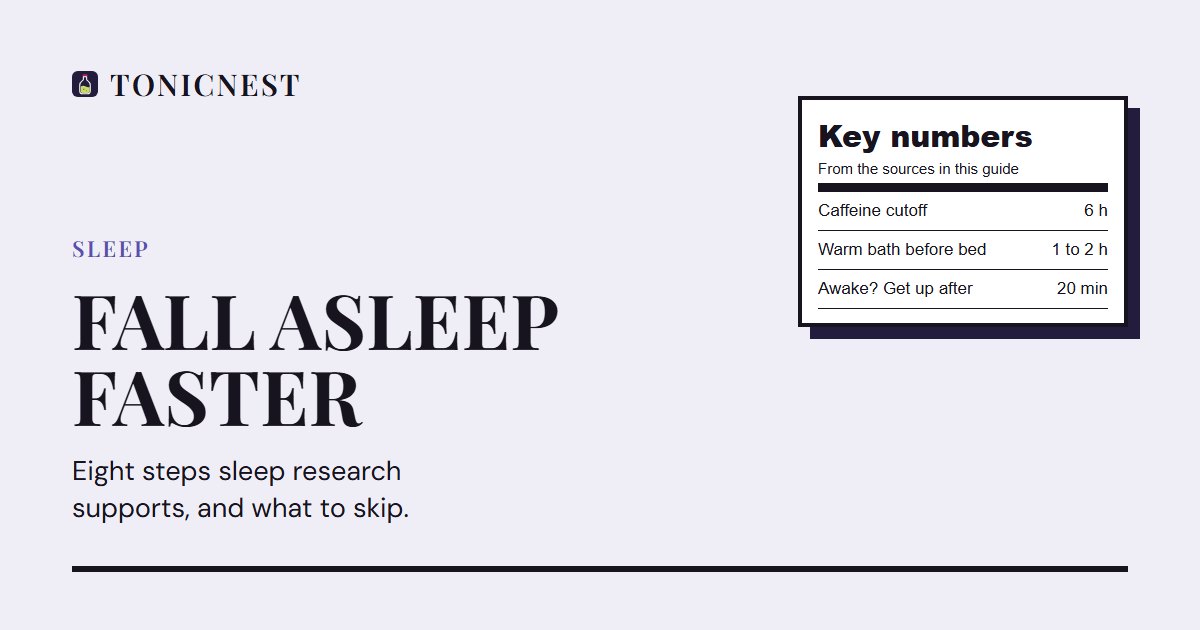
To fall asleep fast, stop caffeine at least 6 hours before bed, take a warm bath or shower 1 to 2 hours before, and write a short to-do list. In bed, use slow breathing or muscle relaxation, and get up if you are still awake after about 20 minutes. For ongoing insomnia, CBT-I cut time to sleep by about 19 minutes in trials.
On this page
- How to fall asleep fast: 8 steps to try tonight
- What is the fastest way to fall asleep?
- Does the military method help you fall asleep in 2 minutes?
- How do you fall asleep fast when you are not tired?
- How do you fall asleep fast when anxious?
- How to fall asleep fast with insomnia: what doctors use first
- What can you take to fall asleep fast?
- How do you help kids fall asleep fast?
- When should you see a doctor about trouble falling asleep?
- Bedtime checklist for falling asleep faster
- The bottom line
- FAQ
This guide on how to fall asleep fast comes from reading the NHLBI insomnia pages, the NCCIH sleep and melatonin pages, two American Academy of Sleep Medicine guidelines, the American College of Physicians guideline and five trials or meta-analyses on caffeine, alcohol, warm baths, bedtime writing and therapy for insomnia. You can read how we review health research before you start.
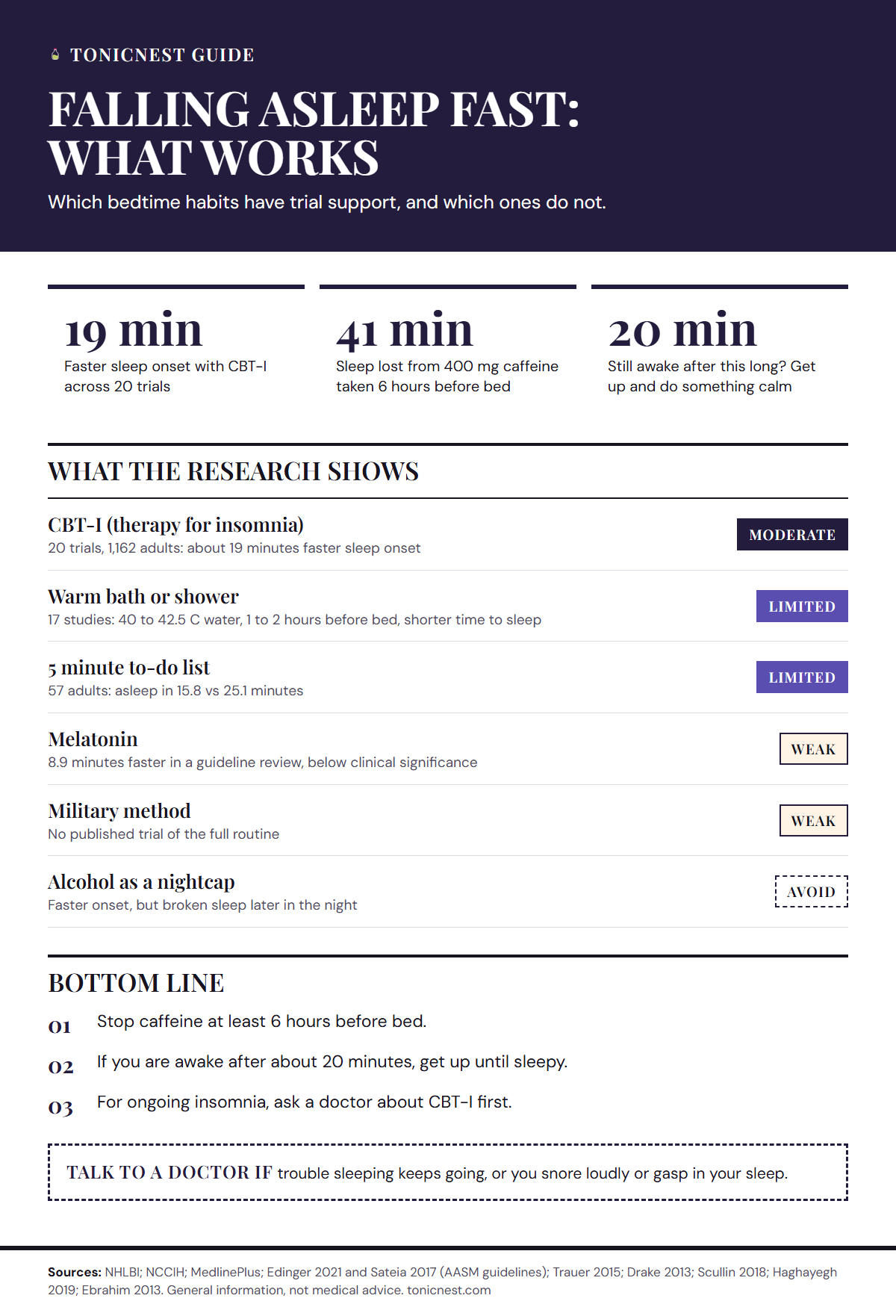
The short answer: get out of bed if you are still awake after about 20 minutes, stop caffeine at least 6 hours before bed, and use a relaxation routine, because the therapy built on these habits cut the time to fall asleep by about 19 minutes in trials[13][9][8].
| What works best | Cognitive behavioral therapy for insomnia (CBT-I), a 6 to 8 week plan, is the first treatment doctors recommend for long-term insomnia[3][5] |
|---|---|
| Size of the effect | About 19 minutes faster sleep onset across 20 trials with 1,162 adults[8] |
| Quick habits with trial data | A warm bath 1 to 2 hours before bed and a 5 minute to-do list both shortened time to sleep in studies[11][10] |
| Caffeine | 400 mg taken 6 hours before bed cut total sleep by 41 minutes[9] |
| Melatonin | May shorten time to sleep a little; a guideline found an 8.9 minute gain, below what counts as clinically meaningful[1][7] |
| Sleep you need | Adults 7 to 9 hours, teens 8 to 10 hours, children 6 to 12 years 9 to 12 hours[13] |
| See a doctor if | Trouble sleeping keeps going, or you snore loudly or gasp in your sleep[13][1] |
How to fall asleep fast: 8 steps to try tonight
The fastest reliable route to sleep is a set of habits that teach your brain the bed is for sleeping, plus a way to calm your body at lights out. These eight steps come from NIH pages, sleep guidelines and controlled trials[3][6].
- Keep the same wake time every day. MedlinePlus advises going to bed and waking up at the same time every day[13]. A fixed wake time makes you sleepy at a steadier hour.
- Stop caffeine by early afternoon. NHLBI says the effects of caffeine can last up to 8 hours[4]. In one trial, 400 mg of caffeine taken 6 hours before bed still cut sleep by 41 minutes[9].
- Skip the nightcap. Alcohol helps you drop off, but a review of studies found it disrupts the second half of the night[12]. NHLBI notes the sleep tends to be lighter than normal[3].
- Take a warm bath or shower 1 to 2 hours before bed. A meta-analysis found water at 40 to 42.5 C (104 to 108.5 F) shortened the time to fall asleep, even with only 10 minutes in the water[11].
- Write tomorrow’s to-do list. In a 2018 trial of 57 young adults, five minutes of writing a to-do list before bed led to faster sleep than writing about tasks already done[10].
- Make the room dark, cool and quiet, and put the phone away. NHLBI says screen light may signal the brain that it is time to be awake[4].
- Relax your body on purpose. Slow belly breathing, progressive muscle relaxation, guided imagery and meditation are the methods the sleep academy lists under relaxation therapy[6].
- Get up if you cannot sleep. If you are still awake after about 20 minutes, get up and do something relaxing in dim light, then return when sleepy[13]. Go to bed only when you feel sleepy[6].
Steps 1 and 8 are the core of stimulus control, which the American Academy of Sleep Medicine (AASM) supports on its own for chronic insomnia[6]. If you also feel worn out during the day, our guide to why you feel tired all the time and the tests that help covers the common causes.
What is the fastest way to fall asleep?
For people who struggle often, the fastest proven method is CBT-I, which shortened sleep onset by about 19 minutes in a 2015 meta-analysis of 20 trials. The same review found 26 fewer minutes awake during the night, and no adverse outcomes were reported[8].
CBT-I bundles several tools. Stimulus control means going to bed only when sleepy, leaving the bed when you cannot sleep, and using the bed only for sleep and sex[3]. Sleep restriction sets a fixed window of time in bed[3]. Relaxation training teaches you to calm down and fall asleep faster[3].
On a single bad night you can borrow the parts you can do alone. A warm shower, a written to-do list and a relaxation routine are the quick ones with study data[11][10][6]. The 2021 AASM guideline advised against using sleep hygiene tips as the only therapy for chronic insomnia[6]. Use them alongside the steps above.
Does the military method help you fall asleep in 2 minutes?
No published trial has tested the military method as a package, so the claim that it puts most people to sleep within 2 minutes is not supported. We searched for one and found none. The 96 percent figure that circulates online has no study behind it that we could read.
The method itself is a mix of things that do have some support. You relax the muscles of your face, drop your shoulders, breathe out slowly and let your arms and legs go heavy. Then you clear your mind with a calm picture. That is close to progressive muscle relaxation and guided imagery, which the AASM lists as forms of relaxation therapy[6].
The AASM gives relaxation therapy on its own a conditional recommendation for chronic insomnia[6]. That makes the routine a reasonable thing to try at lights out, though no study shows it works within two minutes.
How do you fall asleep fast when you are not tired?
If you are not sleepy, the best move is to stay out of bed until you are, because lying awake trains your brain to link the bed with being awake. Going to bed only when sleepy is the first rule of stimulus control[6].
Start with your daytime. MedlinePlus advises against napping after 3 p.m. and suggests getting enough sunlight during the day[13]. NHLBI says adults who nap should keep it to 20 minutes or less, and should limit naps if they have trouble falling asleep[4].
Regular exercise helps too, as long as it is not too close to bedtime[13]. MedlinePlus also lists large meals and drinks late at night as things to avoid[13]. If you keep getting into bed wide awake, a sleep restriction plan from a clinician can rebuild your sleep drive. The AASM warns that sleep restriction may not suit people who drive for work, run heavy machinery, or have bipolar disorder or poorly controlled seizures[6].
How do you fall asleep fast when anxious?
When worry keeps you up, moving the worry onto paper and calming your breathing are two steps with research behind them. In the 2018 to-do list trial, people who wrote a list of upcoming tasks fell asleep in about 15.8 minutes, compared with 25.1 minutes for people who wrote about tasks they had finished[10].
The study also found that more specific lists went with faster sleep[10]. So write real tasks, such as “email the landlord about the heater,” instead of “sort out the house.”
Then use a relaxation method in bed. Belly breathing and progressive muscle relaxation are both named in the AASM guideline[6]. NHLBI says a doctor may also suggest meditation or yoga[3]. If anxiety keeps you awake most nights for weeks, talk to a health care provider. Our sleep guides cover related topics.
How to fall asleep fast with insomnia: what doctors use first
Doctors treat long-term insomnia first with CBT-I, a 6 to 8 week program, before they turn to medicine. NHLBI calls it the usual first treatment option[3]. The American College of Physicians recommends that all adults with chronic insomnia get CBT-I as the initial treatment[5].
That ACP advice is a strong recommendation based on moderate quality evidence[5]. Sleep medicine is a second step, decided with your doctor if CBT-I has not worked[5]. NCCIH also calls CBT-I the most strongly recommended treatment for insomnia[1].
| Study | Who and how many | What was tested | Result |
|---|---|---|---|
| Trauer, 2015 meta-analysis[8] | 20 trials, 1,162 adults with chronic insomnia | CBT-I | About 19 minutes faster sleep onset, 26 minutes less time awake |
| Drake, 2013 trial[9] | Normal sleepers at home, with a sleep monitor | 400 mg caffeine at 0, 3 or 6 hours before bed | All three times disrupted sleep; 6 hours before bed cut 41 minutes of sleep |
| Scullin, 2018 trial[10] | 57 adults aged 18 to 30 | 5 minutes of writing a to-do list | Asleep in 15.8 vs 25.1 minutes |
| Haghayegh, 2019 meta-analysis[11] | 17 studies | Bath or shower at 40 to 42.5 C, 1 to 2 hours before bed | Shorter time to fall asleep |
| Sateia, 2017 AASM guideline[7] | Melatonin trials in adults over 55 | 2 mg prolonged release melatonin | 8.9 minutes faster, below clinical significance |
CBT-I can be done with a therapist or a structured program. Ask your doctor which option suits you, and how long the wait is where you live.
What can you take to fall asleep fast?
No pill or drink reliably makes you fall asleep fast, and the AASM advises against melatonin, valerian, tryptophan and diphenhydramine for chronic insomnia. Those are weak recommendations, which means the evidence for benefit is thin[7].
Melatonin is a hormone the brain makes in response to darkness[2]. NCCIH says it may help people fall asleep a little faster, but it did not improve sleep quality or time awake in a 2022 review of 12 studies with 2,666 people[1]. NHLBI says research has not proven it is an effective treatment for insomnia[3]. Short-term use appears safe for most people[2]. People with epilepsy or who take blood thinners need medical supervision[2].
Read the label with care. In a test of 25 melatonin gummy products, 22 did not match their labels, with amounts from 74 to 347 percent of what was listed[1]. NCCIH says there is very little research on magnesium for sleep; the adult upper limit from supplements is 350 mg a day[1]. Alcohol is not a sleep aid either, since it breaks up sleep later in the night[12]. If you are curious about herbs, our ashwagandha benefits and side effects guide covers its sleep research and its liver risks.
How do you help kids fall asleep fast?
For children, a steady bedtime routine comes first, and melatonin should only be used with a pediatrician’s advice. MedlinePlus says children aged 6 to 12 need 9 to 12 hours of sleep and teens need 8 to 10 hours[13]. A 12 year old who must wake at 6:30 a.m. may need to be asleep by about 9 p.m.
Teens have a later body clock, so they tend to fall asleep later and wake later[13]. The same habits help them: a fixed wake time, no screens in bed and a calm wind-down.
For children with ADHD, a 2019 review of 18 studies with 1,021 children found melatonin helped them fall asleep about 20 minutes earlier and sleep 33 minutes longer[2]. That is a modest gain, and dosing should come from a doctor. Keep supplements out of reach. NCCIH reports about 11,000 emergency visits from 2019 to 2022 for young children who swallowed melatonin without supervision[1].
When should you see a doctor about trouble falling asleep?
See a health care provider if trouble sleeping keeps going despite better habits, because you may have a sleep disorder such as insomnia or sleep apnea. MedlinePlus gives this advice for continued trouble sleeping[13].
Book a visit soon if any of these apply:
- You snore loudly or gasp in your sleep, which can be signs of sleep apnea[1].
- You doze off during the day or struggle to focus[13].
- Poor sleep comes with low mood or anxiety[13].
- You take any medicine and want to add melatonin or another sleep supplement[2].
Never drive or use machinery when you are very sleepy. Lack of sleep can slow your reactions and raise the risk of accidents[13].
Bedtime checklist for falling asleep faster
- Set one wake time and keep it every day[13].
- Have your last coffee, tea or energy drink at least 6 hours before bed[9].
- Skip alcohol in the evening[12].
- Shower or bathe in warm water 1 to 2 hours before bed[11].
- Spend 5 minutes writing a specific to-do list for tomorrow[10].
- Keep the bedroom cool, dark and quiet, with the phone out of reach[4].
- Use belly breathing or muscle relaxation once the lights are out[6].
- Get up after about 20 minutes awake and come back when sleepy[13].
- If you buy melatonin, check the dose on the label, and know that gummies often miss their label amount[1].
The bottom line
Most people fall asleep faster by changing what they do in the hours before bed. Caffeine timing, a warm shower, a written to-do list and getting out of bed when awake all have study support[9][11][10][13].
For most people with ongoing trouble, CBT-I is the better first step than melatonin, because it saved about 19 minutes in trials while melatonin saved under 9 in a guideline review[8][7]. If a few weeks of better habits do not help, ask a doctor about CBT-I and a check for sleep apnea.
Frequently asked questions
What should you drink to fall asleep fast?
No drink has good evidence for making you fall asleep fast. Caffeine can affect sleep for up to 8 hours, and alcohol breaks up sleep later in the night. A small caffeine-free drink is the safe choice.
Does music help you fall asleep faster?
MedlinePlus lists listening to calm music as one way to relax before bed. We did not find a trial on music and time to fall asleep among the sources we read. Keep the volume low and use a timer so it does not run all night.
What should you read to fall asleep fast?
Reading is on the MedlinePlus list of calming things to do before bed. Choose a paper book or a dim e-reader over a bright phone, since screen light may tell your brain it is time to be awake. Pick something calm over something gripping.
Can you fall asleep fast without medication?
Yes, for many people. Cognitive behavioral therapy for insomnia uses no medicine and cut the time to fall asleep by about 19 minutes in trials. Simple steps like a warm shower and a bedtime to-do list also had study support.
Should you nap if you cannot fall asleep at night?
Keep naps short and early. NHLBI suggests adults nap for no more than 20 minutes and limit naps if they have trouble falling asleep. MedlinePlus advises against napping after 3 p.m., since late naps can make it harder to feel sleepy at bedtime.
Sources
- Sleep Disorders and Complementary Health Approaches. NCCIH, 2024
- Melatonin: What You Need To Know. NCCIH, 2024
- Insomnia: Treatment. NHLBI, 2022
- Healthy Sleep Habits. NHLBI
- Management of Chronic Insomnia Disorder in Adults: A Clinical Practice Guideline From the American College of Physicians. Qaseem et al., Annals of Internal Medicine, 2016
- Behavioral and psychological treatments for chronic insomnia disorder in adults: an AASM clinical practice guideline. Edinger et al., Journal of Clinical Sleep Medicine, 2021
- Clinical Practice Guideline for the Pharmacologic Treatment of Chronic Insomnia in Adults. Sateia et al., Journal of Clinical Sleep Medicine, 2017
- Cognitive Behavioral Therapy for Chronic Insomnia: A Systematic Review and Meta-analysis. Trauer et al., Annals of Internal Medicine, 2015
- Caffeine Effects on Sleep Taken 0, 3, or 6 Hours before Going to Bed. Drake et al., Journal of Clinical Sleep Medicine, 2013
- The Effects of Bedtime Writing on Difficulty Falling Asleep: A Polysomnographic Study Comparing To-Do Lists and Completed Activity Lists. Scullin et al., Journal of Experimental Psychology: General, 2018
- Before-bedtime passive body heating by warm shower or bath to improve sleep: A systematic review and meta-analysis. Haghayegh et al., Sleep Medicine Reviews, 2019
- Alcohol and sleep I: effects on normal sleep. Ebrahim et al., Alcoholism: Clinical and Experimental Research, 2013
- Healthy Sleep. MedlinePlus, National Library of Medicine
This article is general information, not medical advice. Dietary supplements are not reviewed by the FDA for safety or effectiveness before they are sold. Talk to your doctor before you start any supplement, especially if you are pregnant, nursing, take medication or have a health condition.