To get rid of bloating, start with the free fixes: eat slowly, skip gum, straws and fizzy drinks, eat smaller meals, and keep a food diary to spot triggers like dairy or sugar alcohols. A short walk after meals helps gas move. If bloating lasts, a low FODMAP trial has the best diet evidence. New bloating with pain or weight loss needs a doctor.
On this page
- How to get rid of bloating: 8 steps in order
- How can I get rid of bloating fast?
- What causes bloating and how do you get rid of it?
- What foods cause bloating, and what should you eat instead?
- What drink or tea helps get rid of bloating?
- What exercise helps get rid of bloating?
- How do you get rid of bloating and constipation?
- How do you get rid of bloating from your period?
- Do supplements or gas pills help with bloating?
- When should you see a doctor about bloating?
- Your bloating checklist
- Bottom line
- FAQ
This guide explains how to get rid of bloating with the steps that NIH pages and gut specialists actually support. We read the NIDDK pages on gas, constipation, IBS and lactose intolerance, the American Gastroenterological Association (AGA) 2023 guidance on bloating, a 2025 network meta-analysis of 28 diet trials, and the small lab studies on exercise and gas. You can see how we pick and grade sources on our how we review page.
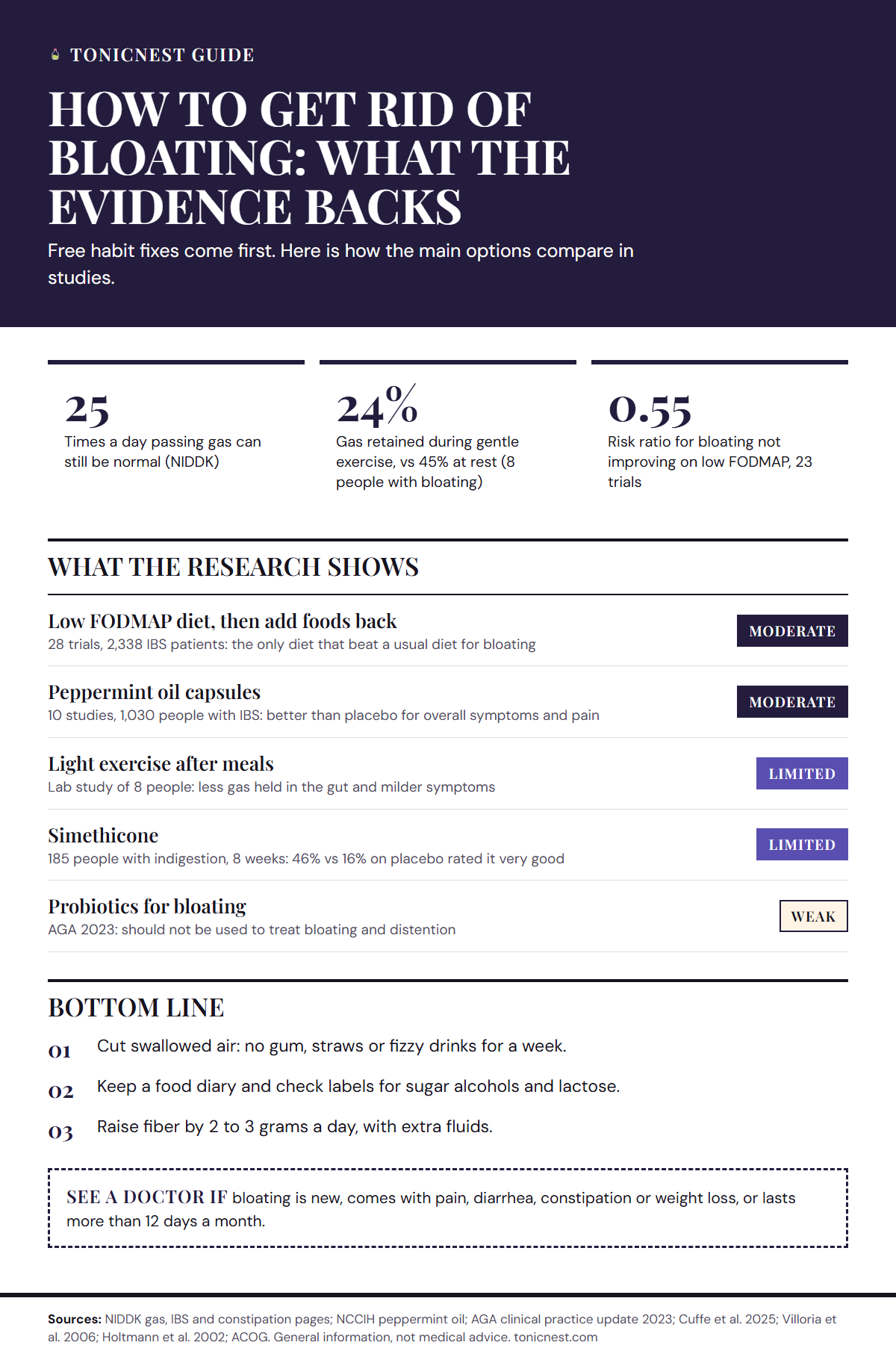
The short answer: swallow less air, cut fizzy drinks and gum, eat smaller meals, track your trigger foods, and walk after you eat. If that is not enough, a short low FODMAP trial has the best diet evidence, with a risk ratio of 0.55 for bloating that did not improve across 23 trials[9].
| What it is | A feeling of fullness or swelling in the belly; only about half of people with it have a belly that visibly grows[1] |
|---|---|
| Common causes | Swallowed air, gas-producing foods, lactose or fructose intolerance, constipation and IBS[1] |
| First steps | Eat slowly, skip gum and fizzy drinks, eat smaller meals, keep a food diary[2][3] |
| Best diet evidence | Low FODMAP diet for a few weeks, then add foods back[4][9] |
| Normal gas | Passing gas 8 to 14 times a day is average, and up to 25 times can be normal[1] |
| What not to rely on | Probiotics: the AGA advises against using them to treat bloating[8] |
| See a doctor if | Bloating changes suddenly or comes with pain, diarrhea, constipation or weight loss[1] |
How to get rid of bloating: 8 steps in order
Most bloating eases when you cut the air you swallow, find the foods that ferment in your gut, and keep your bowels moving. NIDDK lists these habit changes before any medicine[2]. Each step below is cheap and safe to try for a week or two, so work down the list in order.
- Eat slowly and sit down to eat. Eating fast, talking while you chew, and loose dentures all make you swallow more air[1][2].
- Drop fizzy drinks, gum, hard candy and straws for a week. NIDDK names each of these as a source of swallowed air or gas[1][2].
- Eat smaller meals more often. Large and high-fat meals can increase bloating[2][3].
- Keep a food and symptom diary for two weeks. Write down what you ate and when the bloating started, so patterns show up[3].
- Test dairy. Most adults with lactose intolerance handle 12 to 15 grams of lactose, about 1 cup of milk[10]. Lactase tablets taken before dairy are another option[5].
- Read labels for sugar alcohols. Sorbitol, mannitol, xylitol, erythritol and maltitol can all cause gas and bloating[3].
- Raise fiber slowly. Add 2 to 3 grams a day toward the adult range of 22 to 34 grams, and drink more fluids as you go[4][6].
- Take a light walk after meals. In a small lab study, gentle exercise cut the gas held in the gut from 45% to 24%[12].
If a few weeks of these steps do not help, the low FODMAP trial and the doctor visit covered below come next. Steps 4 to 6 work best together, because the diary tells you which foods to test.
How can I get rid of bloating fast?
No study gives a reliable time to relief, but the quickest moves are the ones that help gas leave or stop more from coming in. Go for a gentle walk, and skip fizzy drinks, gum and straws for the rest of the day[2][12].
It helps to know what normal looks like. People pass gas 8 to 14 times a day on average, and experts consider up to 25 times a day normal[1]. Belching up to 30 times a day is typical too[1].
If the bloating followed a dairy meal, a lactase product will not undo it, but it can help next time if you take the tablet before the food[5]. For people whose belly pushes outward each time they bloat, the AGA lists diaphragmatic breathing, taught by a trained clinician, as an option[8]. In that pattern the belly wall relaxes and the diaphragm drops, so the belly sticks out even without extra gas.
What causes bloating and how do you get rid of it?
Bloating is a feeling of fullness or swelling in your abdomen, and only about half of people who feel it have a belly that actually gets bigger[1]. Swallowed air, foods that ferment in the gut, constipation and IBS cover most cases, and each one has its own fix.
NIDDK lists these causes: IBS and other functional gut disorders, lactose and fructose intolerance, small intestinal bacterial overgrowth (SIBO), celiac disease, constipation, GERD, gastroparesis and, rarely, a blockage[1]. A blockage can come from conditions such as colorectal, ovarian or stomach cancer, which is why new or lasting bloating deserves a check[1].
Use this table to match what you notice with a first step. It is a starting point for your diary and your doctor visit, and it does not diagnose anything.
| What you notice | Possible trigger | First thing to try |
|---|---|---|
| Worse after milk, ice cream or soft cheese | Lactose | Smaller dairy portions, or lactase before dairy[5][10] |
| Worse after sugar-free gum, candy or bars | Sugar alcohols | Check labels for sweeteners ending in “ol”[3] |
| Worse after beans, broccoli or cabbage | Fermentable carbs | Smaller portions, added back slowly[2] |
| Worse after apple juice or soda with corn syrup | Fructose | Swap for water; eat whole fruit in small amounts[3] |
| Hard stools or few bowel movements | Constipation | Fiber, fluids and daily movement[6] |
| Belly pain with changed bowel habits for months | Possibly IBS | See a doctor; ask about a low FODMAP trial[4][8] |
| Diarrhea, weight loss or family history of celiac | Possibly celiac disease | Ask about a celiac blood test[8] |
What foods cause bloating, and what should you eat instead?
The foods most linked to gas and bloating contain carbohydrates the small intestine does not fully absorb, so gut bacteria ferment them and make gas[3]. NIDDK names apples, peaches, pears, fruit juices, dairy, whole wheat, drinks with high-fructose corn syrup and sugar alcohols[3].
Cruciferous vegetables such as broccoli and cabbage, beans and other legumes, and high-fiber foods are on the list too[2]. These are healthy foods, so the goal is to find your own limit. Few people need to cut all of them. High-fat foods can also increase bloating[3].
Protein products are a common hidden source. If you use bars or shakes to reach a target like the ones in our guide on how much protein per day you need, check the label for maltitol, sorbitol or milk sugars. Many bars sold as low sugar get their sweetness from sugar alcohols.
Does a low FODMAP diet help bloating?
For people with IBS, it has the best evidence of any diet. A 2025 network meta-analysis pooled 28 randomized trials with 2,338 IBS patients and compared 11 diets[9]. For bloating, only the low FODMAP diet beat a usual diet, with a risk ratio of 0.55 across 23 trials[9].
Treat it as a short test. NIDDK describes cutting high-FODMAP foods for a few weeks and then adding them back one at a time to see which ones cause trouble[4]. The AGA advises doing it with help from a dietitian who knows gut conditions, so you do not cut more than you need to[8].
What drink or tea helps get rid of bloating?
Plain water and other still drinks are the safest choice, because fizzy drinks add gas and juices or sodas with high-fructose corn syrup add sugar that ferments[1][3]. Water also matters when you add fiber, since NIDDK pairs more fiber with more liquids[6].
The case for herbal teas is thin. We looked for trials of ginger, fennel and chamomile tea for bloating and found none we could cite, so we cannot say they work. A warm, unsweetened cup is unlikely to hurt, and it replaces a soda.
Peppermint is the one plant with real data, but the studies used peppermint oil capsules, not tea. A 2022 review of 10 studies with 1,030 people found peppermint oil beat placebo for overall IBS symptoms and belly pain[7]. The most common side effects were heartburn and indigestion[7]. A cup of peppermint tea holds far less oil, so do not expect the same result.
Watch the drinks that hide sugar alcohols or lactose, such as sugar-free sodas, milky coffee and protein shakes[3].
What exercise helps get rid of bloating?
Light movement helps gas move through the gut: in a 2006 lab study of 8 people with bloating, gentle pedaling cut the share of gas retained from 45% to 24% and eased symptoms[12]. An easy walk after a meal follows the same idea.
The study was small. Researchers infused a gas mix into the small intestine for 120 minutes while people lay on their backs and either rested or pedaled gently in 5-minute bouts[12]. Symptom scores dropped from 3.6 at rest to 2.8 with exercise, on a 0 to 6 scale[12]. It was a single short session in a lab, with no long-term follow-up.
Moving more on most days helps the bowels as well. NIDDK says regular physical activity may relieve constipation, a common driver of bloating[6]. ACOG suggests at least 30 minutes of aerobic exercise most days for premenstrual symptoms, which include bloating[13].
We found no trials on specific yoga poses for bloating. If a stretch feels good, there is no reason to stop, but we cannot point to data for one pose over another.
How do you get rid of bloating and constipation?
When bloating comes with hard or infrequent stools, treat the constipation first, which is what the AGA advises for this pattern[8]. Once stool moves along, the fullness often eases too.
NIDDK’s first steps for constipation are more high-fiber foods, plenty of water and other liquids, regular physical activity, and trying to go at the same time each day[6]. Raise fiber slowly, by 2 to 3 grams a day, because adding it gradually may help prevent gas and bloating[4].
A doctor may suggest a laxative for a short time, such as a fiber supplement or an osmotic agent[6]. NIDDK says stimulant laxatives are for severe constipation or when other treatments have not worked[6]. If you strain and still feel you cannot empty, ask about the pelvic floor. The AGA lists biofeedback therapy, a kind of muscle retraining, for people with a pelvic floor problem[8].
How do you get rid of bloating from your period?
Bloating is one of the physical symptoms of premenstrual syndrome, and ACOG suggests eating less fat, salt and sugar, avoiding caffeine and alcohol, and eating six small meals a day instead of three large ones[13]. Regular aerobic exercise, kept up all month, may also lessen symptoms[13].
ACOG also notes that magnesium supplements may help reduce water retention, which it calls bloating, along with breast tenderness and mood symptoms[13]. That is a modest “may help,” and magnesium can interact with some medicines, so ask your doctor or pharmacist before you start.
Period bloating follows a pattern: it shows up in the days before bleeding and fades after. Bloating on most days of the month, whatever your cycle, is a different signal and belongs in the doctor section below[14].
Do supplements or gas pills help with bloating?
A few products have some data, but none has strong evidence for bloating on its own, and the AGA says probiotics should not be used to treat bloating[8]. Most of the steps above cost nothing, so start there before you buy anything.
We grade the evidence with four words. Moderate means several pooled trials with a small, consistent effect. Limited means some trials that are small or of low quality. Weak means pilot studies only, or reviews that found no benefit. Avoid means no evidence plus a safety problem; nothing here got that grade.
| Option | Study | What it found | Grade |
|---|---|---|---|
| Low FODMAP diet | Cuffe 2025: 28 trials, 2,338 IBS patients | Only diet to beat a usual diet for bloating (risk ratio 0.55, 23 trials)[9] | Moderate |
| Peppermint oil capsules | 2022 review: 10 studies, 1,030 people with IBS | Better than placebo for overall IBS symptoms and pain; heartburn possible[7] | Moderate for IBS |
| Simethicone | Holtmann 2002: 185 people with indigestion, 105 mg three times a day for 8 weeks | Rated very good by 46% vs 16% on placebo; not a bloating-only trial[11] | Limited |
| Lactase tablets or drops | NIDDK; review of 36 trials | Useful only if lactose is the trigger; most adults with intolerance handle about 1 cup of milk[5][10] | Limited |
| Probiotics | AGA 2023 guidance | Should not be used to treat bloating and distention[8] | Weak |
Read labels before you buy. Peppermint oil for gut use usually comes as enteric-coated capsules, which are built to open past the stomach[7]. Young children and people who are pregnant or breastfeeding should check with a doctor before using lactase products[5]. NIDDK advises talking with a doctor before starting any supplement for gas[2].
When should you see a doctor about bloating?
See a doctor if your bloating changes suddenly or comes with belly pain, constipation, diarrhea or weight loss[1]. Most bloating is harmless, but these signs point to a cause that home steps will not fix.
Book a visit soon if you have any of these:
- Bloating that is new, or that has changed suddenly[1]
- Bloating with belly pain, diarrhea, constipation or weight loss you did not plan[1]
- Bloating, pelvic or belly pain, trouble eating or feeling full fast, or an urgent need to pee on more than 12 days a month[14]
- Any of these after menopause; ACOG says most ovarian cancer cases occur in women aged 55 to 64[14]
There is no screening test for ovarian cancer, so ACOG asks women to report lasting symptoms like these[14]. Most bloating has an everyday cause, but lasting symptoms are worth ruling out. If tiredness and weight loss come along with bloating, mention both; our guide on why you might be so tired and the tests that help covers the common causes.
What doctors use first
The AGA’s 2023 guidance starts with a careful history and diagnosis by standard symptom criteria, and it saves imaging and scopes for people with warning signs[8]. It also suggests a celiac blood test, constipation treatment when stools are hard, a low FODMAP trial with a dietitian, gut-brain therapies, diaphragmatic breathing and pelvic floor biofeedback[8]. NIDDK adds over-the-counter medicines and prescription treatment for conditions such as IBS or SIBO[2]. Ask about these before you reach for a supplement.
Your bloating checklist
- Eat sitting down and slowly, with no gum, straws or fizzy drinks for a week[2].
- Keep a two-week food and symptom diary[3].
- Check labels for sorbitol, mannitol, xylitol, erythritol and maltitol[3].
- Check labels for milk or lactose if dairy seems to bother you[5].
- Raise fiber by 2 to 3 grams a day, with extra fluids[4][6].
- Walk for a few minutes after your largest meal[12].
- Skip probiotics bought just for bloating[8].
- Bring your diary to the doctor if bloating lasts or comes with warning signs[1].
For more on gut topics, see our probiotics and digestion guides.
Bottom line
Most bloating comes from swallowed air, foods that ferment, or slow bowels. Slower meals, fewer fizzy drinks, a food diary and a walk after eating cost nothing and settle many cases. When they fall short, a short low FODMAP trial has the best diet evidence we found.
For most people the diary is the most useful first step, because it turns a vague complaint into a short list of foods to test. We would skip probiotics for bloating and put the money toward a dietitian visit if the problem lasts. Bloating that is new, constant, or paired with pain or weight loss is a reason to see a doctor before you buy anything.
Frequently asked questions
How do you get rid of bloating after eating?
Take a short, easy walk, and next time eat more slowly in smaller portions. Skip fizzy drinks with the meal. If it happens after the same foods, such as dairy, beans or sugar-free sweets, note them in a food diary and test cutting back.
How do you get rid of bloating overnight?
No study shows a reliable overnight fix. A lighter, lower-fat dinner, no fizzy drinks or gum in the evening, and a short walk after eating give gas the best chance to clear. Bloating that is still there most mornings is worth a doctor visit.
Can chewing gum cause bloating?
Yes. Chewing gum makes you swallow extra air, and sugar-free gum often contains sorbitol, xylitol or maltitol, which can cause gas and bloating. NIDDK lists both gum and these sweeteners as common triggers, so a gum-free week is an easy test.
Do probiotics help bloating after antibiotics?
The evidence does not support buying probiotics for bloating. The American Gastroenterological Association advises against using them to treat bloating, and NIDDK suggests talking with a doctor before taking probiotics. Bloating with diarrhea after antibiotics should be reported to your doctor.
How many times a day is it normal to pass gas?
NIDDK says people pass gas 8 to 14 times a day on average, and up to 25 times a day can be normal. Belching up to 30 times a day is also common. Passing gas is how the gut releases it.
Sources
- Symptoms & Causes of Gas in the Digestive Tract. NIDDK, 2021
- Treatment for Gas in the Digestive Tract. NIDDK, 2021
- Eating, Diet, & Nutrition for Gas in the Digestive Tract. NIDDK, 2021
- Eating, Diet, & Nutrition for Irritable Bowel Syndrome. NIDDK, 2017
- Treatment for Lactose Intolerance. NIDDK, 2018
- Treatment for Constipation. NIDDK
- Peppermint Oil. NCCIH
- AGA Clinical Practice Update on Evaluation and Management of Belching, Abdominal Bloating, and Distention. Gastroenterology (AGA), 2023
- Efficacy of dietary interventions in irritable bowel syndrome: a systematic review and network meta-analysis. Lancet Gastroenterology & Hepatology, 2025
- Systematic review: effective management strategies for lactose intolerance. Annals of Internal Medicine, 2010
- Treatment of functional dyspepsia with simethicone and cisapride: a randomized controlled trial. Alimentary Pharmacology & Therapeutics, 2002
- Physical activity and intestinal gas clearance in patients with bloating. American Journal of Gastroenterology, 2006
- Premenstrual Syndrome (PMS). ACOG
- Ovarian Cancer. ACOG
This article is general information, not medical advice. Dietary supplements are not reviewed by the FDA for safety or effectiveness before they are sold. Talk to your doctor before you start any supplement, especially if you are pregnant, nursing, take medication or have a health condition.