To lower cortisol, sleep 7 to 9 hours, keep most workouts at a moderate pace, stop caffeine after lunch and practice a calming routine daily. Lost sleep raised next-evening cortisol by 37% to 45% in one trial. Ashwagandha lowered cortisol in small trials but not stress scores. A round face, purple stretch marks and easy bruising call for a Cushing's test.
On this page
- How to lower cortisol: 8 steps in order
- Why would you want to lower cortisol?
- How to lower cortisol levels fast?
- What foods lower cortisol?
- What supplements lower cortisol?
- How to lower cortisol levels in women and men?
- Can lowering cortisol help you lose weight?
- When is high cortisol a sign of Cushing’s syndrome?
- What does the research show?
- Who should be careful?
- What do doctors use first?
- Practical checklist
- Bottom line
- FAQ
This guide covers how to lower cortisol using steps that have been tested in people. We read the NIDDK page on Cushing’s syndrome, the MedlinePlus pages on stress and cortisol testing, the NCCIH pages on stress and ashwagandha, and nine studies and reviews on sleep, exercise, caffeine, meditation and supplements.[1][2][3][9][11] Our review method explains how we pick and grade sources.
The short answer: sleep 7 to 9 hours, keep most workouts moderate, stop caffeine after lunch and practice a calming routine most days. In a 1997 trial, cutting sleep raised cortisol the next evening by 37% to 45%.[6][7]
| What it is | A hormone made by the adrenal glands. It helps you respond to stress, control blood sugar and blood pressure, and reduce inflammation.[1] |
|---|---|
| Normal daily rhythm | Highest in the morning, much lower by about 4 p.m., and it drops soon after you fall asleep.[1][2] |
| Steps with the most support | Enough sleep, moderate rather than all-out exercise, and meditation for people under strain.[7][8][10] |
| Most studied supplement | Ashwagandha root extract. Small trials found lower cortisol, but a 2025 review found no change in stress scores.[12][13] |
| Safety | Ashwagandha has rare reports of liver injury and should be avoided in pregnancy.[11][14] |
| When to get tested | A round face, wide purple stretch marks, easy bruising and weak muscles can point to Cushing’s syndrome.[2] |
| Not a real diagnosis | “Adrenal fatigue” has no scientific proof and no valid test.[4] |
How to lower cortisol: 8 steps in order
The steps that lower cortisol are mostly about sleep, workout intensity, caffeine timing and daily stress load. None of them is a quick fix, and none replaces a medical check when the body shows signs of true cortisol excess. Start at the top of this list. The early steps have the clearest data.
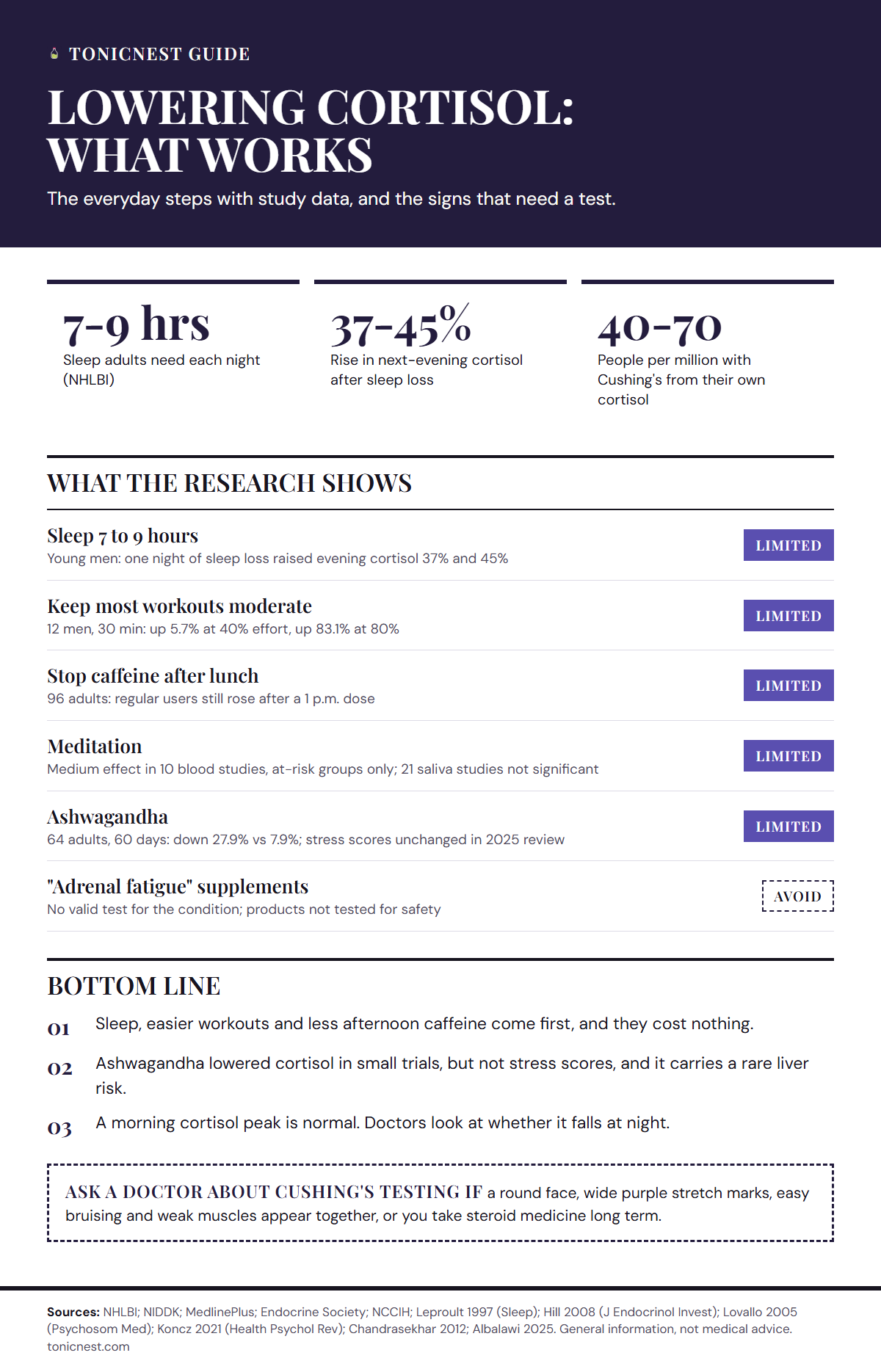
- Protect 7 to 9 hours of sleep. That is the adult range from the NHLBI.[6] In a 1997 trial in young men, partial or total sleep loss raised evening cortisol the next day by 37% and 45%, and delayed the normal evening drop by at least 1 hour.[7]
- Keep most workouts moderate. In a 2008 study of 12 trained men, 30 minutes at 40% of maximum effort raised cortisol by 5.7%. The same time at 60% raised it 39.9%, and 80% raised it 83.1%.[8] Hard sessions are fine now and then, but if stress is the problem, do not make every day a hard day.
- Stop caffeine after lunch. A trial in 96 adults found that daily coffee drinkers still had a cortisol rise from an afternoon dose, even after the morning response faded.[15]
- Do 10 to 20 minutes of a calming practice. MedlinePlus lists breathing exercises, meditation and muscle relaxation.[3] A 2017 review of eight studies found focused-attention meditation lowered blood pressure and cortisol.[9]
- Walk 30 minutes a day. MedlinePlus suggests a daily 30-minute walk for long-term stress.[3]
- Review steroid medicines with your doctor. Long-term, high-dose glucocorticoids are the most common cause of Cushing’s syndrome, the medical name for too much cortisol. Never stop them on your own.[2]
- Deal with the source of stress. Get help if severe stress symptoms last 2 weeks or more.[3]
- Get tested instead of guessing if you have signs of Cushing’s syndrome. A cortisol supplement will not fix a tumor or a medicine side effect.[2]
We chose 10 to 20 minutes in step 4 as a practical daily target. The trials used different session lengths.
Why would you want to lower cortisol?
Cortisol is a hormone you need, and the aim is to keep it from staying high for months at a time. It helps you respond to stress, keeps blood sugar and blood pressure steady and calms inflammation.[1] Problems start when the body makes too much over a long period. That is Cushing’s syndrome.[2]
Most people who search for ways to lower cortisol do not have Cushing’s. They feel stressed, tired or wired, and they have read that cortisol is the cause. Stress does switch on the cortisol response. Still, a vague set of symptoms says little about whether cortisol is actually too high.
The Endocrine Society says “adrenal fatigue” is not a real medical condition and no test can detect it.[4] Tiredness, poor sleep and brain fog are “common and non-specific.” They can come from adrenal insufficiency, depression or obstructive sleep apnea.[4] Our guide on why you might be so tired covers those other causes.
How to lower cortisol levels fast?
There is no proven way to drop cortisol within minutes, but you can stop raising it today. The quickest changes are to skip caffeine after midday, swap an all-out workout for an easy one, and go to bed on time tonight.[8][15][7] They work by taking away known triggers.
A short breathing or relaxation session is a reasonable tool when stress spikes. NCCIH and MedlinePlus list these practices for stress.[3][9] We found no source that measured how many minutes it takes for cortisol to fall after one session, so we make no claim on speed.
What about cortisol in the morning?
A morning peak is normal. MedlinePlus notes that cortisol is usually at its highest in the morning and much lower by about 4 p.m.[1] Trying to flatten that peak is not a sensible goal. What matters more is whether levels fall at night. In Cushing’s syndrome, the normal drop after falling asleep does not happen.[2]
What foods lower cortisol?
No single food has been shown in trials to lower cortisol in a meaningful way. We found nothing in our sources to back the lists of “cortisol-lowering foods” that circulate online. The clearest diet link runs the other way: caffeine raises cortisol.[15]
In the 2005 caffeine trial, 48 men and 48 women followed set caffeine intakes for 5 days at a time: 0, 300 or 600 mg a day. Then they took 250 mg doses at 9 a.m., 1 p.m. and 6 p.m.[15] After caffeine-free days, the doses caused “a robust increase in cortisol across the test day.” Regular use blunted the morning rise, but cortisol climbed again after the 1 p.m. dose.[15] The authors called the response “reduced, but not eliminated.”
MedlinePlus advises avoiding too much caffeine when you are under stress.[3] Beyond caffeine, eat in a way that supports steady sleep and energy. We do not tie any food to a cortisol number.
What supplements lower cortisol?
Ashwagandha is the only supplement with several trials that measured cortisol, and the results are mixed. In a 2012 trial, 64 adults with chronic stress took 300 mg of root extract twice a day for 60 days. Serum cortisol fell 27.9%, compared with 7.9% on placebo.[12]
A 2025 review pooled 7 cortisol studies and 6 stress-score studies with 488 people in total. Cortisol fell by 1.16 ug/dL, but perceived stress did not change in a significant way.[13] One author wrote that review, and it flagged gaps on long-term safety and dosing.[13] NCCIH says some ashwagandha preparations may help with stress and that it may be safe for up to 3 months.[11] Our full ashwagandha benefits and side effects guide covers the liver risk in detail.
Magnesium, vitamins and “adrenal” formulas
A 2017 systematic review of 18 magnesium studies found some benefit for anxiety in vulnerable groups, with 4 of 8 studies positive in anxious people.[16] None used a validated stress measure, and the authors rated the evidence quality as poor.[16] It did not show that magnesium lowers cortisol.
The Endocrine Society warns that supplements sold for “adrenal fatigue” have not been tested for safety.[4] Supplements in the U.S. are not approved by the FDA before they are sold.[11]
How to lower cortisol levels in women and men?
The steps are the same for women and men: sleep, moderate exercise, less caffeine and a calming routine. No source we read showed a different method works better for one sex. Many of the trials were small, and some included only men, such as the sleep and exercise studies.[7][8] The caffeine trial included 48 of each.[15]
Women do face one specific risk. Cushing’s syndrome from the body’s own cortisol is about three times as common in women as in men, and it most often starts between ages 30 and 50.[2] In a 2000 study of 59 premenopausal women, those with more weight around the waist released more cortisol during a stress test.[5] That was a one-time snapshot, so it cannot show which came first.
For women over 50 or 60, we found no trial testing cortisol-lowering steps in that group alone. Medicine reviews matter at any age. More than 10 million Americans take glucocorticoids each year, and these medicines can cause Cushing’s syndrome.[2]
Can lowering cortisol help you lose weight?
Lowering cortisol only clearly changes weight when cortisol is truly too high, as in Cushing’s syndrome. In Cushing’s, weight gain, a round face, fat at the base of the neck and a fatty hump between the shoulders are common signs.[2] Treating the cause is how that weight is addressed.
For people without Cushing’s, the “cortisol belly” idea runs ahead of the evidence. The 59-woman study found a link between waist fat and stress cortisol, but it was cross-sectional.[5] We found no trial showing that lowering cortisol in healthy people leads to belly fat loss. The sleep, exercise and stress steps above are still worth doing for their own sake.
When is high cortisol a sign of Cushing’s syndrome?
Cushing’s syndrome means the body is exposed to too much cortisol over a long time, and it needs a doctor’s tests, not lifestyle changes alone. The kind caused by the body itself is rare, at about 40 to 70 people per million.[2] The most common cause overall is long-term, high-dose glucocorticoid medicine.[2]
NIDDK lists these signs: weight gain, thin arms and legs, a round face, fat at the base of the neck, a fatty hump, easy bruising, wide purple stretch marks and weak muscles.[2] Type 2 diabetes that stays poorly controlled along with high blood pressure can also be a clue.[2] Untreated, it can be fatal.[2]
Which tests check for it?
No one test is perfect, so doctors usually use two of these:[2]
- A 24-hour urine test for free cortisol.
- A late-night saliva test, which you can collect at home.
- A low-dose dexamethasone suppression test: a pill around 11 p.m., then a blood draw around 8 a.m.
A single morning blood test is not how Cushing’s is ruled in or out. Home saliva kits sold for “adrenal fatigue” are not based on scientific facts, according to the Endocrine Society.[4]
What medication lowers cortisol?
For Cushing’s, treatment depends on the cause. It may include surgery, radiation, chemotherapy or cortisol-reducing medicines.[2] If glucocorticoid medicine is the cause, the doctor slowly lowers the dose to the smallest amount that still controls the other condition.[2] These are prescription decisions for an endocrinologist.
| What you notice | Sensible next step |
|---|---|
| Stress, poor sleep, feeling wired, no physical signs | Start the 8 steps above for 4 to 8 weeks |
| Severe stress or low mood for 2 weeks or more | See a doctor or mental health professional[3] |
| Round face, purple stretch marks, easy bruising, weak muscles | Ask a doctor about Cushing’s testing[2] |
| You take steroid tablets, inhalers or shots long term | Review the dose with your prescriber; do not stop on your own[2] |
| Ongoing exhaustion with no clear cause | Get checked for sleep apnea, depression and adrenal insufficiency[4] |
The 4 to 8 week window in the first row is our own planning suggestion; no trial set it.
What does the research show?
The research is strongest for sleep, exercise intensity and caffeine as things that raise cortisol, and weaker for anything sold to lower it. Most studies are small, short and run in narrow groups. Here are the main ones we used. On our infographic, Limited means some trials, small or low quality, and Avoid means no evidence plus a safety concern.
| Study | Who and how long | What was tested | Result |
|---|---|---|---|
| Leproult, 1997[7] | Healthy young men, one night | Partial or total sleep loss | Next-evening cortisol up 37% and 45% |
| Hill, 2008[8] | 12 trained men, 30-minute sessions | Exercise at 40%, 60%, 80% effort | Cortisol up 5.7%, 39.9%, 83.1% |
| Lovallo, 2005[15] | 96 adults, 4 weeks | Caffeine 0, 300 or 600 mg a day | Rise reduced in regular users but not eliminated |
| Koncz, 2021[10] | Meta-analysis of RCTs | Meditation | Medium effect in 10 blood studies, only in at-risk groups; 21 saliva studies not significant |
| Chandrasekhar, 2012[12] | 64 stressed adults, 60 days | Ashwagandha 300 mg twice daily | Cortisol down 27.9% vs 7.9% |
| Albalawi, 2025[13] | Review, 488 people | Ashwagandha | Cortisol down 1.16 ug/dL; stress scores unchanged |
| Boyle, 2017[16] | Review of 18 studies | Magnesium | Some anxiety benefit; poor quality; no stress measure |
On meditation, the 2021 meta-analysis found the effect only in people with an existing illness, measured in blood.[10] So meditation is a sound stress habit, but the cortisol effect in healthy people is small.
Who should be careful?
Most lifestyle steps are low risk, but supplements and medicine changes need care. Ashwagandha can cause drowsiness, stomach upset, diarrhea and vomiting.[11] It should be avoided in pregnancy and while breastfeeding, before surgery, and with autoimmune or thyroid conditions.[11]
It can interact with medicines for diabetes, blood pressure, the immune system, seizures and the thyroid, and with sedatives.[11] A 2020 case series described 5 people with liver injury. Jaundice appeared after 2 to 12 weeks, and none developed liver failure.[14]
Never stop or cut a steroid medicine on your own, even if you suspect it is raising your cortisol.[2] See a doctor right away if:
- You have thoughts of harming yourself.[3]
- You notice yellow skin or eyes while taking a supplement.[14]
- Bruising, stretch marks, muscle weakness and weight gain appear together.[2]
Long-term stress can also wear on sleep and general health. Our guide to how the immune system works and what weakens it covers that side.
What do doctors use first?
For everyday stress, doctors start with sleep, exercise and stress-management skills, plus therapy when symptoms are severe. MedlinePlus lists regular exercise, relaxation methods, enough sleep and less caffeine as first steps.[3]
For suspected Cushing’s syndrome, doctors confirm it with two tests, find the cause and treat that cause.[2] A supplement is never a substitute for that workup. More guides on hormones sit in our hormone balance section.
Practical checklist
- Set a fixed bedtime that gives you 7 to 9 hours in bed asleep.[6]
- Keep at least half your weekly workouts at an easy, conversational pace.[8]
- Make lunch your last caffeine of the day.[15]
- Pick one calming practice and do it daily for a month.[9]
- List every medicine you take and ask if any contain glucocorticoids.[2]
- Before buying ashwagandha, check with your doctor about pregnancy, thyroid and liver issues.[11]
- Skip saliva kits sold for “adrenal fatigue.”[4]
Bottom line
For most people, the best way to bring cortisol down is to sleep enough, ease off daily all-out training and cut afternoon caffeine. These steps have direct study data and carry little risk.[7][8][15]
Ashwagandha has some data for lower cortisol, but the effect on how stressed people feel is unclear, and it has a liver risk.[13][14] If you see the physical signs of Cushing’s syndrome, skip the supplements and ask for testing first.[2]
Frequently asked questions
Is low cortisol a problem too?
Yes. Too little cortisol is adrenal insufficiency, a real medical condition that needs a doctor's care. The Endocrine Society notes that vague tiredness blamed on the adrenals can actually be adrenal insufficiency, depression or sleep apnea, so ongoing symptoms deserve proper testing.
What vitamins lower cortisol?
We found no vitamin with good trial evidence for lowering cortisol. Magnesium, often sold for stress, showed some benefit for anxiety in a 2017 review of 18 studies, but the evidence quality was poor and it did not show lower cortisol.
Can a saliva test show adrenal fatigue?
No. The Endocrine Society says there is no test that can detect adrenal fatigue, and that blood or saliva tests sold for it are not based on scientific facts. Late-night saliva tests ordered by a doctor are used to check for Cushing's syndrome instead.
How long does it take to lower cortisol?
It depends on the cause. In a sleep trial, one short night raised cortisol by the next evening, so better sleep can matter quickly. The main ashwagandha trial ran 60 days. Cushing's syndrome needs medical treatment and its own timeline.
Is high cortisol in the morning normal?
Yes. Cortisol is normally highest in the morning and much lower by about 4 p.m. A high morning level on its own is expected. Doctors look more closely at whether cortisol falls at night, which it fails to do in Cushing's syndrome.
Sources
- Cortisol Test. MedlinePlus, National Library of Medicine
- Cushing's Syndrome. NIDDK, NIH
- Stress. MedlinePlus, National Library of Medicine
- Adrenal Fatigue. Endocrine Society, 2022
- Stress and body shape: stress-induced cortisol secretion is consistently greater among women with central fat. Epel et al., Psychosomatic Medicine, 2000
- How Much Sleep Is Enough?. NHLBI, NIH
- Sleep loss results in an elevation of cortisol levels the next evening. Leproult et al., Sleep, 1997
- Exercise and circulating cortisol levels: the intensity threshold effect. Hill et al., Journal of Endocrinological Investigation, 2008
- Stress. NCCIH, NIH
- Meditation interventions efficiently reduce cortisol levels of at-risk samples: a meta-analysis. Koncz et al., Health Psychology Review, 2021
- Ashwagandha. NCCIH, NIH
- A prospective, randomized double-blind, placebo-controlled study of safety and efficacy of a high-concentration full-spectrum extract of ashwagandha root in reducing stress and anxiety in adults. Chandrasekhar et al., Indian Journal of Psychological Medicine, 2012
- Ashwagandha: cortisol reduction but no effects on perceived stress, a systematic review and meta-analysis. Albalawi, Nutrition and Health, 2025
- Ashwagandha-induced liver injury: a case series from Iceland and the US Drug-Induced Liver Injury Network. Bjornsson et al., Liver International, 2020
- Caffeine stimulation of cortisol secretion across the waking hours in relation to caffeine intake levels. Lovallo et al., Psychosomatic Medicine, 2005
- The effects of magnesium supplementation on subjective anxiety and stress: a systematic review. Boyle et al., Nutrients, 2017
This article is general information, not medical advice. Dietary supplements are not reviewed by the FDA for safety or effectiveness before they are sold. Talk to your doctor before you start any supplement, especially if you are pregnant, nursing, take medication or have a health condition.