Your immune system is a network of cells, tissues and organs that fights infection in two stages: a fast general response and a slower targeted one that builds memory. Poor sleep, stress, heavy drinking and nutrient shortfalls weaken it. In trials, vitamin C, vitamin D, zinc and elderberry have small effects, mostly shorter colds, and they help most in people who start out low.
On this page
- What is the immune system?
- How does the immune system work?
- What are the types of immunity?
- What are the immune system organs?
- What weakens your immune system?
- How does alcohol affect your immune system?
- What are immune system disorders?
- How do you boost your immune system?
- Which supplement fits your situation?
- Safety and who should avoid immune supplements
- What do doctors use first?
- Immune health checklist
- Bottom line
- FAQ
This immune system guide explains how your body’s defenses work, what wears them down and what the research says about vitamin C, vitamin D, zinc and elderberry. We read the MedlinePlus immune system page, three NIH Office of Dietary Supplements fact sheets, the NCCIH elderberry page, two Cochrane reviews and several large trials. You can see how we grade sources on our how we review supplements page.
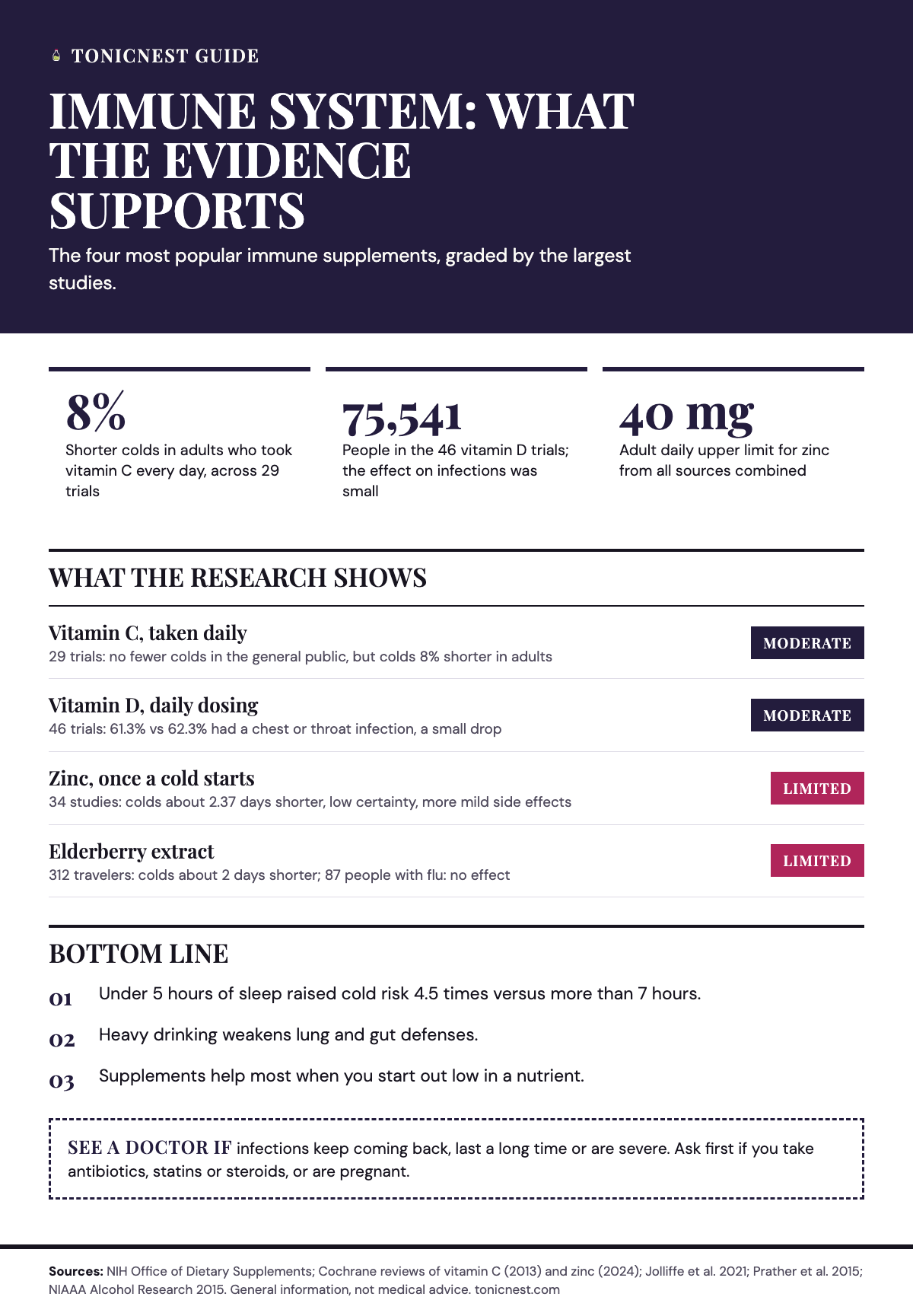
A well-fed, well-rested body already has what it needs, and supplements mostly help people who run low. Regular vitamin C, for example, shortened colds by only about 8% in adults across 29 trials.[7]
| What it is | A network of cells, tissues and organs that helps the body fight infections and other diseases.[1] |
|---|---|
| Main parts | Skin, mucous membranes, white blood cells and lymph organs such as the thymus, spleen, tonsils, lymph nodes and bone marrow.[1] |
| Two layers | Innate defenses act first and are not specific. Adaptive defenses take days or weeks but build memory.[2] |
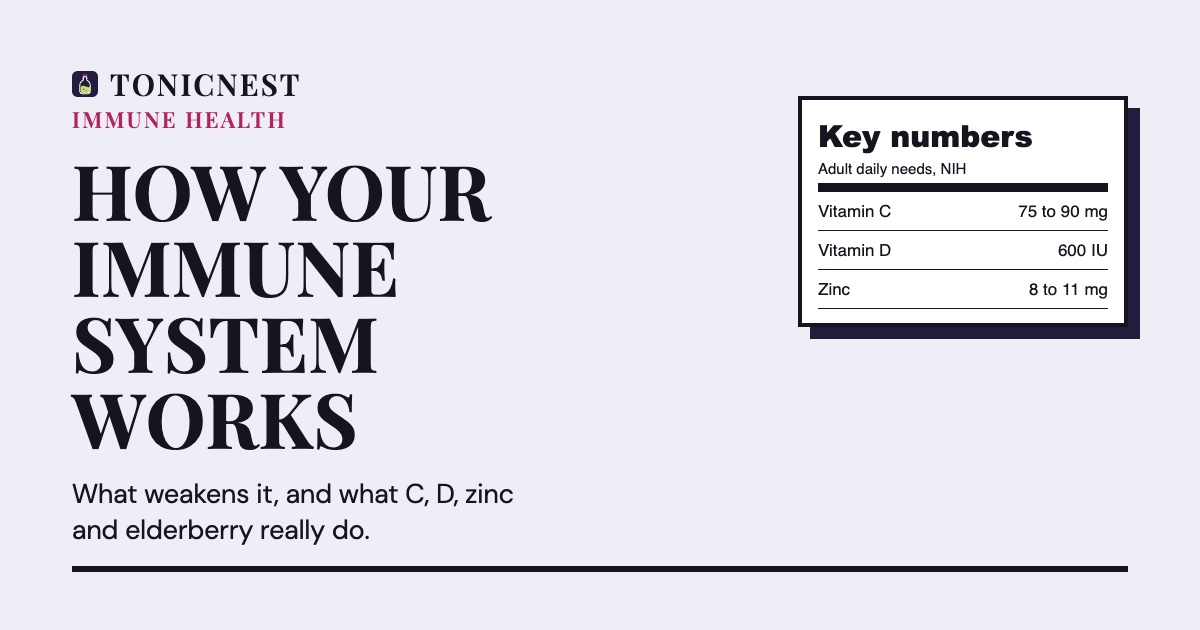
| Daily needs (adults) | Vitamin C 75 to 90 mg, vitamin D 600 IU (800 IU after 70), zinc 8 to 11 mg.[3][4][5] |
| Best supplement evidence | Regular vitamin C and daily vitamin D show small effects on colds and chest infections in large pooled studies.[7][8] |
| Safety | Adult upper limits are 2,000 mg vitamin C, 4,000 IU vitamin D and 40 mg zinc a day.[3][4][5] |
| Who should check first | People on antibiotics, statins, steroids, chemotherapy or diabetes care, and anyone pregnant.[2][3][4][5] |
What is the immune system?
The immune system is a network of cells, tissues and organs that work together to fight infections and other diseases.[1] It spots things that do not belong in the body, such as bacteria, viruses, toxins and damaged cells, and it tries to remove them.[1]
Doctors call these unwanted substances antigens. When the body finds one, it mounts an immune response. Part of that response is making antibodies, which are proteins that attack and weaken the antigen.[1]
The system also keeps a record. After an infection, it remembers the antigen. If the same germ comes back, the body can send the right antibodies quickly, so in most cases you do not get sick. That protection is what people mean by immunity.[1]
Several nutrients matter for this work. The NIH Office of Dietary Supplements lists vitamins A, C, D and E, plus selenium and zinc, as important for normal immune function. Clinical shortfalls of these nutrients weaken immunity and can raise the risk of infection.[2]
How does the immune system work?
Immune system function runs in two stages: a fast, general first response and a slower, targeted second response that learns.[2] The first stage tries to keep germs out or kill them on contact. The second stage builds weapons aimed at one specific germ.[2]
The fast stage uses barriers and general-purpose white blood cells. Skin and the lining of the gut help stop germs from getting in. Neutrophils, macrophages and natural killer cells then hunt down anything that gets past.[2]
The slower stage uses two types of lymphocytes. B cells release antibodies. T cells attack infected cells directly. Both are specific to one germ.[2]
Fighting an infection often causes inflammation. That shows up as redness, swelling, heat and pain. Inflammation helps clear the germ and start healing, but it can also cause symptoms and, in severe cases, damage tissue.[2]
That is why much of the ache and fever of flu comes from your own defenses at work.[2]
What are the types of immunity?
There are three types of immunity: innate immunity you are born with, adaptive (active) immunity you build, and passive immunity you borrow.[1] Each one protects you in a different way and for a different length of time.[1]
Innate immune system
Innate immunity is your first line of defense. It includes the skin and mucous membranes, which block germs from entering, plus cells and chemicals that attack foreign material.[1] It does not recognize a specific germ. It responds the same way to many threats.[2]
Adaptive immunity
Adaptive immunity, also called active immunity, develops after you are infected with a germ or vaccinated against it. It is usually long lasting, and for many diseases it lasts a lifetime.[1] It takes several days or weeks to develop, but it creates immune memory, so a second exposure brings a fast, strong response.[2] Vaccines work by training this adaptive layer ahead of time.[2]
Passive immunity
Passive immunity happens when you receive antibodies instead of making them. Newborns get antibodies from their mothers, and some blood products carry antibodies too. Passive protection works right away but only lasts a few weeks or months.[1]
What are the immune system organs?
The main immune system organs are the thymus, spleen, tonsils, lymph nodes and bone marrow, linked by lymph vessels.[1] These lymph system organs produce, store and carry white blood cells around the body.[1]
Your defenses also include tissues you may not think of as immune organs. The skin is a physical wall against germs. Mucous membranes, the moist linings inside the nose, mouth, lungs and gut, make mucus and other substances that trap and fight germs.[1]
The gut lining is a big part of the picture. NIH describes the gut epithelium, the thin layer of cells that lines the intestine, as one of the physical barriers of innate immunity.[2] Heavy drinking damages that lining, which is one reason alcohol shows up later in this guide.[12]
White blood cells travel through lymph vessels between these sites, which lets the body respond to an infection wherever it starts.[1]
What weakens your immune system?
Poor sleep, long-term stress, heavy drinking and low intake of key nutrients are among the best-studied things that weaken immune defenses. Some medical conditions, such as HIV and inherited immune disorders, weaken them far more.[1]
Sleep has some of the clearest data. In a 2015 study, 164 healthy adults wore sleep trackers for a week and then received cold virus drops in the nose. People who slept under 5 hours a night were 4.5 times more likely (odds ratio 4.50) to catch a cold than those who slept more than 7 hours.[10]
Stress shows a similar pattern. In a classic 1991 study, 394 healthy people were exposed to cold viruses. Rates of clinical colds rose with stress levels, from about 27% to about 47%.[11] If stress is a big factor for you, our guide to ashwagandha benefits and side effects covers what the trials on stress actually found.
Nutrition matters most at the low end. Vitamin C deficiency is uncommon in the United States, affecting about 7% of people age 6 and older, and it is more likely in people who smoke or eat a narrow diet.[2] About 15% of Americans may get only marginal amounts of zinc, and older adults are among the most likely to fall short.[2]
How does alcohol affect your immune system?
Heavy drinking weakens the immune system in the lungs and gut, raising the risk of pneumonia, sepsis and slow healing.[12] Clinicians have long linked excessive alcohol use to these problems, and the list has grown to include acute respiratory distress syndrome and some cancers.[12]
In the airways, alcohol disrupts the tiny hairs (cilia) that sweep germs out. It also impairs immune cells in the lungs and weakens the barrier lining of the lower airways.[12] Lung damage from drinking can go unnoticed until an infection makes it worse.[12]
In the gut, alcohol damages the cells that form the gut barrier and the immune cells that guard it. That lets microbes leak into the bloodstream.[12]
A 2015 NIAAA review notes that binge drinking also affects immune function and makes recovery from injuries such as burns harder.[12] The review does not set a safe drinking level for immunity, so drinking less is the safer choice.
What are immune system disorders?
Immune system disorders happen when the immune system attacks things it should not, or fails to respond well enough.[1] The first group includes allergies, asthma and autoimmune diseases. The second group includes immunodeficiency diseases.[1]
In an autoimmune disease, the immune system attacks healthy cells in your body by mistake.[1] Symptoms depend on which tissue is under attack, so only a doctor can sort them out.
In an immunodeficiency disease, the immune system does not work correctly. People with these conditions get sick more often, and their infections may last longer, be more serious and be harder to treat. Many are genetic.[1]
Some infections damage the immune system directly. HIV destroys white blood cells. Without treatment it can lead to AIDS, in which people develop more and more severe illnesses.[1]
No supplement fixes any of these conditions. If you get infections that are frequent, severe or slow to clear, see a doctor before you reach for a booster.
How do you boost your immune system?
You cannot push a healthy immune system above normal, but you can avoid weakening it by fixing nutrient shortfalls, sleeping enough and limiting alcohol.[2][10][12] For the four supplements people ask about most, the trials show small effects on colds at best, mostly on how long they last.[2]
Vitamin C
A 2013 Cochrane review pooled 29 trials with 11,306 people. In the general public, taking at least 200 mg a day did not reduce the number of colds.[7] It did shorten colds by about 8% in adults and 14% in children. In 598 marathon runners, skiers and soldiers under heavy physical stress, it cut the risk of a cold roughly in half.[7] Starting vitamin C after symptoms began showed no consistent effect.[7]
Vitamin D
A 2021 review of 46 trials with 75,541 people found that 61.3% of the vitamin D group had at least one chest or throat infection, compared with 62.3% on placebo.[8] That is a real but small drop. Daily doses of 400 to 1,000 IU worked best, and the authors called the risk reduction small.[8] Some authors reported funding from supplement makers, which is worth knowing.[8]
Zinc
A 2024 Cochrane review of 34 studies with 8,526 people found that zinc may do little or nothing to stop colds.[9] Taken once a cold starts, it may shorten it by about 2.37 days, but the certainty of that result is low, and mild side effects were more common with zinc than with placebo.[9]
Elderberry
Only a small number of studies exist.[6] In one trial of 312 air travelers, elderberry extract did not reduce the number of colds, but colds were about 2 days shorter.[2] A 2020 trial of 87 people with the flu found no benefit.[2] NIH reviewers describe these studies as small and of poor quality.[2]
We grade each result in two levels. Moderate means several pooled trials with a small, consistent effect. Limited means some trials that are small or of low quality.
| Supplement | Study | Result | Certainty |
|---|---|---|---|
| Vitamin C, taken daily | Cochrane 2013, 29 trials, 11,306 people | No fewer colds in the general public; colds 8% shorter in adults[7] | Moderate |
| Vitamin D, daily or weekly | Jolliffe 2021, 46 trials, 75,541 people | 61.3% vs 62.3% had an infection[8] | Moderate |
| Zinc lozenges or syrup | Cochrane 2024, 34 studies, 8,526 people | No clear prevention; colds about 2.37 days shorter when treated[9] | Limited |
| Elderberry extract | Trials of 312 and 87 people | Shorter colds in one trial, no effect on flu in the other[2] | Limited |
Which supplement fits your situation?
The best match depends on whether you are low in a nutrient, not on how sick you want to avoid getting. Use this table as a starting point for a talk with your doctor, not as a prescription.
| If this sounds like you | Consider | Why |
|---|---|---|
| You eat few fruits and vegetables or you smoke | More vitamin C from food first, a supplement second | Smokers need 35 mg more a day than nonsmokers[3] |
| You get little sun or you are over 70 | Ask about a vitamin D blood test | Protection was linked to daily doses of 400 to 1,000 IU[4][8] |
| You are an older adult with a limited diet | Check zinc intake from food | Older adults are among the most likely to get too little[2] |
| You train hard for endurance events | Regular vitamin C during heavy training | Colds dropped by about half in 598 people under heavy physical stress[7] |
| You already have a cold | Rest and fluids; zinc lozenges only if your doctor agrees | Zinc may shorten colds but raises side effects[9] |
| You are pregnant | Skip elderberry; ask before other supplements | Elderberry safety in pregnancy is unknown[2] |
Safety and who should avoid immune supplements
The usual way people overdo immune supplements is by stacking products that contain the same nutrient. Upper limits count food, drinks and supplements together.[3][5]
- Vitamin C: more than 2,000 mg a day can cause diarrhea, nausea and stomach cramps. If you are getting chemotherapy or radiation, ask your care team before taking it.[3]
- Vitamin D: the adult upper limit is 4,000 IU a day. It can interact with orlistat, statins, steroids such as prednisone and thiazide diuretics.[4]
- Zinc: the adult upper limit is 40 mg a day. Too much for too long can lower immunity, lower HDL cholesterol and cause low copper. Take quinolone or tetracycline antibiotics 2 hours before, or 4 to 6 hours after, zinc.[5]
- Elderberry: raw or unripe berries, leaves and stems can cause nausea, vomiting and severe diarrhea; cooking removes the toxin.[6] People with diabetes should use it with caution, and pregnant women should avoid it.[2]
See a doctor if you have infections that keep coming back, a fever that will not break, trouble breathing, or wounds that heal slowly. Do not rely on elderberry for COVID-19.[6]
What do doctors use first?
Doctors rely on vaccines, treatment of any underlying condition, and correcting proven deficiencies before they think about immune supplements. Vaccines train the adaptive immune response so the body can react fast when it meets a germ later.[1][2]
For people who get sick often, the first step is finding out why. That may mean testing for an immune disorder, HIV or a nutrient deficiency.[1] If a blood test shows low vitamin D, a doctor may prescribe a higher dose for a set time, which is different from a daily over-the-counter habit.[4]
Supplements do not replace these steps. As NCCIH points out, supplements are not approved by the FDA before they are sold, and makers are responsible for their own safety and labeling.[6]
Immune health checklist
- Aim for more than 7 hours of sleep a night.[10]
- Keep alcohol low, and avoid binge drinking.[12]
- Eat fruits and vegetables daily to cover 75 to 90 mg of vitamin C.[3]
- Ask your doctor whether a vitamin D test makes sense for you.[4]
- Add up the zinc in every product you take and stay under 40 mg a day.[5]
- Buy elderberry only as a processed product, never raw berries, and remember some products have been found diluted.[2][6]
- Read labels for doses and third-party testing. Our label checks explain what we look for.
- Keep vaccines up to date. They train adaptive immunity ahead of an infection.[1][2]
Bottom line
Your immune system is built to work without extra help, as long as it is not short on sleep, nutrients or recovery. The research on vitamin C, vitamin D, zinc and elderberry points to small effects, mostly shorter colds, and mostly in people who start out low.[2][7][8][9]
For most people, more sleep and less alcohol make a better first step than a booster capsule, because the data on sleep and alcohol are firmer than the supplement data. If you want to read more on this topic, browse our immunity, energy and lungs section.
Frequently asked questions
What is immunity?
Immunity is protection against a disease. After your body fights a germ, it remembers it and can send the right antibodies quickly the next time, so in most cases you do not get sick. Vaccines build the same kind of memory without the illness.
What is the adaptive defense?
The adaptive defense is the part of the immune system that targets one specific germ. B cells make antibodies and T cells attack infected cells. It takes several days or weeks to build, but it creates memory that speeds up the response next time.
Do immune system booster capsules work?
Most immune booster capsules contain vitamin C, vitamin D, zinc or elderberry. Trials show small effects at best, mostly shorter colds, and mainly in people who start out low. They do not raise a healthy immune system above normal or replace vaccines.
Is it better to get vitamin C from food or pills?
Food is the first choice for most people. Adults need only 75 to 90 mg a day, an amount fruits and vegetables cover easily. Pills make sense for people who eat few fruits and vegetables, smoke, or train very hard.
How long does passive immunity last?
Passive immunity lasts only a few weeks or months. It comes from antibodies you receive rather than make yourself, such as those a newborn gets from its mother or those in some blood products. It protects right away but fades.
Sources
- Immune System and Disorders. MedlinePlus, National Library of Medicine
- Dietary Supplements for Immune Function and Infectious Diseases: Fact Sheet for Health Professionals. NIH Office of Dietary Supplements
- Vitamin C: Fact Sheet for Consumers. NIH Office of Dietary Supplements
- Vitamin D: Fact Sheet for Consumers. NIH Office of Dietary Supplements
- Zinc: Fact Sheet for Consumers. NIH Office of Dietary Supplements
- Elderberry: Usefulness and Safety. NCCIH
- Vitamin C for preventing and treating the common cold. Cochrane Database of Systematic Reviews, 2013
- Vitamin D supplementation to prevent acute respiratory infections: a systematic review and meta-analysis. Lancet Diabetes and Endocrinology, 2021
- Zinc for prevention and treatment of the common cold. Cochrane Database of Systematic Reviews, 2024
- Behaviorally assessed sleep and susceptibility to the common cold. Sleep, 2015
- Psychological stress and susceptibility to the common cold. New England Journal of Medicine, 1991
- Alcohol and the Immune System. Alcohol Research: Current Reviews (NIAAA), 2015
This article is general information, not medical advice. Dietary supplements are not reviewed by the FDA for safety or effectiveness before they are sold. Talk to your doctor before you start any supplement, especially if you are pregnant, nursing, take medication or have a health condition.