Healthy adults need at least 0.8 grams of protein per kilogram of body weight a day, about 46 grams for women and 56 grams for men. The 2025-2030 Dietary Guidelines aim higher, at 1.2 to 1.6 grams per kilogram. Older adults, people who lift weights and people cutting calories tend to do best near that higher range.
On this page
- How much protein should I eat daily?
- How many grams of protein per day for women and men?
- How do you calculate how much protein per day you need?
- How much protein do you need if you exercise?
- Do older adults need more protein per day?
- Does a high protein diet help with weight loss?
- Which foods have the most protein per serving?
- What does the research show about protein intake?
- Is too much protein bad for you, and who should be careful?
- What do doctors and dietitians use first?
- Bottom line on daily protein
- FAQ
How much protein should I eat daily? To answer that, we read the federal Dietary Guidelines, the official intake tables, USDA food data, an expert panel on older adults, two meta-analyses on muscle and weight loss, a review on kidney safety and guidance from NIDDK and the National Institute on Aging.[1][2][3][5][7][9][10][11][12] Below, we turn how much protein per day you need into grams you can count, by weight, sex, age and goal.
The short answer: the minimum for healthy adults is 0.8 grams per kilogram of body weight a day, about 46 grams for women and 56 grams for men, while the 2025-2030 Dietary Guidelines set a goal of 1.2 to 1.6 grams per kilogram.[4][2][1]
| What protein is | A macronutrient made of amino acids; adults should get 10% to 35% of calories from it[2] |
|---|---|
| Minimum (RDA) | 0.8 g per kg of body weight a day, set to maintain nitrogen balance[4] |
| Typical adult amounts | 46 g a day for women, 56 g for men, 71 g in pregnancy and breastfeeding[2] |
| Current goal range | 1.2 to 1.6 g per kg a day in the 2025-2030 Dietary Guidelines[1] |
| Best evidence | 49 trials found muscle gains with lifting level off near 1.62 g per kg[7] |
| Safety | 28 trials in people without kidney disease found no difference in kidney filtration on higher intakes[10] |
| Ask a doctor first | Chronic kidney disease, where protein may need to be moderate[11] |
How much protein should I eat daily?
Most healthy adults need at least 0.8 grams of protein per kilogram of body weight each day, and the newest federal guidelines aim higher, at 1.2 to 1.6 grams per kilogram.[4][1] The 0.8 figure is the Recommended Dietary Allowance (RDA). It applies to all adults regardless of age.[4]
The RDA is a floor. A 2018 review in Nutrients explains that it was “derived as a minimum amount to maintain nitrogen balance,” which means it covers losses, not every goal.[4] That is why the 2025-2030 Dietary Guidelines for Americans give a higher goal of 1.2 to 1.6 grams per kilogram, adjusted for your calorie needs.[1]
The RDA is the lowest safe daily amount, and the higher range reflects newer thinking about muscle, aging and appetite. If you eat a typical mixed diet, you may already be near the low end of the higher range.
A second way to check is by calories. Adults are advised to get 10% to 35% of their calories from protein, so a 2,000 calorie day leaves room for anywhere from 50 to 175 grams.[2] Most people land well inside that window.
How many grams of protein per day for women and men?
The RDA works out to 46 grams of protein a day for women 19 and older and 56 grams for men 19 and older.[2] During pregnancy and breastfeeding, the target rises to 71 grams a day.[2] These figures come from the intake tables in the Dietary Guidelines appendix.
The gap between women and men reflects average body size, not a different rule. Both use the same 0.8 grams per kilogram.[4] A woman who weighs 180 pounds needs more than a man who weighs 130 pounds.
| Group | Grams a day | Notes |
|---|---|---|
| Women 19 and older | 46 g | Based on average body weight[2] |
| Men 19 and older | 56 g | Based on average body weight[2] |
| Pregnancy | 71 g | Higher need for the growing baby[2] |
| Breastfeeding | 71 g | Same as pregnancy[2] |
If you are pregnant, ask your prenatal care team before using a protein powder. Food sources such as eggs, dairy, beans and cooked fish cover most needs.[12]
How do you calculate how much protein per day you need?
Divide your weight in pounds by 2.2 to get kilograms, then multiply by 0.8 for the minimum or by 1.2 to 1.6 for the higher goal.[4][1] That is all most protein calculators do. Per pound, those factors are about 0.36, 0.55 and 0.73 grams.
Here is that math for four common weights. Round to the nearest 5 grams; your body does not need a precise number.
| Weight | Minimum (0.8 g/kg) | Goal (1.2 to 1.6 g/kg) |
|---|---|---|
| 130 lb (59 kg) | 47 g | 71 to 95 g[4][1] |
| 150 lb (68 kg) | 55 g | 82 to 109 g[4][1] |
| 180 lb (82 kg) | 65 g | 98 to 131 g[4][1] |
| 210 lb (95 kg) | 76 g | 115 to 153 g[4][1] |
One limit: these tables use your actual weight. We found no source we trust on using an adjusted weight for people with obesity, so ask a dietitian if your weight is well above the healthy range.
How much protein do you need if you exercise?
People who do regular exercise usually do well on 1.4 to 2.0 grams of protein per kilogram a day, according to the International Society of Sports Nutrition.[8] For lifting, the extra muscle gain appears to level off near 1.6 grams per kilogram.[7]
The best data come from a 2018 meta-analysis by Morton and colleagues. It pooled 49 trials with 1,863 people who did resistance training. Protein supplements added a modest boost to muscle size and strength, but intakes above 1.62 grams per kilogram “resulted in no further” gains in lean mass.[7] Some authors had dairy industry funding, which is worth knowing.
If you lift three or four times a week, 1.6 grams per kilogram is a sensible ceiling to aim for. The ISSN also suggests 20 to 40 grams per dose, or about 0.25 grams per kilogram per meal.[8]
Collagen is a protein too, but it is low in some essential amino acids. We looked at what trials show in our guide on whether collagen supplements work.
Do older adults need more protein per day?
An expert panel called PROT-AGE advises adults over 65 to eat at least 1.0 to 1.2 grams of protein per kilogram a day, more than the standard RDA.[5] The panel suggests 1.2 grams or more for active older adults and 1.2 to 1.5 grams for those with acute or chronic illness.[5]
Adults lose muscle with age, and a higher intake may help slow that loss. The Health ABC study followed 2,066 adults aged 70 to 79 for three years. Those in the highest fifth of protein intake lost about 40% less lean mass than those in the lowest fifth.[6] That study was observational, so it shows a link, not proof.
PROT-AGE also notes that people with severe kidney disease who are not on dialysis may need to limit protein.[5] The National Institute on Aging suggests adding seafood, dairy, fortified soy, beans, peas and lentils to meals.[12] If you are weighing anti-aging pills, our NMN benefits guide shows how thin that evidence is next to basic protein intake.
Does a high protein diet help with weight loss?
In calorie-cut diets, eating more protein led to slightly more fat loss and helped keep muscle, but the effect was small.[9] A 2012 meta-analysis by Wycherley and colleagues pooled 24 trials with 1,063 people over an average of 12.1 weeks.[9]
Compared with standard protein diets at the same calories, the higher protein diets produced 0.79 kg more weight loss and 0.87 kg more fat loss. They also kept 0.43 kg more lean mass.[9] The authors called these “modest benefits.”[9]
That is about 2 pounds over three months. Protein helps you feel full, but calories still decide the result. Higher protein is a reasonable tool if you are cutting calories, as long as the calorie cut is still there.
Which foods have the most protein per serving?
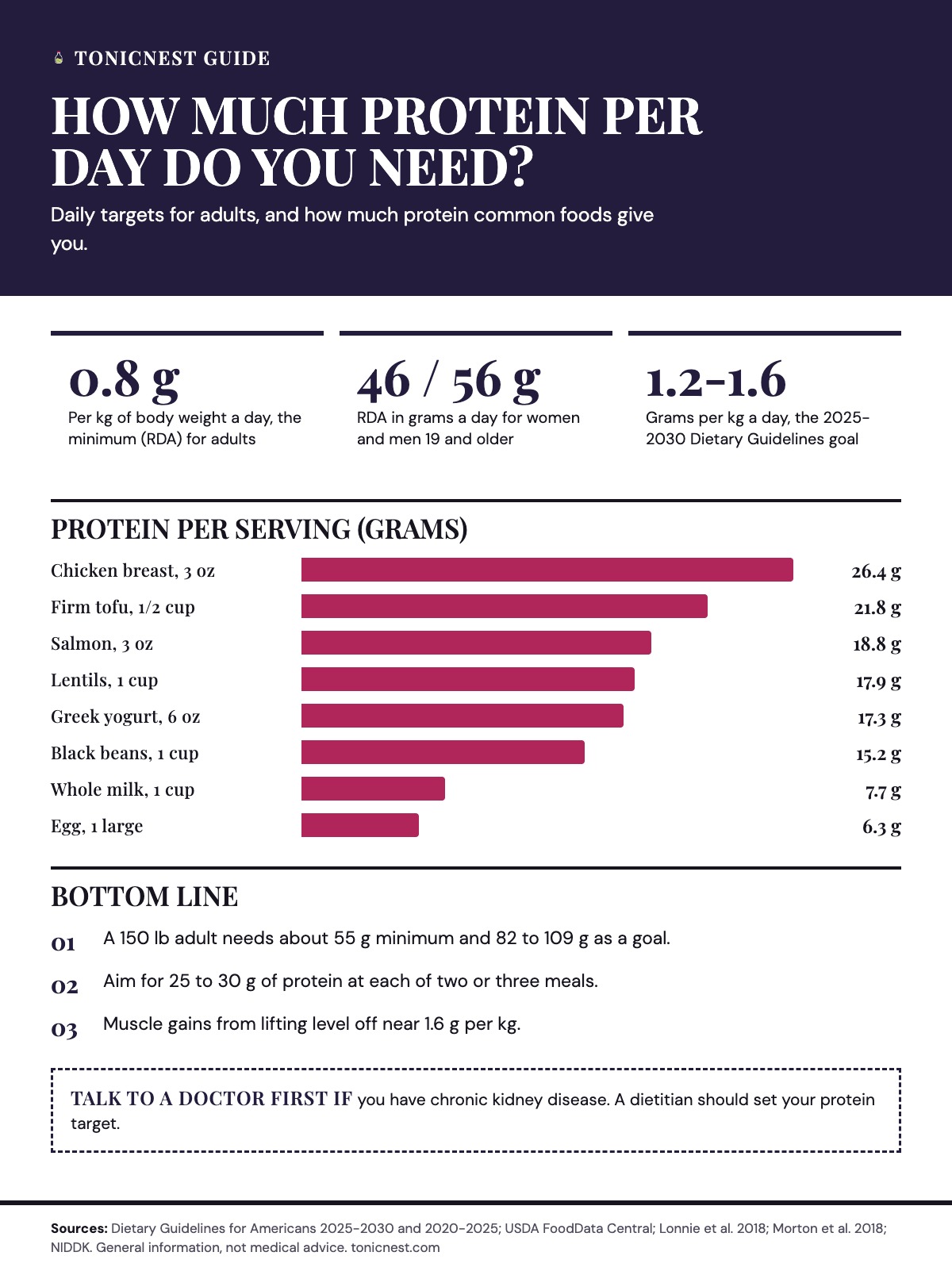
Meat, poultry, fish, tofu, beans, lentils and Greek yogurt give the most protein per normal serving.[3] We took protein per 100 grams from USDA FoodData Central and scaled it to common serving sizes.[3]
| Food and serving | Protein |
|---|---|
| Chicken breast, roasted, 3 oz | 26.4 g[3] |
| Firm tofu, 1/2 cup | 21.8 g[3] |
| Farmed salmon, cooked, 3 oz | 18.8 g[3] |
| Lentils, cooked, 1 cup | 17.9 g[3] |
| Greek yogurt, nonfat, 6 oz (170 g) | 17.3 g[3] |
| Black beans, cooked, 1 cup | 15.2 g[3] |
| Whole milk, 1 cup | 7.7 g[3] |
| Peanut butter, 2 tbsp | 7.1 g[3] |
| Egg, 1 large | 6.3 g[3] |
| Almonds, 1 oz | 6.0 g[3] |
The Dietary Guidelines count one protein serving as 3 ounces of cooked meat, poultry or seafood, 1 egg or half a cup of beans.[1] Plant foods count the same, and beans and lentils bring fiber as well.
A sample 89 gram day for a 150 pound adult
A review on protein through life suggests two to three meals a day, each with about 25 to 30 grams of high-quality protein.[4] Here is one way to hit the 82 to 109 gram goal for a 150 pound adult using the foods above.[3]
- Breakfast: 6 oz Greek yogurt with 1 oz almonds, about 23 g.
- Lunch: 1 cup cooked lentils with 1 egg, about 24 g.
- Snack: 1 cup whole milk with 2 tbsp peanut butter on toast, about 15 g (more with the bread).
- Dinner: 3 oz roasted chicken breast with vegetables, about 26 g.
- Day total: about 89 g, not counting grains and vegetables.
What does the research show about protein intake?
Large pooled trials support moderate protein increases for muscle and weight loss, with clear limits on how much extra helps. The table below sums up the main studies we used.
| Study | Who and how many | Length or intake | Result |
|---|---|---|---|
| Morton et al., 2018 | 49 trials, 1,863 adults lifting weights | Plateau near 1.62 g/kg | Modest extra muscle gain[7] |
| Wycherley et al., 2012 | 24 trials, 1,063 adults dieting | About 12.1 weeks | 0.87 kg more fat loss[9] |
| Houston et al., 2008 (Health ABC) | 2,066 adults aged 70 to 79 | 3 years | About 40% less lean mass lost, observational[6] |
| Devries et al., 2018 | 28 trials, 1,358 adults without kidney disease | 1.5 g/kg or more, or 100 g a day or more | No difference in kidney filtration change[10] |
Is too much protein bad for you, and who should be careful?
For healthy adults, higher protein intakes did not harm kidney function in trials, but people with chronic kidney disease may need to keep protein moderate.[10][11] Devries and colleagues pooled 28 trials with 1,358 adults and found the change in kidney filtration “did not differ” between higher and normal protein diets.[10]
That finding covers people without kidney disease only. NIDDK says some people with CKD “may need to consume moderate amounts of protein so waste doesn’t build up in the blood.” It also warns that too little protein can lead to malnutrition.[11] NIDDK gives no single gram target, so a kidney dietitian should set yours.
Be careful or ask a doctor first if you:
- Have chronic kidney disease or reduced kidney function[11]
- Are pregnant or breastfeeding and thinking about protein powder[2]
- Are over 65 and losing weight without trying[5]
- Have an acute or chronic illness that changes your protein needs[5]
We found no long-term data on eating more than 2 grams per kilogram for decades, so we do not suggest going that high.
What do doctors and dietitians use first?
Doctors and dietitians start with food: a mix of seafood, dairy, soy, beans, peas, lentils, eggs and lean meat spread over the day.[12][1] Protein powder is optional, useful mainly on days when meals fall short.
For older adults, the National Institute on Aging suggests adding protein foods to meals you already eat.[12] For kidney disease, NIDDK points people to a dietitian who can balance protein against waste buildup.[11] You can read how we weigh evidence like this on our how we review page, and find more food-first guides in our nutrition and diet section.
Practical protein checklist
- Work out your weight in kilograms (pounds divided by 2.2).
- Multiply by 0.8 for the minimum and by 1.2 to 1.6 for the goal range.[4][1]
- Aim for about 25 to 30 grams at each of two or three meals.[4]
- If you lift weights, stop adding protein past about 1.6 g/kg.[7]
- If you buy a protein powder, read the label for grams of protein per scoop and serving size.
- If you have kidney disease, ask for a dietitian referral before changing intake.[11]
Bottom line on daily protein
Start with 0.8 grams per kilogram as your floor, then aim for 1.2 to 1.6 grams per kilogram if you are active, over 65 or cutting calories.[4][1][5] For a 150 pound adult, that is roughly 55 grams minimum and 82 to 109 grams as a goal.
For most people, adding a protein food to each meal is a better first step than buying a powder, because food brings fiber and other nutrients and the extra muscle benefit levels off near 1.6 grams per kilogram anyway.[7] If you have kidney disease, let your care team set the number.
Frequently asked questions
How much protein per pound should I eat a day?
The minimum is about 0.36 grams per pound of body weight, which equals the 0.8 grams per kilogram RDA. The 2025-2030 goal of 1.2 to 1.6 grams per kilogram works out to about 0.55 to 0.73 grams per pound.
What is the recommended protein intake as a share of calories?
Adults are advised to get 10% to 35% of their daily calories from protein. On a 2,000 calorie day, that is roughly 50 to 175 grams, a wide range that most people already fall inside.
Is 100 grams of protein a day too much?
For a healthy adult who weighs about 150 pounds or more, 100 grams sits inside the 1.2 to 1.6 grams per kilogram goal. Trials in people without kidney disease found no harm to kidney filtration at 100 grams or more a day.
Should I spread protein across meals?
Yes, that is a reasonable approach. A review on protein through life suggests two to three meals a day with about 25 to 30 grams of high-quality protein each, and sports nutrition experts suggest 20 to 40 grams per dose.
Do I need a protein powder to hit my daily target?
No. Most people can reach their target with food such as chicken, fish, tofu, lentils, beans, eggs and Greek yogurt. A powder is handy on days when meals fall short, but food covers the need for most adults.
Sources
- Dietary Guidelines for Americans, 2025-2030. US HHS and USDA, 2026
- Dietary Guidelines for Americans, 2020-2025, Appendix 1: Nutritional Goals. USDA and HHS, 2020
- FoodData Central (SR Legacy entries for chicken, tofu, salmon, lentils, yogurt, beans, milk, peanut butter, egg, almonds). USDA Agricultural Research Service
- Protein for Life: Review of Optimal Protein Intake, Sustainable Dietary Sources and the Effect on Appetite in Ageing Adults. Lonnie M et al. Nutrients, 2018
- Evidence-based recommendations for optimal dietary protein intake in older people: a position paper from the PROT-AGE Study Group. Bauer J et al. J Am Med Dir Assoc, 2013
- Dietary protein intake is associated with lean mass change in older, community-dwelling adults: the Health ABC Study. Houston DK et al. Am J Clin Nutr, 2008
- A systematic review, meta-analysis and meta-regression of the effect of protein supplementation on resistance training-induced gains in muscle mass and strength. Morton RW et al. Br J Sports Med, 2018
- International Society of Sports Nutrition Position Stand: protein and exercise. Jager R et al. J Int Soc Sports Nutr, 2017
- Effects of energy-restricted high-protein, low-fat compared with standard-protein, low-fat diets: a meta-analysis of randomized controlled trials. Wycherley TP et al. Am J Clin Nutr, 2012
- Changes in Kidney Function Do Not Differ between Healthy Adults Consuming Higher- Compared with Lower- or Normal-Protein Diets: A Systematic Review and Meta-Analysis. Devries MC et al. J Nutr, 2018
- Eating Right for Chronic Kidney Disease. NIDDK, National Institutes of Health
- Healthy Meal Planning: Tips for Older Adults. National Institute on Aging
This article is general information, not medical advice. Dietary supplements are not reviewed by the FDA for safety or effectiveness before they are sold. Talk to your doctor before you start any supplement, especially if you are pregnant, nursing, take medication or have a health condition.