Collagen supplements show small gains in skin elasticity, hydration and wrinkles when all trials are pooled, but a 2025 review of 23 trials found no effect in studies without company funding. Short-term joint pain relief is possible, with very low quality evidence. Sunscreen and strength training have stronger support, and third-party testing matters more than marine or multi-type labels.
On this page
- What is collagen, and is collagen a protein?
- Do collagen supplements work?
- What are the collagen benefits for skin?
- Does collagen powder work for joint pain?
- What are collagen peptides benefits for bone and muscle?
- Does the type of collagen matter: marine, bovine, type I, II or III?
- What are collagen supplements side effects, and who should avoid them?
- What do doctors suggest first for skin and joints?
- Bottom line on collagen supplements
- FAQ
Do collagen supplements work? To answer that, we read two meta-analyses of skin trials, a review of 69 osteoarthritis supplement trials, four single trials on joints, bone and muscle, and guidance from Harvard’s Nutrition Source, MedlinePlus, NIAMS, NCCIH and the NIH Office of Dietary Supplements.[1][2][4][3] We also noted who paid for each study, since funding ended up shaping the answer.
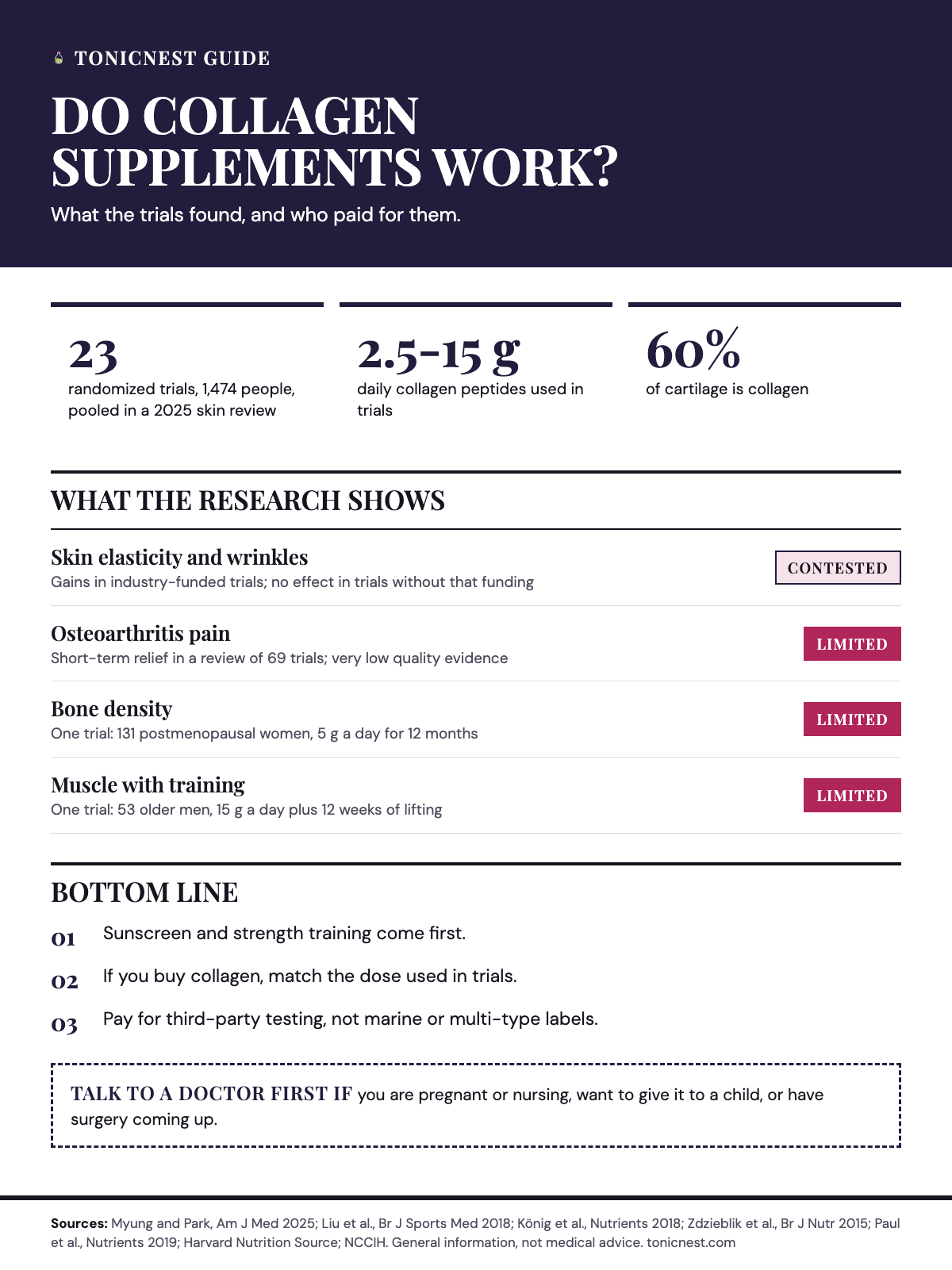
The short answer: a 2025 review pooled 23 randomized trials with 1,474 people and found small skin gains overall, yet the trials without company funding showed no effect on hydration, elasticity or wrinkles.[1]
| What it is | The most abundant protein in the body, sold as hydrolyzed collagen or collagen peptides[3] |
|---|---|
| Main uses studied | Skin aging, joint pain, bone density and muscle with exercise[1][4][6][7] |
| Amounts used in trials | 2.5 to 15 g a day of peptides; 40 mg a day for undenatured type II collagen[8][5] |
| Best evidence | Skin trials look positive when pooled, but not in trials free of industry funding[1] |
| Joints | Short-term pain relief in osteoarthritis trials, with very low quality evidence[4] |
| Safety | No negative side effects reported in trials; heavy metal contamination is a concern[3] |
| Check with a doctor first | Pregnant or nursing, giving it to a child, or having surgery soon[11] |
What is collagen, and is collagen a protein?
Collagen is a structural protein, the most abundant one in the body, and it forms the fibers in skin, bone, tendons and cartilage.[3] It makes tissue strong enough to stretch without tearing. About 60% of cartilage is collagen.[3]
Your body makes less collagen with age. Harvard’s Nutrition Source says production drops fastest with too much sun, smoking, heavy drinking, poor sleep and little exercise.[3] Sun is the biggest single driver of skin aging, according to MedlinePlus.[9]
Yes, collagen is a protein, but an incomplete one. It lacks tryptophan, one of the amino acids your diet must supply.[8] That makes it a poor swap for your main protein foods. A 2019 analysis, written with an author from collagen maker GELITA, calculated that collagen could replace up to 36% of daily protein before amino acid balance suffers.[8]
When you swallow collagen, digestion breaks it into amino acids and short peptides. Your body then sends those wherever it needs protein most, which may or may not be your face.[3]
Do collagen supplements work?
Collagen supplements show modest benefits in many trials, but the effect largely disappears in independent, high-quality studies.[1] The evidence is limited and contested. Most published research was paid for, at least in part, by companies that sell collagen.[3]
The clearest test came in 2025. Researchers Myung and Park searched three databases through June 14, 2024, and pooled 23 randomized trials.[1] All trials together showed better hydration, elasticity and wrinkles. Then they split trials by funding. Trials paid for by companies showed gains. Trials without that funding showed none.[1] High-quality trials also showed no significant effect in any skin measure.[1]
An earlier 2021 review of 19 trials and 1,125 people, 95% of them women, reached a positive verdict after about 90 days of use.[2] It did not split results by who paid. That gap explains why two reviews of nearly the same trials can read so differently.
For joints, a 2018 review in the British Journal of Sports Medicine found short-term pain relief from collagen hydrolysate, but rated the overall evidence very low quality.[4]
What are the collagen benefits for skin?
The skin benefits reported in trials are small changes in elasticity, hydration and wrinkle depth, measured with lab devices over about 90 days.[2] Those results come mostly from industry-funded studies.[1][3] Whether a person would see the change in a mirror is not clear from the data.
The 2021 meta-analysis of 19 trials covered people aged 20 to 70.[2] It pooled studies of different products and doses, which makes a single best product or dose impossible to name. The 2025 review found that when you remove funded and low-quality trials, the skin effect is no longer there.[1]
Collagen fibers sit deep in the skin, not on the surface. That is why Harvard notes that dermatologists have long doubted collagen creams, since the molecules are too large to pass through the outer skin.[3]
The skin steps with stronger support are cheaper. MedlinePlus advises avoiding sunburn, using sunscreen outdoors even in winter, and keeping skin moist with lotion.[9] Browse our skincare and anti-aging guides for more on those basics.
Does collagen powder work for joint pain?
Collagen powder may ease osteoarthritis pain for a few weeks or months, but no supplement in the largest review showed meaningful relief in the long term.[4] The 2018 review by Liu and colleagues covered 69 trials of 20 supplements for hand, hip and knee osteoarthritis.[4]
Collagen hydrolysate was one of 7 supplements with a large short-term effect on pain (effect size above 0.80).[4] Undenatured type II collagen was one of only two with a meaningful effect at the medium term. None had clinically important effects at long-term follow-up.[4] The authors graded the evidence from very low to high, and very low overall. They declared no competing interests.[4]
The best known type II trial, from 2016, gave 191 adults with knee osteoarthritis 40 mg of undenatured type II collagen, glucosamine plus chondroitin, or placebo for 180 days.[5] The collagen group scored better on the WOMAC joint index than both other groups.[5] Two of its three authors worked for InterHealth Nutraceuticals, the company behind that ingredient.[5] One company-run trial is a signal that still needs independent repeats.
What are collagen peptides benefits for bone and muscle?
Single trials suggest collagen peptides may support bone density in postmenopausal women and muscle gains in older men who lift weights, but each finding rests on one study.[6][7] Both trials included a co-author from the Collagen Research Institute in Kiel, Germany.[6][7]
In the bone trial, 131 postmenopausal women with low bone density took 5 g of specific collagen peptides or placebo daily for 12 months.[6] Only 102 finished. Spine T-scores rose by 0.1 with collagen and fell by 0.03 with placebo.[6] That is a small shift, and the women were not followed for fractures.
In the muscle trial, 53 men with sarcopenia, average age 72, did resistance training three times a week for 12 weeks.[7] Those taking 15 g of collagen peptides gained 4.2 kg of fat-free mass, against 2.9 kg on placebo.[7] The placebo was silica, not another protein, so the trial cannot show collagen beats any protein powder.
For collagen supplements for women and for men alike, keep the scale in mind. In the muscle trial, training drove most of the gain, and each finding still rests on a single study.
| Study | Who and how long | Dose | Result |
|---|---|---|---|
| Myung and Park, 2025 review[1] | 23 trials, 1,474 people | Varied | Skin gains overall; no effect in trials without industry funding |
| de Miranda, 2021 review[2] | 19 trials, 1,125 people aged 20 to 70 | Varied, about 90 days | Better hydration, elasticity and wrinkles; funding not analyzed |
| Liu, 2018 review[4] | 69 osteoarthritis trials, 20 supplements | Varied | Short-term pain relief; no long-term benefit; very low quality evidence |
| Lugo, 2016 trial[5] | 191 adults, knee osteoarthritis, 180 days | 40 mg type II | Better WOMAC scores; authors from the ingredient maker |
| König, 2018 trial[6] | 131 postmenopausal women, 12 months | 5 g peptides | Small rise in spine and hip T-scores |
| Zdzieblik, 2015 trial[7] | 53 men aged about 72, 12 weeks of training | 15 g peptides | 4.2 kg vs 2.9 kg fat-free mass gain |
Does the type of collagen matter: marine, bovine, type I, II or III?
In the studies we read, the dose and form used in the trial mattered more than the animal source, and no trial compared marine with bovine collagen head to head. Premium labels often lean on fish sources, type numbers or “hydrolyzed” wording to justify a higher price.
Skin, bone and muscle studies used hydrolyzed collagen peptides at 2.5 to 15 g a day.[8][6][7] The joint trial that used type II collagen gave only 40 mg a day of an undenatured ingredient from chicken sternum cartilage.[5] Those are two different products with different doses. A powder that lists “type I, II and III” in one scoop does not copy either design.
Hydrolyzed and peptide forms are simply collagen broken into shorter pieces that absorb more easily.[3] Hydrolyzed is the standard form in collagen research, so the word alone does not justify a premium.
| If the label claims | What the trials used | What to do |
|---|---|---|
| Marine collagen absorbs better | No head-to-head trial in our sources | Do not pay more for the fish source alone |
| Type I, II and III blend | Peptide trials used 2.5 to 15 g; type II trial used 40 mg undenatured[8][5] | Match the dose to the trial you care about |
| Hydrolyzed peptides | Standard form in skin, bone and muscle trials[2][6][7] | Expected, so not worth extra |
| Third-party tested | Seals confirm contents and contaminant limits[12] | Worth paying for, given heavy metal concerns[3] |
| Added vitamin C, biotin or zinc | Not tested in the trials above | Check you do not already get these elsewhere |
Label checks before you pay more
- Find the grams of collagen per serving on the Supplement Facts label, and compare it with the 2.5 to 15 g range used in trials.[8][12]
- Look for a seal from NSF International, U.S. Pharmacopeia or ConsumerLab.com, which test that the label matches the contents.[12]
- Treat “verified” or “certified” without a named tester as marketing, since NCCIH says those words do not guarantee quality.[11]
- Check the source animal if you avoid fish, beef or pork for diet reasons.
- Work out the cost per gram of collagen, not per scoop or per jar.
- Read how we review supplements for the checks we run on labels and testing claims.
What are collagen supplements side effects, and who should avoid them?
Trials have not shown negative side effects from collagen supplements, but contamination and missing safety data for some groups are real gaps.[3] Harvard flags concerns about heavy metals in collagen products and notes the label may not match what is inside.[3]
The safety record in trials looks clean. In the 180-day knee trial, safety outcomes did not differ between collagen, glucosamine plus chondroitin, and placebo.[5] The 2018 osteoarthritis review found no safety differences between most supplements and placebo.[4]
The FDA does not review dietary supplements for safety or effectiveness before they are sold.[11] Companies must follow manufacturing rules, and the FDA can act after a product is on the market.[12]
Talk to a doctor before taking collagen if you:
- Are pregnant, nursing or trying to conceive, since many supplements have not been tested in these groups.[11]
- Want to give it to a child.[11]
- Have surgery coming up, and tell your surgical team about every supplement you take.[11]
- Notice any side effect. Stop taking it and contact your health care provider.[11]
What do doctors suggest first for skin and joints?
For aging skin, sun protection comes first; for osteoarthritis, exercise and weight management come first.[9][10] A collagen supplement is not a replacement for either.
MedlinePlus says most skin aging is tied to sun exposure, so prevention is lifelong. Avoid sunburn, wear sunscreen outdoors in every season and use moisturizer.[9]
For osteoarthritis, NIAMS lists range-of-motion work, strengthening with weights or bands, water exercise and balance training.[10] Losing weight, if you carry extra, can reduce stress and pain in knees and hips.[10] Doctors may add oral pain relievers or anti-inflammatory medicines, and surgery is considered when damage is extensive.[10]
Food helps your body make its own collagen. Fish, poultry, eggs, dairy, beans and soy supply the amino acids, while citrus, berries and peppers supply vitamin C and shellfish, nuts and whole grains supply zinc.[3]
Bottom line on collagen supplements
Collagen looked safe in the trials so far, and it may ease joint pain in the short term.[3][4] The skin claims are where the gap is widest: the effect shows up in company-funded trials and fades in independent ones.[1]
For most people, daily sunscreen and regular strength training are the better first spend, because the evidence behind them is stronger and the cost is lower.[9][10] If you still want collagen, buy a third-party tested peptide powder at a trial-matched dose, and skip the premium for marine or multi-type labels.[12][8]
Frequently asked questions
What is collagen good for?
Collagen gives skin, bone, tendons and cartilage their strength. As a supplement, it has been studied for skin aging, joint pain, bone density and muscle with exercise, but most evidence is limited and much of it was funded by collagen makers.
Is collagen good for you?
For most adults, collagen appears safe, and trials have not reported negative side effects. It is an incomplete protein because it lacks tryptophan, so it should not replace main protein foods like fish, eggs, dairy or beans.
How long does collagen take to work?
One skin review based its findings on about 90 days of daily use. The knee trial ran 180 days and the bone trial 12 months. Three months is a fair point to judge whether it is worth the cost.
Can you get collagen from food instead?
Yes. Tough cuts of meat, fish skin, gelatin and bone broth contain collagen, though broth supplies only about 5 to 10 grams of protein per cup. Your body also builds collagen from protein foods plus vitamin C and zinc.
Are collagen drinks better than collagen powder?
No trial we read compared drinks with powders. What matters is the grams of collagen per serving, the form used in trials and independent testing. Drinks often cost more per gram and may add sugar or flavorings.
Sources
- Effects of Collagen Supplements on Skin Aging: A Systematic Review and Meta-Analysis of Randomized Controlled Trials. Myung SK, Park Y. American Journal of Medicine, 2025
- Effects of hydrolyzed collagen supplementation on skin aging: a systematic review and meta-analysis. de Miranda RB et al. International Journal of Dermatology, 2021
- Collagen. The Nutrition Source, Harvard T.H. Chan School of Public Health
- Dietary supplements for treating osteoarthritis: a systematic review and meta-analysis. Liu X et al. British Journal of Sports Medicine, 2018
- Efficacy and tolerability of an undenatured type II collagen supplement in modulating knee osteoarthritis symptoms. Lugo JP et al. Nutrition Journal, 2016
- Specific Collagen Peptides Improve Bone Mineral Density and Bone Markers in Postmenopausal Women. König D et al. Nutrients, 2018
- Collagen peptide supplementation in combination with resistance training improves body composition and increases muscle strength in elderly sarcopenic men. Zdzieblik D et al. British Journal of Nutrition, 2015
- Significant Amounts of Functional Collagen Peptides Can Be Incorporated in the Diet While Maintaining Indispensable Amino Acid Balance. Paul C, Leser S, Oesser S. Nutrients, 2019
- Aging changes in skin. MedlinePlus, National Library of Medicine
- Osteoarthritis: Diagnosis, Treatment, and Steps to Take. NIAMS, National Institutes of Health
- Using Dietary Supplements Wisely. NCCIH, National Institutes of Health
- Dietary Supplements: What You Need to Know. NIH Office of Dietary Supplements
This article is general information, not medical advice. Dietary supplements are not reviewed by the FDA for safety or effectiveness before they are sold. Talk to your doctor before you start any supplement, especially if you are pregnant, nursing, take medication or have a health condition.