Normal blood sugar levels are a fasting glucose of 99 mg/dL or below, a 2-hour glucose test result of 139 mg/dL or below, and an A1C under 5.7%. Prediabetes is fasting 100 to 125, a 2-hour result of 140 to 199, or A1C 5.7% to 6.4%. Diabetes starts at 126 fasting, 200 at 2 hours, or A1C 6.5%, usually confirmed by a repeat test.
On this page
- Blood sugar levels chart: what is normal, prediabetes and diabetes?
- What are normal blood sugar levels during a normal day?
- What is glucose in blood work?
- What is a normal A1C range?
- What are normal fasting glucose levels?
- What does high glucose mean in a blood test?
- What blood sugar level is too low?
- What blood sugar levels do people with diabetes aim for?
- Can you bring high blood sugar levels down without medicine?
- What does the research show?
- What should you do with your result?
- Safety: when to see a doctor right away
- What do doctors use first?
- Practical checklist
- Bottom line
- FAQ
We read the NIDDK diagnosis criteria, the MedlinePlus pages on glucose and A1C tests, the American Diabetes Association’s 2026 Standards of Care, a continuous glucose monitor study of 153 healthy people, and the Diabetes Prevention Program trial to put the key blood sugar levels on one page.
In short, blood sugar levels are normal when fasting glucose is 99 mg/dL or below, a 2-hour glucose test reads 139 mg/dL or below, and A1C is below 5.7%.[1]
| What it is | Glucose, the main sugar in your blood and your body’s main source of energy[9] |
|---|---|
| Normal fasting level | 99 mg/dL or below after at least 8 hours without food[1] |
| Normal A1C | Below 5.7%, a measure of your average over the past 2 to 3 months[1][3] |
| Typical day in healthy people | Average around 98 to 99 mg/dL, with 96% of the day between 70 and 140 mg/dL[5] |
| Too low | Below 70 mg/dL for many people with diabetes[8] |
| Who diagnoses | A health care professional, using lab tests, usually repeated to confirm[1] |
Blood sugar levels chart: what is normal, prediabetes and diabetes?
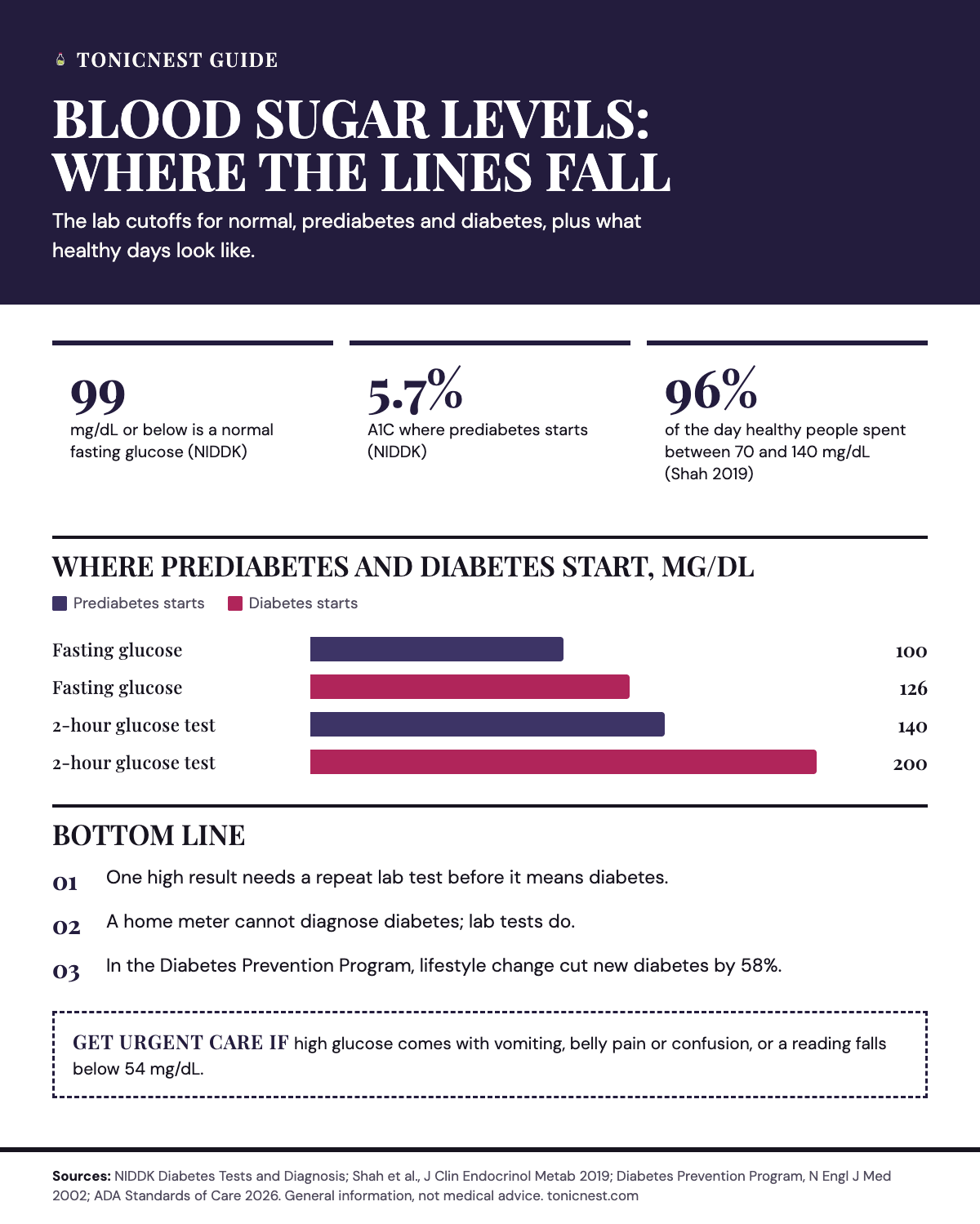
Doctors sort blood sugar into three bands, normal, prediabetes and diabetes, using the same cutoffs for every adult who is not pregnant. Each test has its own numbers. A fasting result of 100 to 125 mg/dL, for example, means prediabetes, and 126 or higher points to diabetes.[1]
| Test | Normal | Prediabetes | Diabetes |
|---|---|---|---|
| Fasting glucose (after 8+ hours) | 99 mg/dL or below | 100 to 125 mg/dL | 126 mg/dL or above |
| After a meal: 2-hour glucose tolerance test | 139 mg/dL or below | 140 to 199 mg/dL | 200 mg/dL or above |
| A1C (2 to 3 month average) | Below 5.7% | 5.7% to 6.4% | 6.5% or above |
| Random glucose, any time | No set range | No set range | 200 mg/dL or above with symptoms |
The “after-meal” row comes from the oral glucose tolerance test. You drink a set amount of glucose and have blood drawn 2 hours later.[1] No guideline gives a separate after-meal cutoff for everyday food in people without diabetes.
One high number is not a diagnosis. NIDDK says your doctor will usually repeat a test to confirm the result.[1] Pregnancy uses different and lower targets, covered further down.
What are normal blood sugar levels during a normal day?
In healthy people, blood sugar sits close to 100 mg/dL for most of the day and rarely goes above 140 mg/dL. The best data come from a 2019 study that put continuous glucose monitors on 153 healthy people aged 7 to 80 for up to 10 days.[5]
Average glucose was 98 to 99 mg/dL in every age group except people 60 and older, who averaged 104 mg/dL.[5] The group spent a median 96% of the day between 70 and 140 mg/dL.[5]
Time above 140 mg/dL came to about 30 minutes a day. Time below 70 mg/dL came to about 15 minutes a day.[5] Short rises after meals and brief dips both showed up in these healthy volunteers.
This matters if you wear a monitor out of curiosity. A spike to 150 after a large pasta dinner, followed by a return to the 90s, fits what this study saw in people without diabetes. Readings that stay high for hours fall outside that pattern and are worth showing to a doctor.
What is glucose in blood work?
Glucose on a blood test report is the amount of sugar in your blood at the moment the sample was taken, shown in milligrams per deciliter (mg/dL). It often appears on a basic or complete metabolic panel during a routine checkup.[2]
Whether the number means much depends on when you last ate. A fasting sample, taken after at least 8 hours without food or drinks other than water, is the one the diagnosis chart uses.[1] A sample drawn after breakfast will read higher and should not be judged against fasting cutoffs.
The A1C test works differently. It shows your average blood glucose over the past 2 to 3 months, so you do not need to fast for it.[3] MedlinePlus notes that anemia and some other blood conditions can make A1C less accurate, and A1C is not used to diagnose gestational diabetes.[3]
A home meter or a continuous glucose monitor is useful for tracking. NIDDK is clear that a meter cannot diagnose diabetes. That takes a lab test.[1]
What is a normal A1C range?
A normal A1C is below 5.7%. A result from 5.7% to 6.4% means prediabetes, and 6.5% or higher means diabetes. The test measures how much glucose has stuck to the hemoglobin in your red blood cells, which is why it reflects the last 2 to 3 months.[1][3]
A1C can be turned into an estimated average glucose. A study of 507 people with and without diabetes produced the formula: average glucose in mg/dL equals 28.7 times A1C minus 46.7.[7]
| A1C | Estimated average glucose | Band |
|---|---|---|
| 5.7% | About 117 mg/dL | Start of prediabetes |
| 6.5% | About 140 mg/dL | Start of diabetes |
| 7% | About 154 mg/dL | Common treatment goal in diabetes |
These are estimates.[7] Two people with the same A1C can have different daily patterns, which is one reason doctors look at both A1C and glucose readings.
What are normal fasting glucose levels?
A normal fasting glucose level is 99 mg/dL or below. Between 100 and 125 mg/dL is prediabetes, and 126 mg/dL or above on two tests means diabetes. Fasting means at least 8 hours with no food or caloric drinks before the blood draw.[1]
Fasting glucose is cheap and quick, so it is the most common screening number. NIDDK suggests testing adults 35 and older, and younger adults who have overweight and other risk factors.[10]
If your result is normal but you have risk factors, NIDDK says retesting at least every 3 years is reasonable. If you have prediabetes, you should be tested for type 2 diabetes every year.[10]
A single borderline value, say 101 mg/dL, is worth repeating. Poor sleep, a late snack you forgot about, or a recent illness can nudge one reading upward.
What does high glucose mean in a blood test?
High glucose, called hyperglycemia, means more sugar is staying in your blood than your cells are taking in, most often because of diabetes or prediabetes. Insulin moves glucose into cells. When the body makes too little insulin or responds poorly to it, glucose builds up.[9]
Diabetes is not the only cause. MedlinePlus lists an overactive thyroid, pancreas problems, adrenal problems, some medicines, and stress from surgery, serious illness or injury.[2][9]
Common symptoms of high blood sugar are thirst, needing to urinate often, tiredness or weakness, headaches and blurred vision.[9] Many people with prediabetes have no symptoms at all, which is why screening matters.[10]
Very high glucose can lead to diabetic ketoacidosis, or DKA. Its signs include trouble breathing, nausea or vomiting, belly pain, confusion and severe tiredness. It can be life threatening and needs urgent care.[9]
What blood sugar level is too low?
For many people with diabetes, blood sugar below 70 mg/dL counts as low, and below 54 mg/dL is a serious low that needs action right away. These cutoffs come from NIDDK and the American Diabetes Association.[4][8]
Low blood sugar can make you shaky, sweaty, hungry, dizzy or confused, and your heart may race.[8] People who take insulin or certain diabetes pills are at the highest risk.
The usual fix is 15 to 20 grams of fast-acting carbohydrate, such as glucose tablets or juice, then a recheck after 15 minutes.[8] Low blood sugar in people without diabetes is uncommon and deserves a medical workup.[2]
What blood sugar levels do people with diabetes aim for?
For most nonpregnant adults with diabetes, the ADA suggests an A1C below 7%, glucose of 80 to 130 mg/dL before meals, and below 180 mg/dL at the after-meal peak. These are treatment goals, not the normal range for people without diabetes.[4]
For people who use a continuous glucose monitor, the ADA goal is more than 70% of the day between 70 and 180 mg/dL, with less than 4% of the day below 70.[4] Goals are set person by person. Older adults and people with frequent lows often get looser targets.
Pregnancy is stricter. The ADA’s pregnancy goals are fasting below 95 mg/dL and either below 140 mg/dL one hour after a meal or below 120 mg/dL two hours after.[6]
Can you bring high blood sugar levels down without medicine?
For people with prediabetes, the strongest evidence is for weight loss and regular activity, which cut the rate of new type 2 diabetes by more than half in a large trial. The Diabetes Prevention Program followed 3,234 adults with raised glucose for an average of 2.8 years.[11]
The lifestyle group aimed for at least 7% weight loss and 150 minutes of activity a week. New diabetes cases fell 58% compared with placebo. Metformin lowered them 31%.[11] NIDDK now says losing 5% to 7% of starting weight can lower the chance of type 2 diabetes in people at high risk.[10]
Supplements have much thinner support. NCCIH rates the evidence for chromium, cinnamon and berberine as weak, and says they should not replace medical care.[12] Our look at berberine benefits and side effects covers its drug interactions in detail.
What does the research show?
These are the studies and guidelines behind the numbers on this page.
| Study or guideline | Who and how many | Length or method | Main finding |
|---|---|---|---|
| Shah et al., 2019[5] | 153 healthy people, aged 7 to 80 | Continuous monitor, up to 10 days | Average 98 to 99 mg/dL; 96% of the day between 70 and 140 |
| ADAG, Nathan et al., 2008[7] | 507 people with and without diabetes | About 3 months of glucose readings | Formula linking A1C to average glucose |
| Diabetes Prevention Program, 2002[11] | 3,234 adults with raised glucose | Average 2.8 years | Lifestyle cut new diabetes 58%; metformin 31% |
| NCCIH review of supplements[12] | Chromium, cinnamon, berberine and others | Summary of trials | Weak evidence of possible benefit |
What should you do with your result?
This decision table turns a lab number into a next step. It is general information, so follow your own clinician’s advice.
| Your result | What it suggests | Usual next step |
|---|---|---|
| Fasting 99 mg/dL or below, A1C below 5.7% | Normal[1] | Retest at least every 3 years if you have risk factors[10] |
| Fasting 100 to 125, or A1C 5.7% to 6.4% | Prediabetes[1] | Ask about a lifestyle program; test yearly[10] |
| Fasting 126+, or A1C 6.5%+, once | Possible diabetes[1] | Repeat test to confirm[1] |
| Random 200+ with thirst and frequent urination | Likely diabetes[1] | See a doctor soon[9] |
| Below 70 with symptoms | Low blood sugar[8] | Take 15 to 20 g fast carbs, recheck in 15 minutes[8] |
Safety: when to see a doctor right away
Most blood sugar questions can wait for a routine visit. Get urgent care right away if:
- You have high glucose with trouble breathing, vomiting, belly pain or confusion, which can signal DKA.[9]
- A reading is below 54 mg/dL, or someone cannot eat or swallow during a low.[4]
- Someone with diabetes passes out or has a seizure.[8]
- You are pregnant and your readings sit above your care team’s targets.[6]
If you take diabetes medicine, do not add a supplement that claims to lower glucose without telling your doctor. Combined effects can push blood sugar too low.[12] The same check applies to other popular supplements, such as those in our guide to CoQ10 benefits and dosage.
What do doctors use first?
Doctors start with lab tests, not home devices. NIDDK lists fasting glucose, A1C and the glucose tolerance test as the standard tools, usually confirmed with a second test.[1]
For prediabetes, the first step is lifestyle change, with metformin as an option for some people.[10][11] For diabetes, care follows the ADA’s individual goals, with medicines, monitoring and regular checkups.[4] No supplement is a stand-in for this care.[12]
Practical checklist
- Fast for at least 8 hours before a fasting glucose test, drinking only water.[1]
- Ask which test you had: fasting, random, glucose tolerance or A1C. Each uses a different chart.[1]
- Repeat any single high result before you assume a diagnosis.[1]
- Tell your doctor if you have anemia, since it can throw off A1C.[3]
- Get screened from age 35, or earlier with risk factors.[10]
- Check supplement labels for glucose claims and read how we review supplements before you buy.
- Browse more guides in our blood sugar and diabetes section.
Bottom line
Normal blood sugar levels are a fasting glucose of 99 mg/dL or below, a 2-hour test result of 139 or below, and an A1C below 5.7%.[1] Healthy people spend most of the day between 70 and 140 mg/dL.[5]
For most people with a borderline result, the better first step is a repeat lab test and a plan for weight and activity, since that approach cut new diabetes by 58% in the DPP.[11] The evidence behind it is far stronger than anything published for glucose supplements.
Frequently asked questions
What is a normal blood sugar level after eating?
There is no official after-meal cutoff for everyday meals in people without diabetes. On a 2-hour glucose tolerance test, 139 mg/dL or below is normal. In a monitor study, healthy people spent only about 30 minutes a day above 140 mg/dL.
What does mg/dL mean on a glucose test?
It stands for milligrams per deciliter. It tells you how many milligrams of glucose are in one deciliter of blood. US labs report blood sugar this way, and every cutoff in the chart above uses this unit.
Is a fasting blood sugar of 110 normal?
No. A fasting result of 110 mg/dL falls in the prediabetes range of 100 to 125 mg/dL. One result is not a diagnosis, so most doctors repeat the test or add an A1C before deciding what it means.
Can a home glucose meter diagnose diabetes?
No. NIDDK says a blood glucose meter cannot diagnose diabetes. Meters and monitors are good for tracking, but a diagnosis needs lab tests such as fasting glucose, A1C or a glucose tolerance test, usually repeated.
Can stress or illness raise blood sugar?
Yes. MedlinePlus lists stress from surgery, serious illness or injury among causes of high glucose in people without diabetes. Some medicines and thyroid, adrenal or pancreas problems can also raise it, so a one-off high reading needs context.
Sources
- Diabetes Tests and Diagnosis. NIDDK, NIH
- Blood Glucose Test. MedlinePlus, National Library of Medicine
- Hemoglobin A1C (HbA1c) Test. MedlinePlus, National Library of Medicine
- 6. Glycemic Goals, Hypoglycemia, and Hyperglycemic Crises: Standards of Care in Diabetes 2026. American Diabetes Association, Diabetes Care, 2026
- Continuous Glucose Monitoring Profiles in Healthy Nondiabetic Participants (Shah et al.). J Clin Endocrinol Metab, 2019
- 15. Management of Diabetes in Pregnancy: Standards of Care in Diabetes 2026. American Diabetes Association, Diabetes Care, 2026
- Translating the A1C Assay Into Estimated Average Glucose Values (Nathan et al.). Diabetes Care, 2008
- Low Blood Glucose (Hypoglycemia). NIDDK, NIH
- Hyperglycemia. MedlinePlus, National Library of Medicine
- Insulin Resistance and Prediabetes. NIDDK, NIH
- Reduction in the Incidence of Type 2 Diabetes With Lifestyle Intervention or Metformin (Diabetes Prevention Program). N Engl J Med, 2002
- Diabetes and Dietary Supplements. NCCIH, NIH
This article is general information, not medical advice. Dietary supplements are not reviewed by the FDA for safety or effectiveness before they are sold. Talk to your doctor before you start any supplement, especially if you are pregnant, nursing, take medication or have a health condition.