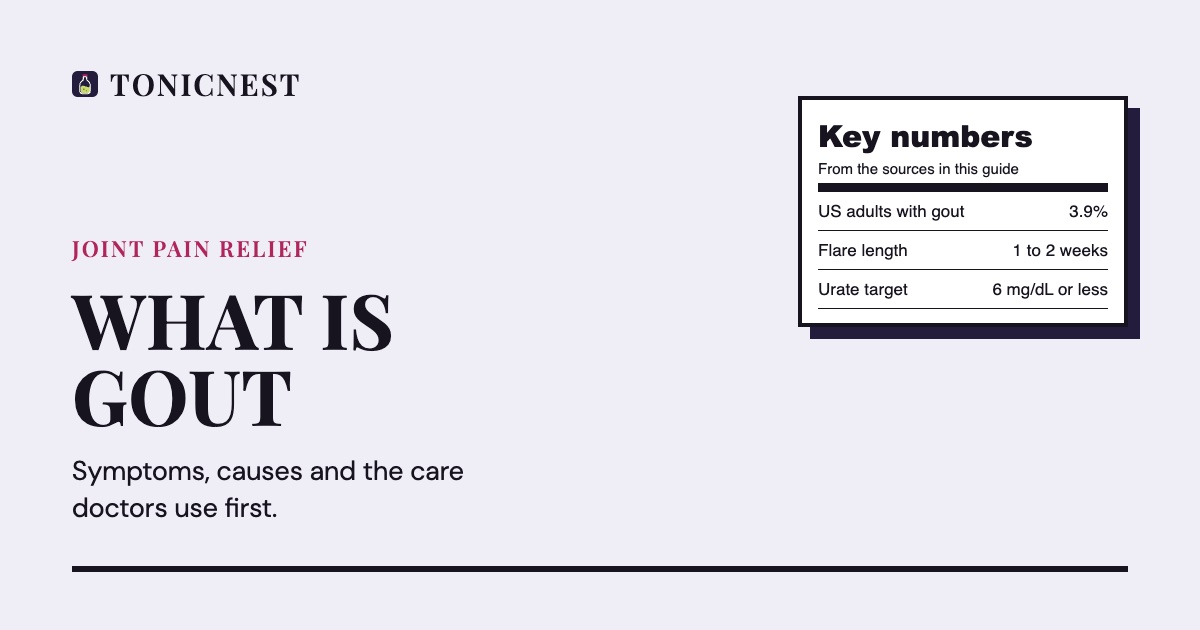
Gout is a type of inflammatory arthritis caused by urate crystals that build up in a joint, most often the big toe. Flares bring sudden pain, swelling and redness, often at night, and usually ease in a week or two. About 3.9% of US adults have it. Flare medicine helps in the short term, and a urate-lowering drug aimed at 6 mg/dL or lower prevents repeat flares.
On this page
- What is gout?
- What are the symptoms of gout?
- What does gout feel like?
- What causes gout?
- How do you get gout?
- How is gout diagnosed?
- How is a gout flare treated?
- What is the long-term treatment for gout?
- Do cherries or vitamin C help gout?
- What should you do if you think you have gout?
- When should you see a doctor right away?
- What doctors use first
- Practical checklist for living with gout
- Bottom line
- FAQ
What is gout? To answer that, we read the two NIAMS gout pages from the National Institutes of Health, the MedlinePlus and CDC gout pages, the American College of Rheumatology 2020 treatment guideline, a national survey of US adults, and the studies and Cochrane review on cherries and vitamin C.[1][2][3][4][7][8][11] Every number below links to the page it came from. This page explains the condition. It does not replace a diagnosis.
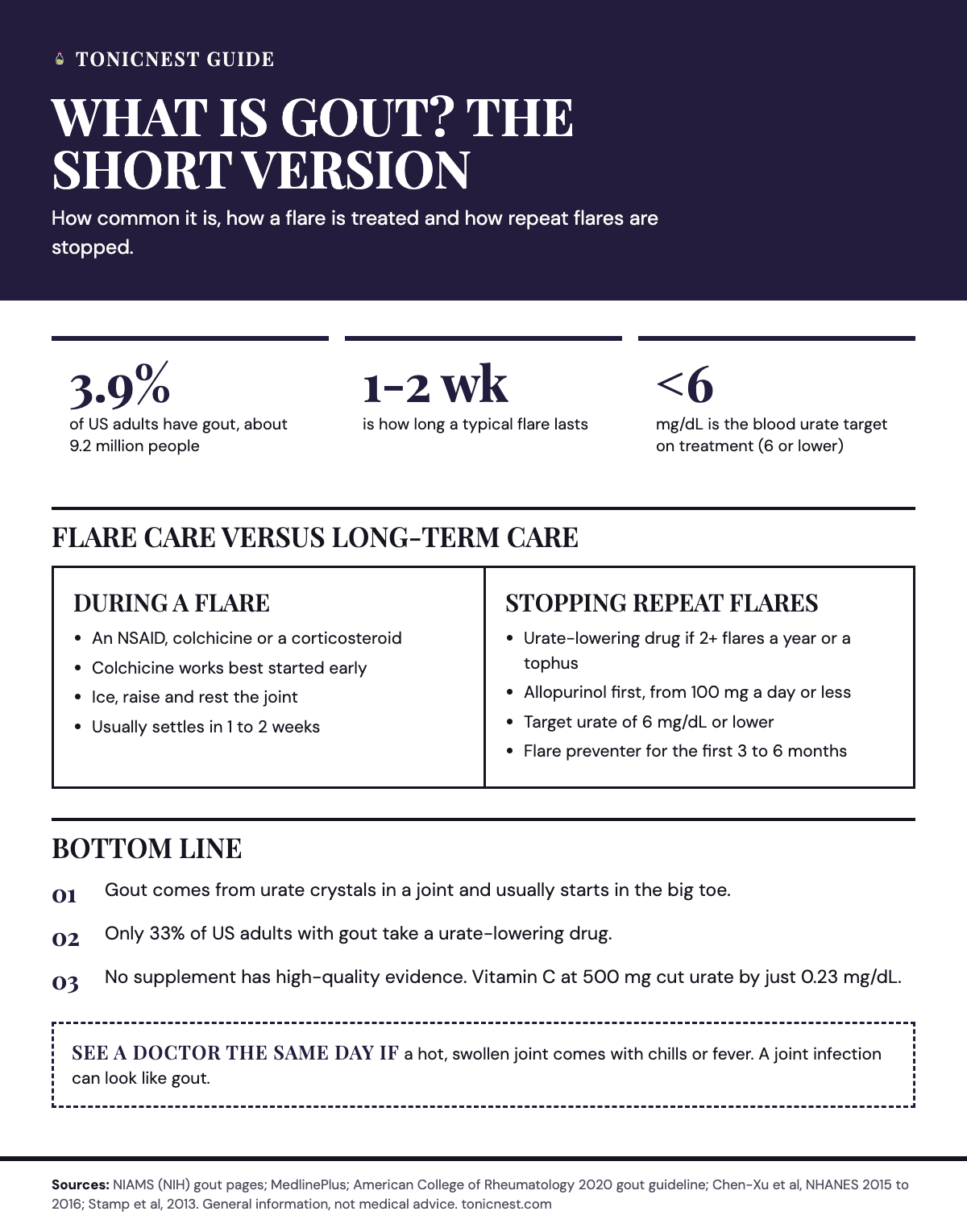
The short answer: gout is a type of inflammatory arthritis caused by needle-shaped urate crystals in a joint, and it affects about 3.9% of US adults, or roughly 9.2 million people.[1][8]
| What it is | Inflammatory arthritis caused by urate crystals that build up in a joint[1][3] |
|---|---|
| Where it usually starts | The big toe, or another joint in the foot or ankle[3][5] |
| How long a flare lasts | Usually a week or two, then symptoms fade[1][3] |
| Who has it | 3.9% of US adults: 5.2% of men and 2.7% of women[8] |
| Main cause | Too much urate in the blood, though only about one in four people with high urate get gout[5] |
| Standard care | Flare medicine, plus a urate-lowering drug for frequent flares, aiming for urate of 6 mg/dL or lower[6][7] |
| Supplements | No high-quality evidence for or against vitamin C or skim milk powder[11] |
What is gout?
Gout is a common form of inflammatory arthritis that happens when urate, a waste product, builds up and forms sharp crystals inside a joint.[1][3] Those crystals set off inflammation. The result is sudden pain and swelling in the joint. Between flares, most people feel normal.[1]
NIAMS describes gout in stages. It begins with high urate in the blood and no symptoms. Flares come next, followed by quiet stretches between them. If gout goes untreated for years, some people develop tophi, which are hard lumps of crystals under the skin, in and around the joints.[1]
Gout is a different disease from osteoarthritis, the wear-and-tear arthritis that most joint products are sold for. If you have read about whether collagen supplements work for joint pain, keep in mind that those trials studied osteoarthritis, not gout. There is also a look-alike called calcium pyrophosphate arthritis, sometimes called pseudogout. It causes similar flares, but a different crystal drives it.[3]
Gout often travels with other health problems. NIAMS lists high blood pressure, chronic kidney disease, obesity, diabetes, kidney stones, heart attack and heart failure as conditions more common in people with gout.[1] About 15% of people with gout also get kidney stones.[5]
What are the symptoms of gout?
The main symptom of gout is sudden, intense pain in one joint that may look swollen and red and feel warm.[1] Flares often start at night, and the pain can be bad enough to wake you up. A flare usually settles over a week or two.[1]
Signs that point to gout include:
- One joint at a time, most often the big toe.[4]
- Skin over the joint that is red and warm.[1]
- Trouble moving or using the joint during the flare.[1]
- No symptoms between flares. Some people go years before the next one.[1]
- Hard lumps under the skin after years without treatment, often over a joint or on the outer ear.[1][6]
Without treatment, flares may come more often and last longer.[1] Tophi start out painless, but over time they can become painful and damage bone and soft tissue.[1]
Gout symptoms in the foot
The first flare usually affects the big toe or another joint in the foot or ankle.[5] MedlinePlus notes that flares often begin in the big toe or a lower limb.[3] So a hot, swollen big toe joint that appears overnight is the classic picture. When a second flare happens, it usually comes within a year.[5]
What does gout feel like?
A gout flare usually feels like sudden, severe pain in a joint that seemed fine the day before, often starting at night.[1] The joint swells, turns red and feels warm. Moving or using it can be hard while the flare lasts.[1]
NIAMS lists these common flare triggers:[1]
- Certain foods, especially purine-rich animal foods.
- Alcohol.
- Some medicines.
- An injury to the joint.
- Being ill with another condition.
The pain fades as the flare ends, and the joint usually feels normal again until the next one.[1]
What causes gout?
Gout is caused by too much uric acid, also called urate, building up in the body over a long time until it forms needle-like crystals in the joints.[3] Uric acid comes from purines. Purines are in your own tissues and in many foods.[3]
Normally, most uric acid dissolves in the blood. Your kidneys filter it out, and it leaves in your urine.[3] Trouble starts when the body makes too much or removes too little.[1] High uric acid in the blood is called hyperuricemia.[3]
High urate does not always lead to gout. It does not cause problems for everyone, and only about one in four people with hyperuricemia go on to develop gout.[3][5] That is why researchers are still studying how genes and the environment work together.[1]
Genes matter too. Variations in genes such as SLC2A9 and ABCG2 affect urate levels, and gout rates differ by ancestry: about 1% in people of Asian ancestry and 3% to 4% in people of European ancestry.[5]
How do you get gout?
You get gout when urate stays high for a long time, and some traits, drinks, foods and medicines make that more likely.[1] Risk factors named by NIAMS include:[1]
- Being male, or having gone through menopause.
- Getting older, or having a family history of gout.
- Drinking alcohol or sugar-sweetened drinks such as soda.
- Eating a lot of purine-rich animal foods.
- Obesity, high blood pressure or chronic kidney disease.
- Taking water pills (diuretics), low-dose aspirin, niacin or cyclosporine.
Men are about twice as likely to have gout as women in national US data, at 5.2% versus 2.7%.[8] Alcohol also matters in the short run. The ACR guideline notes that more than one or two drinks in 24 hours was linked to a 40% higher risk of a flare.[7]
Supplement users should note the niacin item. Niacin is vitamin B3, and some multivitamins and energy products contain it.[1] If you have gout, read labels and tell your doctor about every supplement you take.
How is gout diagnosed?
Doctors diagnose gout from your history, a joint exam, a blood test for urate and, when possible, a look at joint fluid under a microscope to find urate crystals.[2] Imaging such as ultrasound or dual-energy CT can also show crystal deposits.[2]
A blood test cannot settle the question alone. Many people with high urate never get gout.[1] Finding the crystals in joint fluid is the most direct proof.[2]
Bring notes to the visit. Write down when the pain started, which joint it hit, what you ate and drank in the day before, and every medicine and supplement you take.[1][2] That list helps your doctor spot triggers and drugs, such as water pills or low-dose aspirin, that can raise urate.[1]
How is a gout flare treated?
A gout flare is treated with anti-inflammatory medicine, usually an NSAID, colchicine or a corticosteroid, started as early as possible.[2][7] Colchicine works best when it is taken as soon as symptoms appear.[2] The ACR guideline strongly recommends all three as first choices for a flare.[7]
At home, NIAMS suggests putting ice on the joint, raising it and resting it.[2] The ACR guideline also conditionally supports ice as an add-on.[7]
Which medicine is right depends on your kidneys, your heart, your stomach and the other drugs you take. Ask your doctor or pharmacist before you choose. If you already have a flare plan from your doctor, keep the medicine at home so you can start it on the first day.
What is the long-term treatment for gout?
Long-term gout treatment uses a urate-lowering drug to keep blood urate at 6 mg/dL or lower, the target set by the American College of Rheumatology.[6][7] Taking it regularly is the key to preventing flares and shrinking or preventing tophi.[2]
The 2020 ACR guideline strongly recommends starting a urate-lowering drug for anyone with at least one tophus, joint damage seen on X-ray, or two or more flares a year.[7] Allopurinol is the first choice, started at 100 mg a day or less and raised slowly. Febuxostat is an alternative.[7] Probenecid helps the kidneys remove uric acid, and pegloticase infusions break uric acid down.[6]
Starting one of these drugs can stir up flares at first. That is why doctors usually add a flare-preventing medicine for the first 3 to 6 months.[7] For most people, the guideline suggests staying on urate-lowering treatment for the long term.[7]
Many people with gout are not treated this way. In the 2015 to 2016 national survey, only 33% of US adults with gout were taking a urate-lowering drug.[8]
Do cherries or vitamin C help gout?
No supplement has strong evidence for gout, and none replaces urate-lowering medicine.[7][11] A 2021 Cochrane review found only 2 trials with 160 people and no high-quality evidence for or against vitamin C or skim milk powder.[11] Here is what the main studies found:
| Study | Who and how long | What was tested | Result |
|---|---|---|---|
| Zhang, 2012 (case-crossover) | 633 people with gout | Cherries or cherry extract over 2 days | 35% lower odds of a flare; 75% lower when combined with allopurinol[9] |
| Stamp, 2013 (randomized trial) | 40 people with gout, 8 weeks | Vitamin C, 500 mg a day | Urate fell 0.23 mg/dL, versus 1.9 mg/dL when allopurinol was started or raised[10] |
| Cochrane review, 2021 | 2 trials, 160 people | Skim milk powder, vitamin C | No high-quality evidence either way[11] |
| ACR guideline, 2020 | Expert panel review | Adding vitamin C to care | Conditionally recommends against it[7] |
The cherry study was observational. It shows a link between eating cherries and fewer flares, not proof that cherries caused the drop.[9] The vitamin C trial found a change in urate too small to matter.[10] For how we weigh studies like these, see how TonicNest reviews the evidence.
What should you do if you think you have gout?
The right next step depends on where you are: a first flare needs a diagnosis, and repeat flares need a talk about urate-lowering treatment.[2][7] Use this table to find your situation.
| Your situation | Usual next step |
|---|---|
| First sudden hot, swollen joint, no diagnosis yet | See a doctor and ask whether joint fluid can be tested for crystals[2] |
| Hot, swollen joint with chills or fever | Get seen the same day, since a joint infection can look similar[12] |
| Diagnosed with gout and a flare is starting | Start your flare medicine early; ice, raise and rest the joint[2] |
| Two or more flares a year, or a tophus | Ask about a urate-lowering drug[7] |
| On allopurinol and still having flares | Ask for a urate test and whether you are at 6 mg/dL or lower[6][7] |
| One flare, no tophi, high urate | Review triggers with your doctor: alcohol, sugary drinks, weight and medicines[1][7] |
When should you see a doctor right away?
See a doctor quickly for any new, hot, swollen joint, because gout and a joint infection can look alike and need very different care.[12] Infectious arthritis causes intense joint pain, redness and swelling, and it often brings chills and fever.[12]
Get care right away if:
- A painful, swollen joint comes with chills or a fever.[12]
- You cannot move the joint or the area around it.[12]
- This is your first flare and no one has confirmed it is gout.[2]
- Flares are coming more often or lasting longer than before.[1]
- You notice hard lumps near a joint or on your ear.[1][6]
If you are pregnant, have kidney disease or take other medicines, ask which gout drugs suit you. NIAMS advises talking with your doctor before you change your diet or your medicines.[2]
What doctors use first
For a flare, doctors start with an NSAID, colchicine or a corticosteroid.[2][7] For frequent flares, tophi or joint damage, they add a urate-lowering drug, with allopurinol as the usual first choice and a goal of 6 mg/dL or lower.[6][7] Lifestyle changes are added on top of that care.[7]
The ACR guideline gives conditional support to limiting alcohol, purine-rich foods and high-fructose corn syrup, and to weight loss for people who are overweight.[7] More gout guides are in our joint pain relief section.
Practical checklist for living with gout
- Limit alcohol, and remember NIAMS includes nonalcoholic beer in that advice.[2]
- Cut back on soda and other sugar-sweetened drinks.[1][7]
- Go easy on organ meats, shellfish, sardines and anchovies.[2][4]
- Consider the DASH eating pattern, which NIAMS mentions for gout.[2]
- Aim for 150 minutes of physical activity a week.[4]
- Check supplement labels for niacin, and bring the list to your doctor. Our label-reading guide shows what to look for.[1]
- Keep taking your urate-lowering drug as prescribed, and ask for urate checks.[2][6]
Bottom line
Gout is arthritis caused by urate crystals. It shows up as sudden, hot, swollen flares, most often in the big toe, that settle in a week or two.[1][3] It is common, affecting about 9.2 million US adults, and many of them are not on the treatment that would stop the flares.[8]
For most people with repeat flares, a urate-lowering drug aimed at 6 mg/dL or lower is the better first step than any supplement, because it addresses the cause and the evidence for cherries and vitamin C is thin.[7][10][11]
Frequently asked questions
What is the main cause of gout?
The main cause is too much uric acid in the blood over a long time. It forms needle-like crystals in a joint. Alcohol, sugary drinks, purine-rich animal foods, some medicines, kidney disease and genes all raise the odds, though most people with high uric acid never get gout.
How long does a gout flare last?
A gout flare usually gets better over a week or two, and most people feel normal between flares. Without treatment, flares may come more often and last longer. Starting flare medicine early, especially colchicine, tends to work best.
Can gout go away on its own?
Each flare settles on its own in a week or two, but the cause does not. Urate crystals stay in the joint unless urate is lowered. Over years, untreated gout can lead to more frequent flares, tophi and joint damage.
What foods should you avoid with gout?
NIAMS advises limiting alcohol, including nonalcoholic beer, and avoiding organ meats, shellfish, sardines and anchovies. The CDC adds red meat, tuna, trout, mussels, scallops and sugary foods. Cutting sugar-sweetened drinks also helps, according to the ACR guideline.
Is gout the same as pseudogout?
No. Pseudogout, now called calcium pyrophosphate arthritis, causes similar painful flares, but it comes from calcium crystals, not uric acid. A doctor can tell them apart by looking at joint fluid under a microscope, which also guides the right treatment.
Sources
- Gout: Symptoms, Causes and Risk Factors. NIAMS, National Institutes of Health
- Gout: Diagnosis, Treatment and Steps to Take. NIAMS, National Institutes of Health
- Gout. MedlinePlus, National Library of Medicine
- Gout. Centers for Disease Control and Prevention, 2024
- Gout (MedlinePlus Genetics). MedlinePlus Genetics, National Library of Medicine
- Gout. American College of Rheumatology, 2025
- 2020 American College of Rheumatology Guideline for the Management of Gout. FitzGerald JD et al. Arthritis Care and Research, 2020
- Contemporary Prevalence of Gout and Hyperuricemia in the United States and Decadal Trends: NHANES 2007-2016. Chen-Xu M et al. Arthritis and Rheumatology, 2019
- Cherry consumption and decreased risk of recurrent gout attacks. Zhang Y et al. Arthritis and Rheumatism, 2012
- Clinically insignificant effect of supplemental vitamin C on serum urate in patients with gout. Stamp LK et al. Arthritis and Rheumatism, 2013
- Dietary supplements for chronic gout. Andres M et al. Cochrane Database of Systematic Reviews, 2021
- Infectious Arthritis. MedlinePlus, National Library of Medicine
This article is general information, not medical advice. Dietary supplements are not reviewed by the FDA for safety or effectiveness before they are sold. Talk to your doctor before you start any supplement, especially if you are pregnant, nursing, take medication or have a health condition.