To get rid of dandruff, use a shampoo with zinc pyrithione, selenium sulfide, ketoconazole, salicylic acid or coal tar. Lather it into the scalp, leave it on for up to 5 to 10 minutes, and use it at least twice a week, then about once a week to keep flakes away. Ketoconazole has the strongest trial record. See a doctor if nothing changes in 2 to 4 weeks.
On this page
- How to get rid of dandruff: 7 steps dermatologists recommend
- What causes dandruff?
- Which dandruff shampoo ingredient works best?
- What does the research show on dandruff shampoos?
- How often should you use dandruff shampoo?
- Do natural remedies or supplements help dandruff?
- Are dandruff shampoos safe, and who should avoid them?
- What do dermatologists use when dandruff shampoo fails?
- Bottom line on getting rid of dandruff
- FAQ
How to get rid of dandruff is mostly a question of picking the right shampoo and using it the right way. To answer it, we read the American Academy of Dermatology (AAD) guidance on dandruff and seborrheic dermatitis, the FDA rule that sets which dandruff ingredients can be sold over the counter, a Cochrane review of 51 antifungal trials, and four clinical trials.[1][5][8]
The short answer: wash with a shampoo that contains zinc pyrithione, selenium sulfide, ketoconazole, salicylic acid or coal tar, leave it on for up to 5 to 10 minutes, and use it at least twice a week until the flakes settle.[1][5]
| What it is | Itchy flaking of the scalp without visible inflammation, at the mild end of the same spectrum as seborrheic dermatitis[7] |
|---|---|
| How common | About 50% of adults worldwide, more often men, peaking around age 20[7] |
| Main cause | A reaction to yeast that lives on everyone’s skin, fed by scalp oil; not caused by poor hygiene[3] |
| First step | An over-the-counter dandruff shampoo with one of five main actives[1] |
| Best evidence | Ketoconazole, from a Cochrane review of 51 trials with 9,052 people[8] |
| How often | At least twice a week, then about once a week to keep flakes away[5][2] |
| See a doctor if | No change after 2 to 4 weeks of regular use, or the scalp is red, broken or spreading[6][1] |
How to get rid of dandruff: 7 steps dermatologists recommend
Most dandruff clears with a medicated shampoo used on the scalp, left on for a few minutes, at least twice a week.[1][5] Mild cases often improve with regular washing alone. If that is not enough, these are the steps the AAD gives, in order.[1]
- Wash more often with your regular shampoo. Mild dandruff usually responds to regular washing, especially on an oily scalp.[1]
- Pick one dandruff shampoo active. Look for zinc pyrithione, selenium sulfide, ketoconazole, salicylic acid, sulfur or coal tar on the Drug Facts label.[1]
- Lather it into the scalp, not the hair ends. The actives can dry hair, so people with curly or coily hair should keep the shampoo on the scalp.[1]
- Leave it on. Some dandruff shampoos need to sit for up to 5 to 10 minutes before you rinse.[1]
- Match the schedule to your hair. Fine or straight hair and an oily scalp may need the dandruff shampoo twice a week; coarse, curly or coily hair about once a week.[1]
- Switch actives if one stops working. The AAD suggests alternating shampoos with different active ingredients.[1]
- Drop to a maintenance dose. Once flakes are under control, many people keep using the shampoo once a week to prevent flare-ups.[2]
You can use your normal shampoo and conditioner afterward if your hair needs it.[1] If you use a coal tar shampoo and your hair is thinning, protect your scalp with a hat or an SPF 30 or higher sunscreen.[1]
What causes dandruff?
Dandruff is linked to a yeast that lives on everyone’s skin and feeds on sebum, the oil your scalp makes.[3] Some people react to that yeast, and the reaction shows up as flakes and itch. Antifungal shampoos lower the yeast and ease symptoms, which supports this idea.[3]
The condition shows up on oily skin like the scalp, face and chest, and at ages when the body makes more sebum.[3] Dandruff starts at puberty, peaks around age 20 and becomes less common after 50.[7]
According to the AAD, seborrheic dermatitis is not caused by unclean skin and is not an allergy.[3] Common triggers include stress, cold and dry weather, and hot showers.[4] Many people find it eases in warm, humid weather.[3]
Is dandruff the same as seborrheic dermatitis?
They sit on one spectrum. Dandruff stays on the scalp and causes itchy flaking without visible inflammation. Seborrheic dermatitis adds a red or discolored rash and can spread to the eyebrows, sides of the nose, ears and chest.[7] The same shampoos treat mild to moderate seborrheic dermatitis on the scalp.[2]
Some conditions raise the risk of seborrheic dermatitis, including Parkinson’s disease, HIV and depression.[3] Flakes can also come from psoriasis, eczema or a fungal scalp infection, which is why stubborn cases need a dermatologist.[1]
Which dandruff shampoo ingredient works best?
Ketoconazole has the strongest trial record, but zinc pyrithione, selenium sulfide, salicylic acid and coal tar are all allowed by the FDA for dandruff and listed by dermatologists.[8][5][1] In practice, pick one your scalp tolerates and that you will use on schedule. Check the Drug Facts box for the active and its strength.[5]
| Active | OTC strength | What it targets | Watch for |
|---|---|---|---|
| Zinc pyrithione | 0.3% to 2% (rinse-off)[5] | Malassezia yeast[9] | Well tolerated in trials[9] |
| Selenium sulfide | 1%, or 0.6% micronized[5] | Scale and fast skin turnover[7] | Irritation in about 3%; orange-brown scalp staining[7] |
| Ketoconazole | 1% OTC; 2% by prescription[6][8] | Malassezia yeast[9] | Do not use on a broken or inflamed scalp[6] |
| Salicylic acid | 1.8% to 3%[5] | Listed by the AAD for dandruff[1] | We found no trial of it used alone |
| Coal tar | 0.5% to 5%[5] | Scale, itch and oil[7] | Sunburn risk for 24 hours; can tint light hair[5][4] |
Sulfur at 2% to 5% is also on the FDA list, sometimes paired with salicylic acid.[5] Ketoconazole is not part of that list. The 1% shampoo is sold over the counter under its own drug approval, with its own directions.[6]
What does the research show on dandruff shampoos?
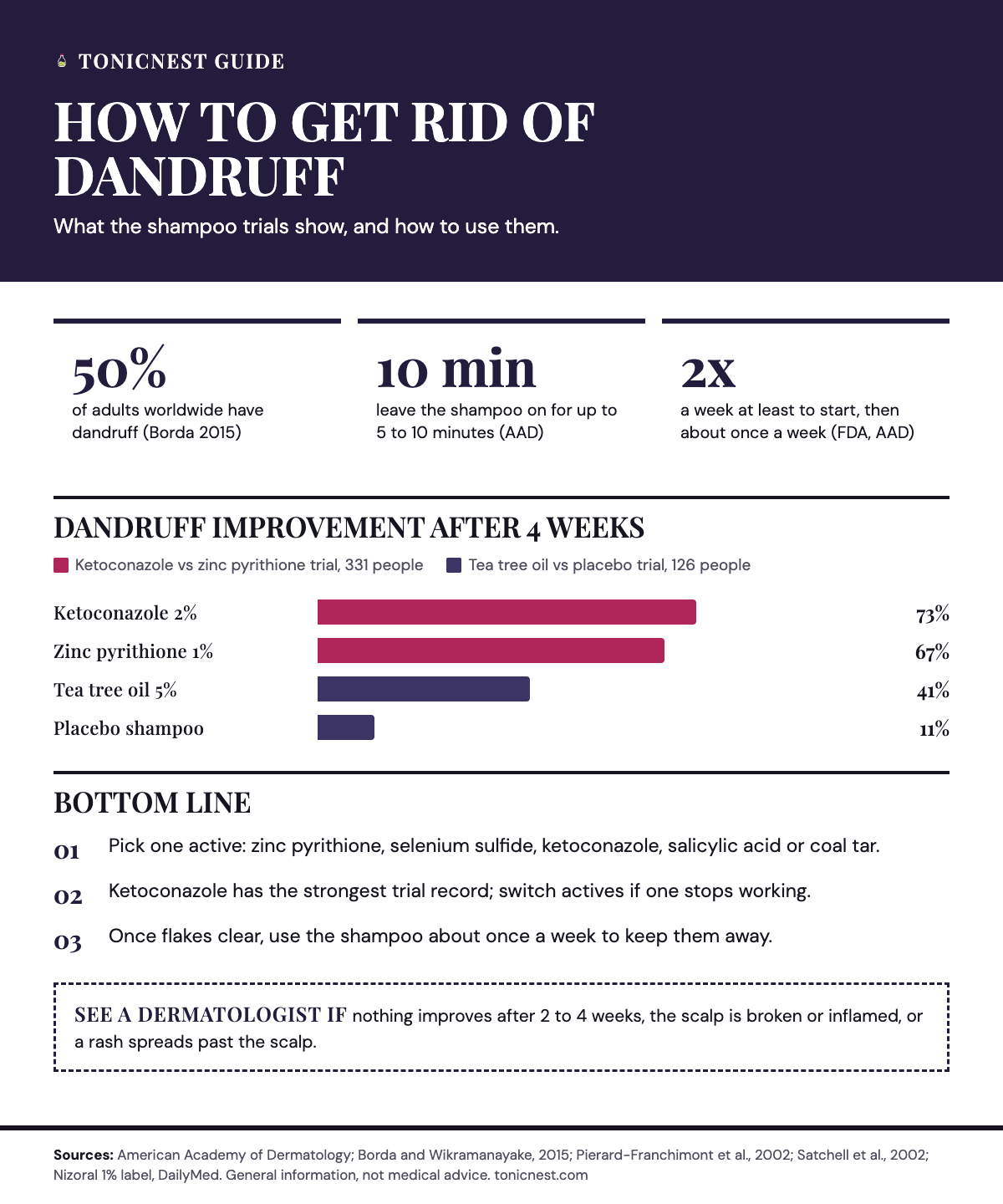
A 2015 Cochrane review found that ketoconazole 2% cut the risk of failed clearance by 31% compared with placebo at four weeks.[8] The review pooled 51 trials with 9,052 people. The evidence was rated low quality, 24 of the trials had a conflict of interest such as drug company funding, and few followed people past four weeks.[8]
| Study | People | What was compared | Result |
|---|---|---|---|
| Cochrane review, 2015 | 51 trials, 9,052 | Topical antifungals vs placebo or steroids | Ketoconazole 31% lower risk of failed clearance; 44% fewer side effects than steroids[8] |
| Pierard-Franchimont, 2002 | 331, severe dandruff | Ketoconazole 2% vs zinc pyrithione 1%, 4 weeks | 73% vs 67% improvement; fewer relapses with ketoconazole[9] |
| Danby, 1993 | 246, moderate to severe | Ketoconazole 2% vs selenium sulfide 2.5% vs placebo | Both beat placebo; all 9 side effects in the selenium group[10] |
| Satchell, 2002 | 126, mild to moderate | 5% tea tree oil shampoo vs placebo, 4 weeks | 41% vs 11% improvement; no side effects[11] |
Keep the strengths in mind when you shop. The ketoconazole trials used the 2% prescription strength, while drugstore shelves carry 1%.[9][6] The selenium sulfide trial used 2.5%, which is stronger than the 1% sold over the counter.[10][5] A stronger product is not proven to work better for you, so start with the label strength.
How often should you use dandruff shampoo?
Use a dandruff shampoo at least twice a week to start, which is the direction the FDA requires on rinse-off dandruff products.[5] Hair type changes the schedule. The goal is to bring flakes under control, then cut back to the least that keeps them away.[1][2]
| If you have | Then try |
|---|---|
| Fine or straight hair, or an oily scalp | Wash often, even daily, with dandruff shampoo twice a week[1] |
| Straight or wavy hair with seborrheic dermatitis | Dandruff shampoo 2 to 3 times a week[2] |
| Coarse, curly or tightly coiled hair | Dandruff shampoo about once a week, on the scalp only[1][2] |
| Ketoconazole 1% shampoo | Every 3 to 4 days for up to 8 weeks, then as needed[6] |
| Flakes under control | Once a week to prevent flare-ups[2] |
| No change after 2 to 4 weeks | Stop and see a doctor[6] |
A quick lather and rinse gives the active little time on the scalp, so read the bottle and wait as long as it says.[1][2]
Do natural remedies or supplements help dandruff?
Tea tree oil shampoo at 5% has one good trial behind it, and a probiotic has one small industry-funded trial; neither replaces a medicated shampoo.[11][12] We found no trials we could cite for apple cider vinegar, coconut oil or baking soda, so we do not recommend them here.
Tea tree oil shampoo
In a 2002 Australian trial, 126 people with mild to moderate dandruff used a 5% tea tree oil shampoo or a placebo every day for four weeks.[11] The tea tree group improved by 41% on a severity score, against 11% for placebo, and no side effects were reported.[11] That is one trial, with a single-blind design, so treat it as limited evidence. Tea tree oil is not on the FDA’s list of dandruff actives.[5]
Probiotic supplements
A 2017 trial gave 60 men with moderate to severe dandruff a daily sachet of the probiotic Lactobacillus paracasei ST11 or a placebo for 56 days.[12] Flakes and redness improved more in the probiotic group, with no side effects reported.[12] The study was small, all male, and run by authors from L’Oreal and Nestle, which sell skin and probiotic products. We rate this as limited evidence. If you want to read how we weigh company-funded trials, see how TonicNest reviews supplements and studies.
The same funding pattern shows up across beauty supplements. In our look at whether collagen supplements work for skin, trials without company money found no effect.
Are dandruff shampoos safe, and who should avoid them?
Dandruff shampoos are safe for most adults when used as the label directs, but some actives need extra care.[5][6] All carry the same basic warnings: for external use only, keep out of the eyes, and see a doctor if the condition worsens or does not improve.[5]
- Coal tar: can raise your chance of sunburn for up to 24 hours and should not be used for long periods without a doctor’s advice.[5] Long-term use has been linked to a risk of skin cancer in reviews.[7] It can also tint light, bleached or dyed hair.[4]
- Selenium sulfide: about 3% of users get irritation, and it can leave an orange-brown stain on the scalp.[7]
- Ketoconazole 1%: do not use on a broken or inflamed scalp; stop if a rash appears; ask a doctor first if you are pregnant or breastfeeding.[6]
- Children: the AAD does not recommend dandruff shampoo for babies with cradle cap, and the ketoconazole label says to ask a doctor for children under 12.[2][6]
- Curly and coily hair: the actives can dry the hair, so apply to the scalp only.[1]
See a doctor if
- Flakes do not improve after 2 to 4 weeks of regular use.[6]
- Your dandruff is severe, or a rash spreads to the face, ears or chest.[1][7]
- The scalp is broken or inflamed.[6]
- You think the flakes could be psoriasis, eczema or a fungal scalp infection.[1]
What do dermatologists use when dandruff shampoo fails?
When over-the-counter shampoo is not enough, dermatologists move to prescription antifungal shampoos, creams or foams, and short courses of anti-inflammatory medicine.[2] They also check whether the flakes come from seborrheic dermatitis, psoriasis, eczema or a fungal infection.[1]
Options the AAD lists include ciclopirox shampoo, which left 58% and 26% of patients in two trials with little or no seborrheic dermatitis after four weeks.[2] Others are prescription ketoconazole cream, gel or foam, a corticosteroid for fast control of a flare, roflumilast foam, and calcineurin inhibitors. Oral antifungals are kept for widespread or stubborn cases.[2]
No supplement is a replacement for this care. For other evidence-checked guides, browse our skin, hair and nails section.
Dandruff shampoo label checklist
- The Drug Facts box names one active: zinc pyrithione, selenium sulfide, ketoconazole, salicylic acid, sulfur or coal tar.[5]
- The strength sits in the FDA range, such as 1% selenium sulfide or 0.5% to 5% coal tar.[5]
- The directions say how long to leave it on and how many times a week.[1][5]
- Coal tar products carry a sun warning; plan for a hat or sunscreen.[5][1]
- Pick alcohol-free conditioners and styling products if your scalp flares easily.[4]
- For how we check claims on labels, see our review method.
Bottom line on getting rid of dandruff
Dandruff is common and rarely serious. A drugstore shampoo with a proven active, left on the scalp for a few minutes and used at least twice a week, clears most cases.[1][5]
For most people, a ketoconazole or zinc pyrithione shampoo is the better first step than any supplement or home remedy, because those two have the most trial data behind them.[8][9] If nothing changes in 2 to 4 weeks, see a dermatologist.[6]
Frequently asked questions
What is dandruff?
Dandruff is itchy flaking of the scalp without visible redness. It affects about half of adults, starts at puberty and is more common in men. It sits at the mild end of the same condition as seborrheic dermatitis.
Is dandruff caused by not washing your hair?
No. Dermatologists say seborrheic dermatitis is not caused by unclean skin and is not an allergy. It is linked to a skin yeast and scalp oil. Regular washing still helps mild dandruff.
How long does it take dandruff shampoo to work?
Most trials measured results at about four weeks. The ketoconazole 1% label says to use it every 3 to 4 days for up to 8 weeks, and to see a doctor if nothing improves in 2 to 4 weeks.
Can I use dandruff shampoo every day?
Some people with fine hair or an oily scalp wash daily, but the AAD suggests using the dandruff shampoo itself about twice a week. Follow the label, since ketoconazole 1% is used every 3 to 4 days.
Does dandruff come back after it clears?
It often does, because the yeast returns. Dermatologists suggest keeping a dandruff shampoo in your routine about once a week to prevent flare-ups, and switching actives if one stops working.
Sources
- How to treat dandruff. American Academy of Dermatology, 2023
- Seborrheic dermatitis: Diagnosis and treatment. American Academy of Dermatology
- Seborrheic dermatitis: Causes. American Academy of Dermatology, 2022
- Seborrheic dermatitis: Self-care. American Academy of Dermatology
- 21 CFR Part 358 Subpart H: Drug products for the control of dandruff, seborrheic dermatitis, and psoriasis. US Food and Drug Administration, eCFR
- Nizoral (ketoconazole 1%) anti-dandruff shampoo label. DailyMed, National Library of Medicine
- Seborrheic Dermatitis and Dandruff: A Comprehensive Review. Borda LJ, Wikramanayake TC. J Clin Investig Dermatol, 2015
- Topical antifungals for seborrhoeic dermatitis. Okokon EO et al. Cochrane Database of Systematic Reviews, 2015
- A multicenter randomized trial of ketoconazole 2% and zinc pyrithione 1% shampoos in severe dandruff and seborrheic dermatitis. Pierard-Franchimont C et al. Skin Pharmacol Appl Skin Physiol, 2002
- A randomized, double-blind, placebo-controlled trial of ketoconazole 2% shampoo versus selenium sulfide 2.5% shampoo in moderate to severe dandruff. Danby FW et al. J Am Acad Dermatol, 1993
- Treatment of dandruff with 5% tea tree oil shampoo. Satchell AC et al. J Am Acad Dermatol, 2002
- The positive benefit of Lactobacillus paracasei NCC2461 ST11 in healthy volunteers with moderate to severe dandruff. Reygagne P et al. Beneficial Microbes, 2017 (industry funded)
This article is general information, not medical advice. Dietary supplements are not reviewed by the FDA for safety or effectiveness before they are sold. Talk to your doctor before you start any supplement, especially if you are pregnant, nursing, take medication or have a health condition.