To calculate BMI, divide your weight in kilograms by your height in meters squared. In US units, divide pounds by inches squared and multiply by 703. Someone 5 feet 9 inches tall who weighs 150 pounds has a BMI of 22.1. For adults, 18.5 to 24.9 is the healthy range, 25 to 29.9 is overweight and 30 or more is obesity. Children use percentiles instead.
On this page
- How to calculate BMI with height and weight
- What is the BMI formula?
- How do you calculate BMI in pounds and inches?
- How do you calculate BMI in kilograms and meters?
- What is a normal BMI? The BMI chart and ranges
- Is the BMI calculator different for women and men?
- How is BMI calculated for children and teens?
- How accurate is BMI?
- What should you do with your BMI result?
- When should you not rely on BMI alone?
- What do doctors check besides BMI?
- Practical checklist before you calculate
- Bottom line
- FAQ
How to calculate BMI comes down to one formula: your weight divided by your height squared. We read the CDC’s BMI pages, the NHLBI calculator and healthy weight pages, three NIDDK pages, MedlinePlus, a WHO expert report and a large NHANES accuracy study, then worked each example by hand so you can check the math.
The short answer: divide your weight in kilograms by your height in meters squared, or divide pounds by inches squared and multiply by 703. A result of 18.5 to 24.9 falls in the healthy range for adults.[2][5]
| What it is | A measure of body weight relative to height[1] |
|---|---|
| Metric formula | Weight (kg) divided by height (m) squared[2] |
| US formula | Weight (lb) divided by height (in) squared, times 703[2] |
| Healthy adult range | 18.5 to 24.9[5] |
| Obesity starts at | 30.0 for adults 20 and older[3] |
| Children and teens | Ages 2 to 19 use BMI percentiles for sex and age, not adult cut-offs[4] |
| Main limit | It cannot tell fat from muscle or bone[1] |
How to calculate BMI with height and weight
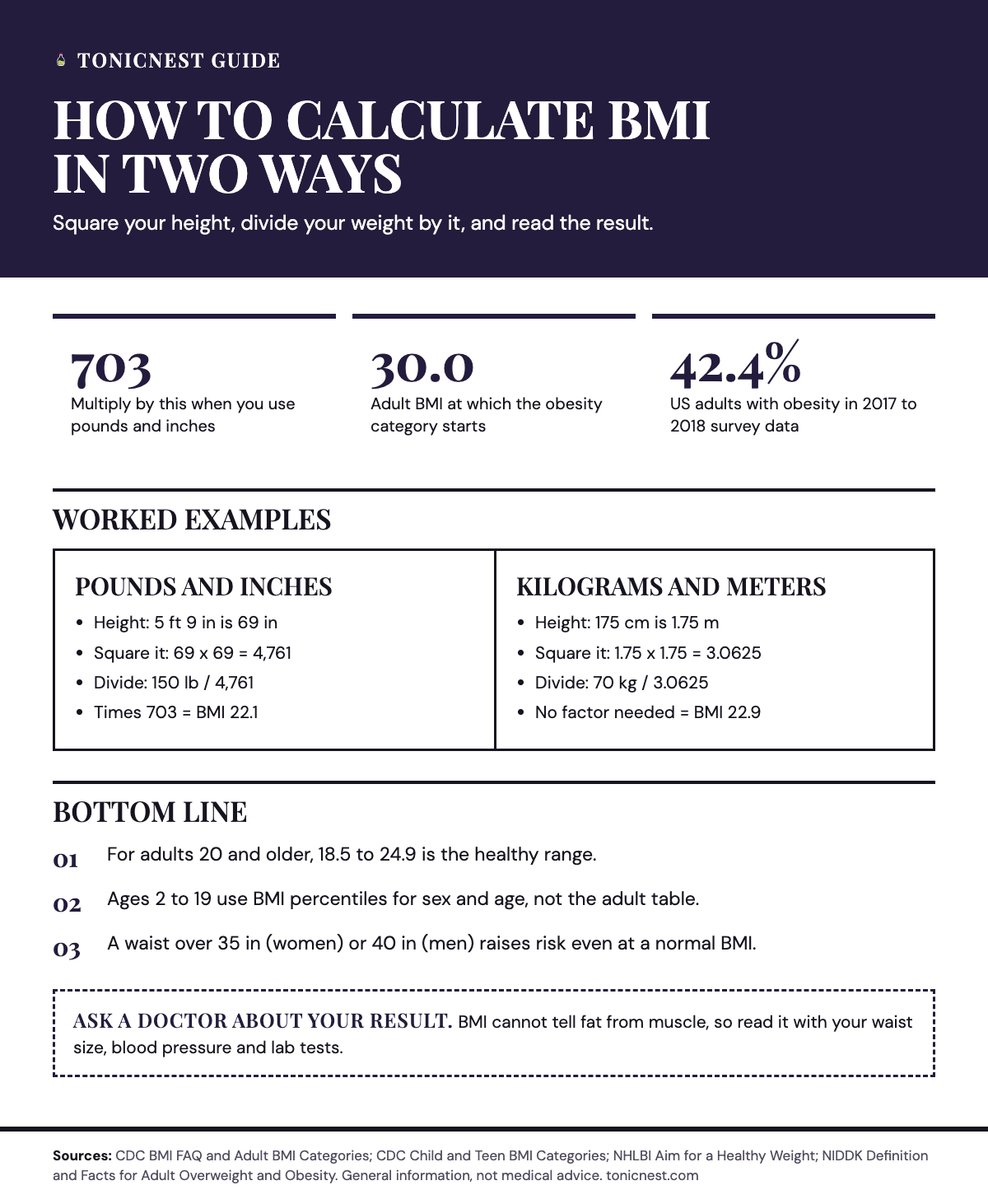
To calculate BMI, square your height and divide your weight by that number; if you use pounds and inches, multiply the answer by 703. The CDC lists exactly these hand formulas, and the steps below follow them.[2] You need only a scale, a tape measure and a calculator.
- Weigh yourself in light clothes, with no shoes, on a flat hard floor. Write the number down.
- Measure your height without shoes, standing straight against a wall. Accurate height and weight matter because small errors change the result.[4]
- Convert your height to a single unit. For US units, turn feet into inches (5 feet 9 inches is 69 inches). For metric, turn centimeters into meters (175 cm is 1.75 m).
- Square your height: multiply it by itself. 69 times 69 is 4,761. 1.75 times 1.75 is 3.0625.
- Divide your weight by the squared height.
- If you used pounds and inches, multiply that answer by 703.[2]
- Round to one decimal place and compare it with the adult categories below.[3]
If you are 20 or older, the CDC’s Adult BMI Calculator does the same math for you. People aged 2 to 19 need the separate Child and Teen calculator, because their result is read as a percentile.[3][4]
What is the BMI formula?
The BMI formula is weight in kilograms divided by height in meters squared, written as kg/m2. The CDC gives three versions that all land on the same number, so you can use whichever units you already have.[1][2]
| Units you have | Formula |
|---|---|
| Kilograms and meters | weight (kg) / [height (m)]2[2] |
| Kilograms and centimeters | [weight (kg) / height (cm) / height (cm)] x 10,000[2] |
| Pounds and inches | weight (lb) / [height (in)]2 x 703[2] |
The 703 converts the pounds-and-inches result to the metric scale, so the same cut-offs work in both systems. The centimeter version uses 10,000 for the same reason: there are 100 centimeters in a meter, and the height is squared.
How do you calculate BMI in pounds and inches?
In pounds and inches, BMI equals weight divided by height in inches squared, then multiplied by 703. Here are two worked examples. The second one is the CDC’s own example, so you can check your method against an official answer.[2]
Example 1: 5 feet 9 inches, 150 pounds
- Height in inches: 5 x 12 + 9 = 69 inches
- Height squared: 69 x 69 = 4,761
- Weight divided by height squared: 150 / 4,761 = 0.0315
- Times 703: 0.0315 x 703 = 22.1
A BMI of 22.1 sits inside the healthy weight band. The CDC’s chart for a 5 foot 9 inch adult agrees: 125 to 168 pounds is the healthy range at that height.[3]
Example 2: 5 feet 8 inches, 200 pounds
- Height in inches: 68
- Height squared: 68 x 68 = 4,624
- 200 / 4,624 x 703 = 30.4
The CDC uses this exact case and gets 30.4, which falls in the obesity category because it is 30.0 or higher.[2]
How do you calculate BMI in kilograms and meters?
In metric units, BMI is simply kilograms divided by meters squared, with no conversion factor. That makes it the easier version if your scale and tape read in metric.[1]
Example 3: 1.75 m, 70 kg
- Height squared: 1.75 x 1.75 = 3.0625
- 70 / 3.0625 = 22.9
- Centimeter check: 70 / 175 / 175 x 10,000 = 22.9
Example 4: 1.68 m, 85 kg
- Height squared: 1.68 x 1.68 = 2.8224
- 85 / 2.8224 = 30.1
Example 3 is in the healthy range. Example 4 is just over the line into class 1 obesity, which runs from 30 to less than 35.[3]
You can also run the formula backward to find a healthy weight range for your height. Multiply your squared height by 18.5 and by 24.9. For someone 1.75 m tall, that gives about 56.7 to 76.3 kg. This uses the NHLBI healthy range of 18.5 to 24.9.[5]
What is a normal BMI? The BMI chart and ranges
For adults 20 and older, a normal or healthy BMI is 18.5 to less than 25. The CDC applies the same adult categories regardless of age, sex or race, and splits obesity into three classes.[3]
| Category | BMI | Weight at 5 ft 9 in |
|---|---|---|
| Underweight | Under 18.5 | 124 lb or less |
| Healthy weight | 18.5 to under 25 | 125 to 168 lb |
| Overweight | 25 to under 30 | 169 to 202 lb |
| Class 1 obesity | 30 to under 35 | 203 to 236 lb |
| Class 2 obesity | 35 to under 40 | 237 to 270 lb |
| Class 3 (severe) obesity | 40 or more | 271 lb or more |
Source for all rows: CDC Adult BMI Categories.[3] High BMI is common. In 2017 to 2018 national survey data, 42.4% of US adults had obesity and 73.1% had overweight or obesity.[7]
Is the BMI calculator different for women and men?
No. For adults, the BMI formula and the cut-offs are the same for women and men. The CDC says adult categories apply regardless of sex, and the NHLBI says its calculator applies to adult men and women.[3][5] Searches for a “BMI calculator for women” or “for men” lead to the same math.
Sex does matter in two other places. For children and teens, BMI is compared with others of the same sex and age.[4] And waist size limits differ: a waist over 35 inches for women or over 40 inches for men raises the risk of heart disease and type 2 diabetes.[6]
Body build also differs on average. A 2008 analysis of 13,601 US adults found BMI correlated more with lean mass than with body fat in men, while in women it tracked body fat more closely.[12]
How is BMI calculated for children and teens?
Children and teens use the same BMI formula, but the result is read as a percentile for their sex and age instead of the adult cut-offs. The CDC applies this to everyone aged 2 through 19, because they are still growing.[4]
- Underweight: below the 5th percentile
- Healthy weight: 5th to below the 85th percentile
- Overweight: 85th to below the 95th percentile
- Obesity: 95th percentile or higher[4]
The CDC’s example: a 12-year-old girl who is 5 feet tall and weighs 136 pounds has a BMI of 26.6. On the growth charts that is the 96th percentile, so she is in the obesity category.[4] For an adult, 26.6 would only be overweight. So an adult chart gives the wrong answer for a child. Pediatric guidance recommends a BMI check every year from age 2.[1]
How accurate is BMI?
BMI is a screening tool that rarely flags obesity by mistake, yet it misses many people who carry excess fat. The CDC calls it quick, cheap and reliable for screening, and says it is moderately to strongly linked with direct body fat measures.[1]
| Study | Who | Finding |
|---|---|---|
| Romero-Corral, 2008[12] | 13,601 US adults aged 20 to 79 (NHANES III) | BMI 30 or more caught only 36% of men and 49% of women with high body fat, but was rarely wrong when it did flag obesity |
| WHO Expert Consultation, 2004[11] | Review of Asian population data | Health risk rises at BMIs below 25 in many Asian groups; the observed risk cut-off ranged from 22 to 25 |
| NIDDK guidance[8] | US adults | Asian Americans count as overweight from BMI 23, Pacific Islanders from 26 |
| MedlinePlus[10] | Clinical summary | BMI may overstate fat in athletes and understate it in older people who have lost muscle |
A high BMI is a good reason to talk with a doctor. A normal BMI does not prove you have a healthy amount of body fat, especially if most of your weight sits around your waist.[6][12]
What should you do with your BMI result?
Use your BMI as a starting point for a conversation, then pair it with your waist size and your other health numbers. The CDC says to weigh BMI alongside medical history, habits, a physical exam and lab tests such as glucose and cholesterol.[1] This table turns the result into a next step.
| If your adult BMI is | Then |
|---|---|
| Under 18.5 | Ask your doctor why. Low weight can be a health risk too, and the NHLBI points readers to eating disorder resources.[5] |
| 18.5 to 24.9 | Measure your waist. Over 35 inches (women) or 40 inches (men) still raises risk.[6] |
| 23 or more and you are Asian American | Count it as the overweight range for diabetes risk.[8] |
| 25 to 29.9 | Check blood pressure, glucose and cholesterol with your doctor.[1] |
| 30 or more | A first goal of 5% weight loss over 6 months is often suggested; at 200 pounds that is 10 pounds.[9] |
| 35 or more | Ask about all options. Doctors may recommend weight-loss surgery at this level.[9] |
Small losses help. The NHLBI says losing just 3% to 5% of your weight can lower triglycerides and blood glucose, and 5% to 10% over about 6 months is the usual target.[6]
When should you not rely on BMI alone?
BMI alone is a poor guide for very muscular people, older adults, children and anyone with an eating disorder history. In these groups the number can point the wrong way, so a clinician should read it in context.[2][10]
- Athletes and very muscular people may land in the overweight or obesity range on BMI alone, because the formula cannot tell muscle from fat.[2]
- Older adults who have lost muscle can have a normal BMI with too much body fat.[10]
- Children and teens need the percentile charts, never the adult table.[4]
- Asian Americans and Pacific Islanders have different overweight thresholds for diabetes risk.[8]
- If counting your BMI feeds worry about food or weight, talk with a doctor before tracking it; the NHLBI links eating disorder support next to its calculator.[5]
See a doctor soon if your weight changes a lot without trying, or if your BMI is in the obesity range and you have high blood pressure, high blood sugar or trouble breathing at night. Obesity raises the risk of type 2 diabetes, heart disease, stroke and sleep apnea.[2][10]
What do doctors check besides BMI?
Doctors use BMI as one input next to a health history, a physical exam, waist size and blood tests. MedlinePlus lists all of these as part of checking for obesity, and the CDC notes that a DEXA scan measures body composition precisely but is costly and not widely available.[1][10]
If weight is a concern, standard care starts with lifestyle changes: an eating plan and more activity. Structured programs typically include 14 or more counseling sessions over 6 months and at least 150 minutes a week of moderate activity. Prescription medicines or surgery may follow when lifestyle changes are not enough.[9]
Supplements are not part of that standard path. Some ingredients, such as berberine, have small effects on weight in trials, which we cover in our berberine benefits and side effects review. None of them replaces the steps above. You can browse more evidence checks in our weight loss guides.
Practical checklist before you calculate
- Weigh at the same time of day, ideally in the morning, in light clothes and no shoes.
- Measure height against a wall with your heels, back and head touching it.
- Use one unit system all the way through; do not mix pounds with meters.
- Square the height before you divide, and multiply by 703 only for pounds and inches.[2]
- Round to one decimal and check the adult table, or the percentile chart for anyone under 20.[3][4]
- Measure your waist just above your hipbones, right after you breathe out.[6]
- Bring both numbers to your next checkup. Our review method explains how we pick the sources behind guides like this one.
Bottom line
Calculating BMI takes about a minute: square your height, divide your weight by it, and multiply by 703 if you used pounds and inches. Adults with a result from 18.5 to 24.9 fall in the healthy range, and 30 or more is obesity.[2][3]
For most people, the best next step is to measure your waist as well, because BMI misses more than half of adults with excess body fat. Take both numbers to your doctor rather than reading too much into either one alone.[6][12]
Frequently asked questions
What is the CDC BMI calculator?
It is a free online tool from the CDC. The adult version is for people 20 and older and shows your BMI and category. A separate Child and Teen version for ages 2 to 19 also gives a BMI percentile and plots it on a growth chart.
What BMI is considered obese?
For adults, a BMI of 30.0 or higher is in the obesity category. It is split into class 1 (30 to under 35), class 2 (35 to under 40) and class 3, or severe obesity, at 40 or more, according to the CDC.
Is a BMI of 25 bad?
A BMI of 25 is the start of the overweight range, not a diagnosis. It is a cue to check your waist size, blood pressure, blood sugar and cholesterol with your doctor. For Asian Americans, NIDDK already counts 23 as overweight.
Can you have a high BMI and still be healthy?
Yes, in some cases. Very muscular people can score in the overweight or obesity range because BMI cannot tell muscle from fat. A doctor can use a physical exam, waist size and lab tests to judge whether a high BMI reflects excess fat.
How often should you check your BMI?
There is no fixed rule for adults, but the CDC says tracking BMI over time helps spot weight gain or loss and related health risk. For children, pediatric guidance recommends a BMI check every year starting at age 2.
Sources
- About Body Mass Index (BMI). CDC, 2025
- BMI Frequently Asked Questions. CDC, 2024
- Adult BMI Categories. CDC, 2024
- Child and Teen BMI Categories. CDC, 2024
- Calculate Your BMI. NHLBI, NIH
- Aim for a Healthy Weight. NHLBI, NIH, 2025
- Definition and Facts for Adult Overweight and Obesity. NIDDK, NIH, 2023
- Risk Factors for Type 2 Diabetes. NIDDK, NIH
- Treatment for Overweight and Obesity. NIDDK, NIH
- Obesity. MedlinePlus, National Library of Medicine
- Appropriate body-mass index for Asian populations and its implications for policy and intervention strategies. WHO Expert Consultation, The Lancet, 2004
- Accuracy of body mass index in diagnosing obesity in the adult general population. Romero-Corral et al., International Journal of Obesity, 2008
This article is general information, not medical advice. Dietary supplements are not reviewed by the FDA for safety or effectiveness before they are sold. Talk to your doctor before you start any supplement, especially if you are pregnant, nursing, take medication or have a health condition.